


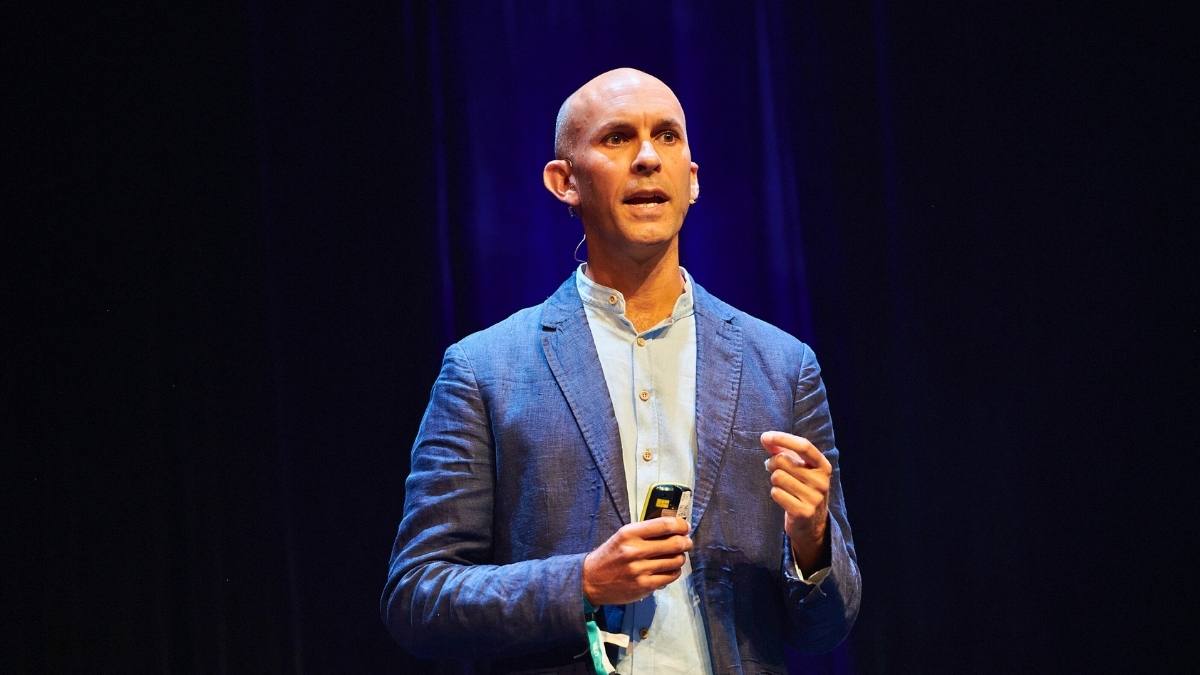
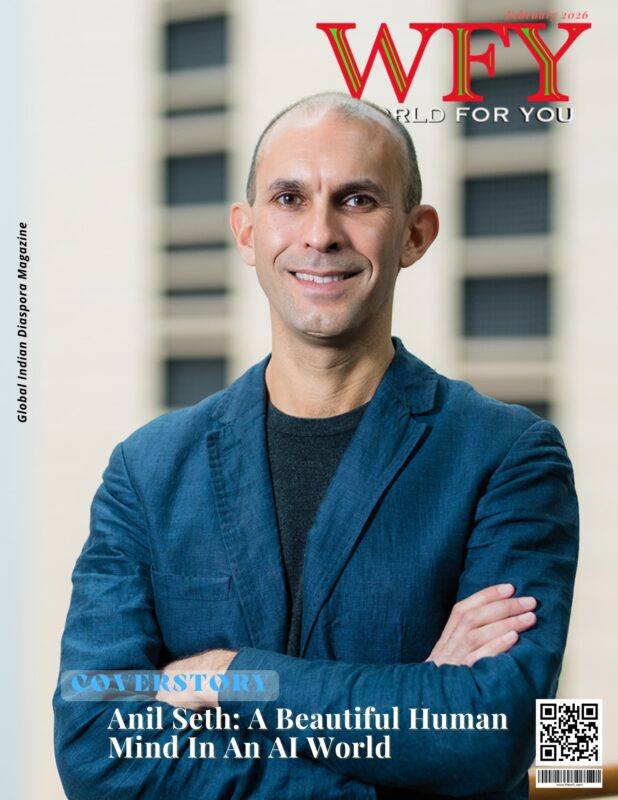
By Melwyn Williams, WFY Bureau | Cover Story | The WFY Magazine, February 2026 edition
In an age dominated by artificial intelligence, the most urgent question may not be how intelligent machines can become, but how human consciousness actually works. Anil Seth, one of the world’s leading neuroscientists studying consciousness, stands at the centre of this inquiry. Bridging neuroscience, artificial intelligence, and philosophy, his work challenges long-held assumptions about perception, reality, and the self. As machines grow more capable, Seth’s research reminds us that intelligence is not the same as experience, and that the human mind remains a biological, embodied, and deeply meaningful process. This cover story explores his life, ideas, and why understanding consciousness has never mattered more, especially for a world navigating the promises and pressures of artificial intelligence.

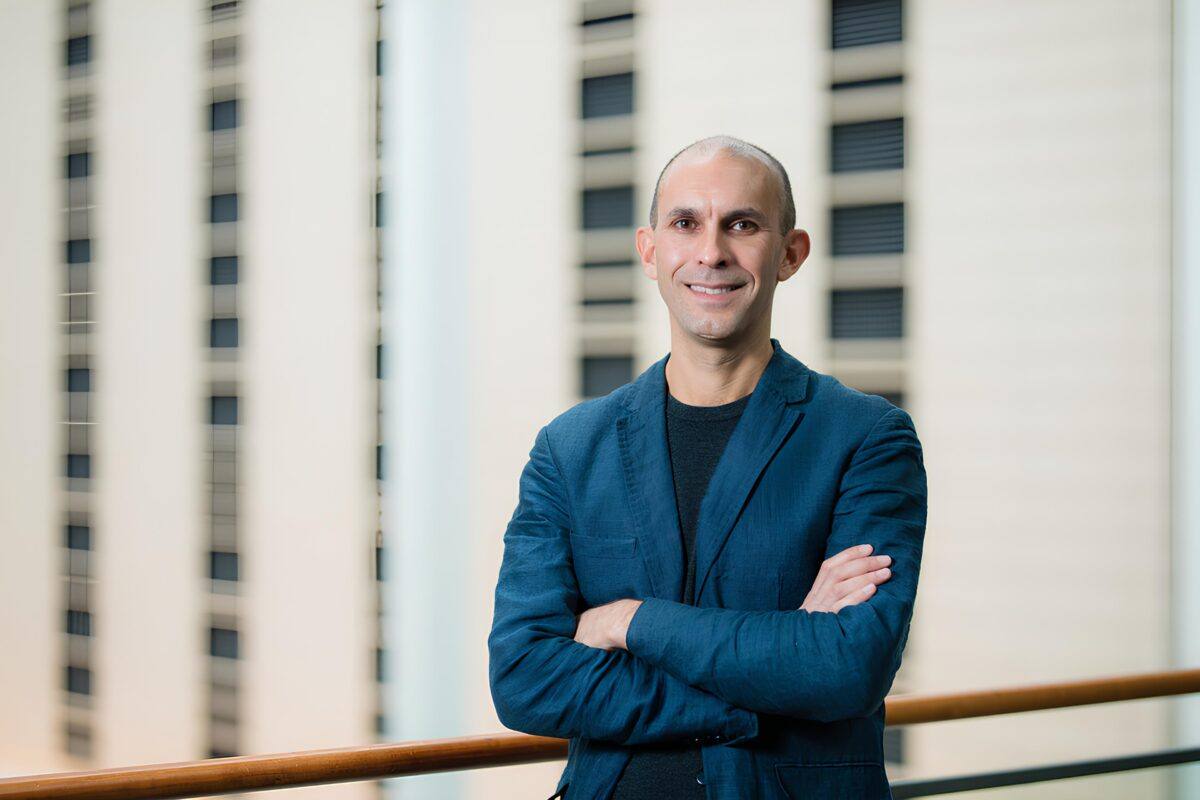
In a world increasingly shaped by machines that learn, predict, and decide, the most urgent question facing humanity is no longer technological. It is existential. What does it mean to be human when intelligence is no longer our exclusive domain? What separates experience from computation, awareness from automation, life from code?
These are not abstract puzzles for a distant future. They are questions already embedded in our phones, workplaces, hospitals, classrooms, courts, and creative spaces. Artificial intelligence systems now diagnose disease, write essays, generate music, recommend prison sentences, screen job applicants, predict consumer behaviour, and shape political messaging. According to global technology expenditure estimates, spending on artificial intelligence crossed the USD 200 billion mark in 2024 and is projected to double before the end of the decade. India alone is expected to contribute tens of billions of dollars annually to the AI economy, driven by government-backed digital infrastructure, private enterprise, and a vast skilled workforce.
Yet amid this technological acceleration, one critical domain remains stubbornly unresolved. Consciousness.
This is where the work of Anil Seth assumes quiet but profound importance. A neuroscientist by training and temperament, Seth has spent decades examining the biological roots of subjective experience. His research does not aim to build smarter machines. Instead, it asks a more unsettling question. Why does the human brain feel like something from the inside at all?
At a time when machines simulate intelligence with increasing fluency, Seth’s work reminds us that intelligence is not synonymous with experience. Computation is not consciousness. And prediction is not awareness. These distinctions matter deeply, especially for societies negotiating the ethical, cultural, and political consequences of artificial intelligence.
For the Indian diaspora, this conversation carries particular resonance. India stands at the crossroads of technological ambition and civilisational philosophy. It is both a global hub for software development and a civilisation with ancient traditions of inquiry into mind, self, and perception. Seth’s work occupies a rare space between these worlds, not by invoking spiritual authority but by applying rigorous science to the most human of questions.
The Mind as a Living Process
For much of modern history, consciousness was treated as either a philosophical mystery or a metaphysical given. Science could explain reflexes, perception, memory, and behaviour, but the feeling of being alive seemed to resist measurement. Why does pain hurt? Why does colour appear vivid? Why does the self feel continuous even as the body and brain constantly change?
Traditional scientific models treated perception as a passive process. The world delivers sensory information. The brain receives it. Consciousness emerges as a faithful representation of external reality.
Seth’s research challenges this assumption. Drawing on decades of neuroscience, computational modelling, and clinical observation, he advances a different understanding. The brain does not simply receive the world. It actively constructs it.

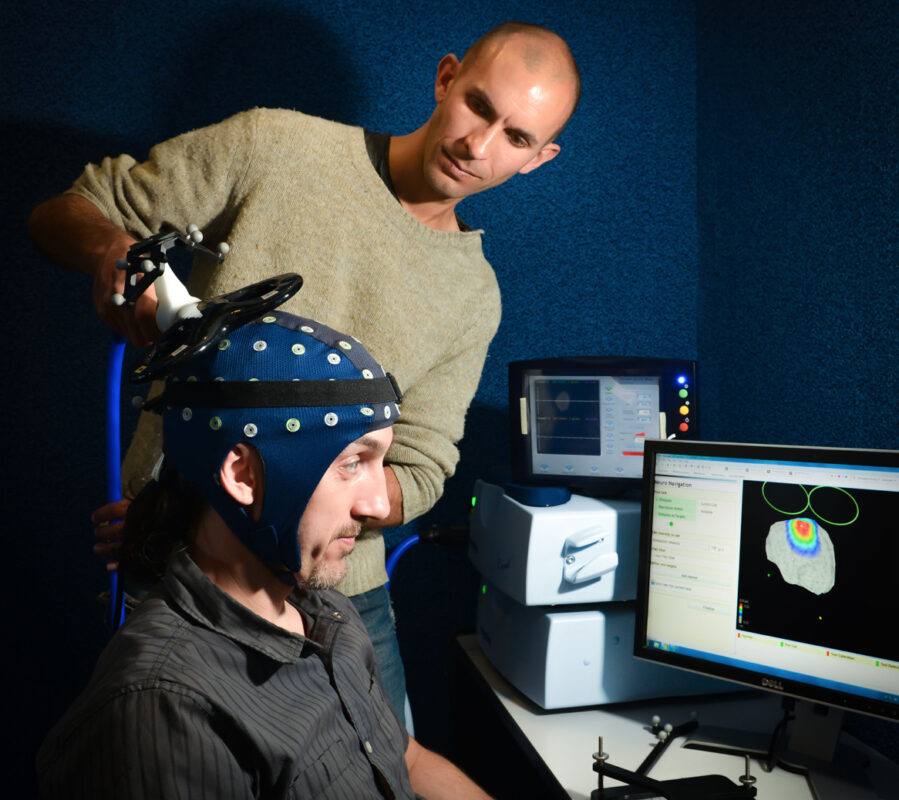
At every moment, the brain generates predictions about what is likely to happen next. Sensory input is used not to build perception from scratch, but to correct these predictions when they are wrong. Conscious experience, in this view, is the brain’s best guess about what is out there and what is happening within the body.
This idea carries profound implications. If perception is a controlled construction rather than a direct mirror of reality, then reality itself is experienced differently by every brain. This helps explain why individuals can look at the same event and remember it differently. It explains hallucinations, illusions, and altered states of consciousness. It also explains why mental health conditions such as anxiety, depression, and psychosis involve not broken senses, but misaligned predictions.
Crucially, this model does not diminish human experience. It grounds it in biology. Consciousness becomes not a magical property but a dynamic process shaped by evolution to keep organisms alive.
Artificial Intelligence and the Illusion of Mind
The rise of artificial intelligence has revived old questions about machine consciousness. If a machine can speak fluently, reason convincingly, and behave adaptively, should it be considered conscious? Does intelligence automatically imply awareness?
Seth’s answer is clear, though not dismissive. Current AI systems do not possess consciousness because they lack the biological foundations that give rise to subjective experience. They do not have bodies that need to stay alive. They do not regulate internal states like temperature, hunger, pain, or balance. They do not experience the world as a matter of survival.
Most contemporary AI operates on statistical pattern recognition. Large language models predict the next word based on vast datasets. Vision systems classify images using learned correlations. Reinforcement learning agents optimise rewards within defined environments. These processes are powerful, but they are not experiences.
This distinction matters because confusion between intelligence and consciousness carries ethical risk. If machines are mistakenly treated as conscious entities, responsibility becomes blurred. Accountability weakens. Human agency erodes.
At the same time, overestimating machine awareness risks underestimating human vulnerability. Systems that appear intelligent can still reinforce bias, amplify misinformation, and make decisions without understanding consequences. Treating them as sentient distracts from the very real human values embedded in their design.
Global surveys show rising public anxiety about artificial intelligence. In India, recent studies indicate that while a majority of urban professionals welcome AI-driven efficiency, there is growing concern about job displacement, privacy erosion, and algorithmic discrimination. These concerns are not unfounded. Automation is expected to affect millions of jobs globally, particularly in clerical, administrative, and routine analytical roles.
Seth’s work reframes this anxiety. The danger is not that machines will become human. It is that humans may forget what being human actually involves.

The Body’s Role in Being Human
One of the most distinctive aspects of Seth’s research is its emphasis on the body. Consciousness, in his view, is not confined to the brain alone. It is deeply tied to the body’s internal signals.
Heartbeat, breathing, gut sensation, hormonal balance, and immune response all feed into the brain’s predictive processes. The sense of self emerges not only from thoughts and memories, but from the constant regulation of bodily life.
This insight has practical implications. Medical research increasingly recognises the role of interoception, the perception of internal bodily states, in mental health. Conditions such as anxiety disorders and depression are now understood partly as disturbances in how the brain predicts and interprets bodily signals.
This body-centred understanding of mind resonates strongly with Indian philosophical traditions, though Seth approaches it without metaphysical claims. Yogic, Ayurvedic, and meditative practices have long emphasised breath, bodily awareness, and balance. Modern neuroscience now offers biological explanations for why such practices affect mental states.
For the Indian diaspora, this convergence is significant. It allows for dialogue between scientific modernity and cultural inheritance without reducing one to the other. It opens space for evidence-based integration rather than romanticised appropriation.
Consciousness, Identity, and the Indian Diaspora
Migration reshapes identity. For millions of Indians living abroad, identity is negotiated daily across languages, customs, and social expectations. The sense of self becomes layered, contextual, and adaptive.
Seth’s work offers a framework for understanding this fluidity. If the self is not a fixed essence but a continuously updated model, then identity is not something we lose or dilute through migration. It is something we recalibrate.
Diaspora life requires constant prediction. How will this gesture be interpreted? Which language fits this setting? What version of self feels safe, authentic, or effective here? These are not superficial adjustments. They reflect the brain’s fundamental task of maintaining coherence in changing environments.
Artificial intelligence systems are increasingly used to profile, categorise, and predict human behaviour. For diaspora communities, this raises concerns about stereotyping and misrepresentation. Algorithms trained on incomplete or biased data risk flattening complex identities into narrow categories.
Understanding consciousness as a dynamic, embodied process highlights the limits of such systems. Human identity is not a dataset. It is a lived negotiation shaped by memory, emotion, culture, and bodily experience.
The Ethics of Knowing the Mind
As neuroscience advances, ethical questions intensify. Brain imaging technologies can now detect patterns associated with attention, emotion, and even intention. Brain-computer interfaces are being developed to restore movement, speech, and sensory function.
These technologies hold immense promise. They also carry risks.
Who owns neural data? Can brain signals be used in courts, workplaces, or insurance assessments? How do we protect mental privacy in an age of biometric surveillance?
Seth’s emphasis on the biological basis of consciousness strengthens the case for cognitive rights. If the mind is not an abstract entity but a vulnerable biological process, then protecting mental autonomy becomes a matter of public policy, not philosophical debate.
Several countries are already exploring legal frameworks for neuro-rights. India, with its vast population and rapidly digitising health sector, will need to engage with these issues sooner rather than later. The Indian diaspora, often at the forefront of global technology development, has a role to play in shaping ethical standards that travel across borders.
Education, Creativity, and the AI Question
One of the most visible impacts of artificial intelligence is in education and creative work. AI tools can now generate essays, artwork, music, and video content at unprecedented speed. This has sparked fears about originality, authorship, and the future of human creativity.
Seth’s perspective offers a reframing. Creativity is not defined by output alone. It is rooted in experience, intention, and embodied exploration. A poem generated by an algorithm may resemble human writing, but it does not arise from lived experience. It does not reflect memory, vulnerability, or desire.
Education systems must adapt accordingly. Rather than competing with machines on information retrieval or pattern replication, human learning should focus on interpretation, ethical reasoning, emotional literacy, and embodied understanding.
For Indian diaspora families, education is often both aspiration and anxiety. The challenge is not to shield children from technology, but to equip them with a deep understanding of what technology cannot replace.
Why This Conversation Matters Now
The global AI conversation often oscillates between utopian optimism and dystopian fear. Both extremes obscure reality.
Artificial intelligence will continue to transform economies, labour markets, and cultural production. But it will not resolve the mystery of consciousness. Nor will it replace the human need for meaning, connection, and moral responsibility.
Seth’s work matters because it restores humility to technological ambition. It reminds us that intelligence is not the pinnacle of evolution. Survival, embodiment, and experience are.
For a world facing climate crisis, political polarisation, and social fragmentation, this reminder is timely. Technology can optimise systems. It cannot tell us what we value.
A Beautiful Human Mind
The phrase “a beautiful human mind” is not a sentimental compliment. It is a recognition of complexity. The human mind is not efficient. It is not always rational. It is prone to error, bias, and illusion. Yet it is capable of empathy, imagination, and moral reflection.
In an AI world, beauty lies not in outperforming machines, but in understanding ourselves better. Consciousness is not a problem to be solved. It is a condition to be respected.
As artificial systems grow more capable, the challenge is not to make machines more human. It is to remain human in how we design, deploy, and govern them.
That task demands science, yes. But it also demands wisdom.
ANIL SETH
Neuroscientist | Consciousness Researcher | Public Intellectual

1. Life Timeline (Chronological Overview)
1972
Anil Seth is born in the United Kingdom to Indian-origin parents. His upbringing reflects a blend of British academic culture and Indian intellectual heritage.
Early 1990s
Completes undergraduate studies in Natural Sciences with a focus on Physics and Artificial Intelligence at the University of Cambridge. This early exposure to both physical science and machine intelligence becomes foundational to his later work.
Late 1990s
Undertakes postgraduate research in Computer Science and Artificial Intelligence, developing a strong grounding in computational models of intelligence.
2001–2004
Completes his PhD in Cognitive Science at the University of Sussex, specialising in neural modelling and the mechanisms underlying perception and consciousness.
Mid-2000s
Begins academic career combining neuroscience, psychology, and computation. Publishes early work on neural dynamics and perception.
2010s
Emerges as a leading figure in consciousness science, focusing on predictive processing, perception, and the biological basis of subjective experience.
2017
Appointed Professor of Cognitive and Computational Neuroscience at the University of Sussex.
2018
Becomes Co-Director of the Sackler Centre for Consciousness Science, one of the world’s leading interdisciplinary research centres dedicated to the scientific study of consciousness.
2021
Publishes Being You: A New Science of Consciousness, which brings his work to a global readership beyond academia.
2021–Present
Recognised internationally as a key voice in debates around AI, human consciousness, ethics, and the future of intelligence, while continuing active laboratory research and academic mentorship.
2. Early Life and Family Background
Anil Seth was born and raised in the United Kingdom in a family of Indian origin. While he does not foreground personal biography in his public work, his background reflects the experience of many second-generation diaspora families. Cultural inheritance coexists with Western education, encouraging inquiry rather than dogma.
His early intellectual interests were shaped less by tradition and more by curiosity about how systems work. Physics, computation, and later biology offered him structured ways to approach questions that had long fascinated philosophers. What is the nature of reality? How does the mind relate to the world? Where does the sense of self arise?
This blend of scientific rigour and openness to fundamental questions would later define his research style.
3. Education
- Undergraduate:
University of Cambridge
Degree in Natural Sciences, with emphasis on Physics and Artificial Intelligence - Postgraduate:
Advanced studies in Computer Science and Artificial Intelligence - Doctorate (PhD):
University of Sussex
PhD in Cognitive Science, focusing on neural modelling, perception, and consciousness
His educational trajectory is notable for its interdisciplinarity. Rather than specialising narrowly, Seth moved across physics, AI, computer science, psychology, and neuroscience. This breadth allows him to speak fluently across disciplines that often remain siloed.
4. Academic and Professional Career
- Professor of Cognitive and Computational Neuroscience, University of Sussex
- Co-Director, Sackler Centre for Consciousness Science
- Leads a research laboratory studying:
- Conscious perception
- Predictive processing in the brain
- The biological basis of the self
- Altered states of consciousness
- Distinctions between human and machine intelligence
He has supervised numerous doctoral and postdoctoral researchers and contributed extensively to peer-reviewed scientific literature. His work is cited across neuroscience, psychology, philosophy of mind, and artificial intelligence ethics.
5. Key Achievements and Contributions
Scientific Contributions
- Advanced the predictive processing model of perception, arguing that the brain actively constructs experience rather than passively receiving sensory input.
- Developed influential theories describing consciousness as a biological process rooted in bodily regulation, not abstract computation.
- Helped clarify why artificial intelligence does not equate to conscious experience, despite advanced performance.
Institutional Impact
- Helped establish consciousness science as a legitimate experimental discipline, moving it beyond philosophical speculation.
- Built interdisciplinary bridges between neuroscience, AI research, philosophy, and ethics.
Public Engagement
- Made complex neuroscience accessible without oversimplification.
- Contributed to global discussions on:
- AI ethics
- Mental health
- Human identity
- The limits of machine intelligence
6. Awards, Honours, and Recognition
- Fellow of the Royal Society of Biology
- Recipient of multiple academic research grants from major UK and international funding bodies
- Recognised internationally as a leading authority in consciousness research
- Being You shortlisted and recognised by several global science and non-fiction book awards
- Invited speaker at major global forums on science, technology, and ethics
While not a prize-driven public figure, Seth’s influence lies in sustained scholarly credibility rather than ceremonial accolades.
7. Personal Life
Anil Seth maintains a private personal life. He is known to balance intensive academic work with interests in music, creative arts, and public science communication. He lives in the United Kingdom and continues to work actively in research, teaching, and writing.
His public persona is deliberately understated. He avoids ideological alignment, spiritual branding, or technological evangelism. This restraint has contributed to his credibility across scientific and policy communities.
8. Why He Matters Today
Anil Seth occupies a rare position. He is equally at ease discussing neural mechanisms in academic journals and explaining human consciousness to general audiences without diluting complexity.
At a moment when artificial intelligence is often framed as either salvation or threat, Seth offers a third position. Understanding ourselves better.
Disclaimer: This article is an original editorial work prepared for The WFY Magazine. It is intended for informational and reflective purposes only. The content draws upon widely accepted scientific research, publicly available data trends, and independent journalistic analysis. No direct quotations or proprietary sources have been used. The views expressed are those of the authoring bureau and do not represent endorsements or official positions of any individual, institution, or organisation mentioned.