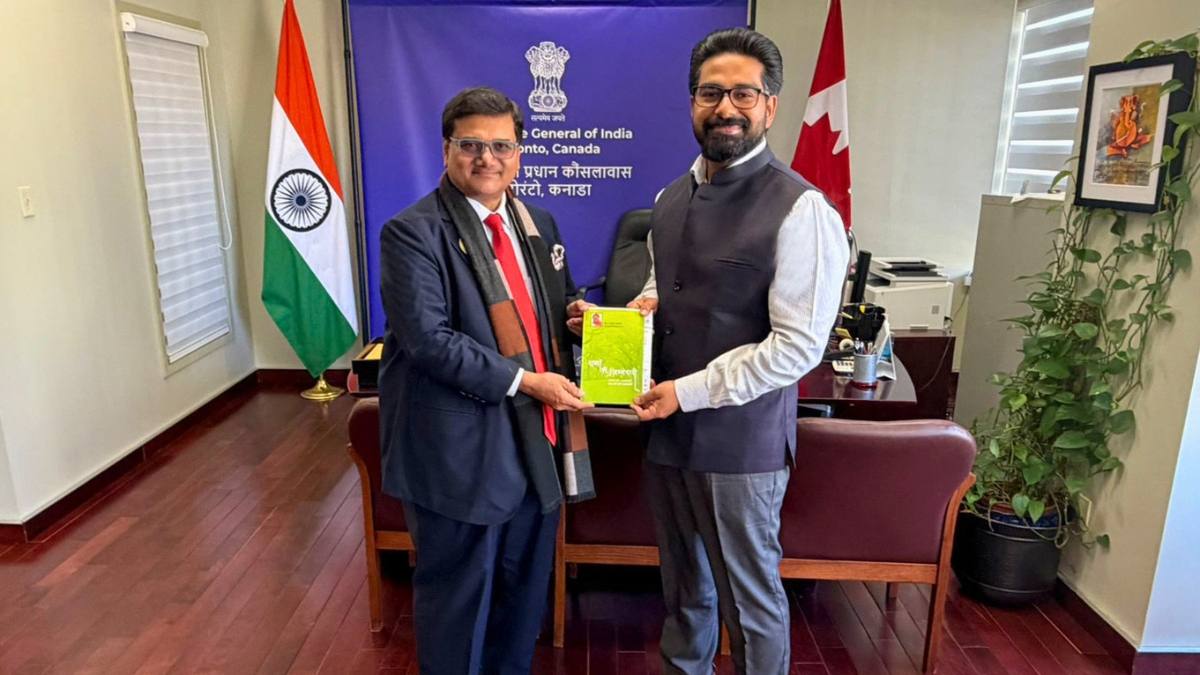
On a brisk Toronto evening, the Forest Hill Room at the Canopy by Hilton Toronto Yorkville was filled well before proceedings began. What unfolded was not just another business presentation—it was a reframing of how the Indian diaspora might think about its role in shaping the future of global trade.


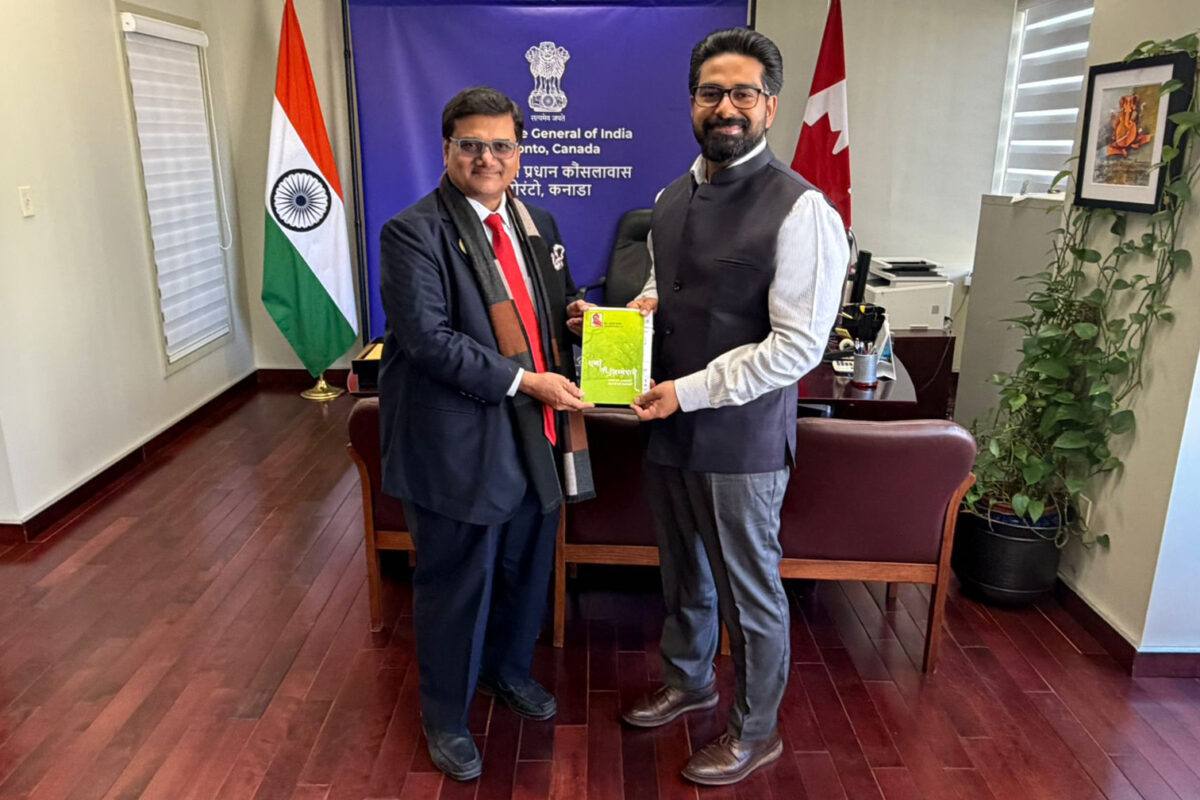
Dr. Jagat Shah, a long-standing architect of international trade networks and a familiar voice across diaspora corridors, brought with him more than data—he brought a perspective honed over decades of working across 40+ countries, 80+ industrial clusters, and thousands of enterprises. With Kapidhwaja Pratap Singh, Acting Consul General of India, Toronto in attendance, the evening carried both institutional weight and community relevance.


“When talent, capital, and opportunity connect across borders, nations don’t just trade—they transform together.”
— Kapidhwaja Pratap Singh, Acting Consul General of India in Toronto


At the heart of Dr. Shah’s address was a simple but underleveraged truth: India and Canada are not competing economies—they are complementary ones.
“India and Canada are not just trading partners; they are complementary economies waiting to unlock exponential value through trust, technology, and talent.”
— Dr. Jagat Shah

One brings scale, talent, and cost efficiency; the other brings resources, technology, and structured capital. The opportunity lies in intelligently bridging that gap.
From Obvious Trade to Invisible Opportunity
While bilateral trade figures—hovering around $8.6 billion in goods and $15 billion in services—offer a snapshot, Dr. Shah pushed the audience to look beyond the obvious. His presentation spotlighted ten underexplored sectors that could define the next decade of India–Canada engagement.
These weren’t the usual headline industries. Instead, they reflected where the future is quietly being built:
- Critical minerals beyond mining—processing, refining, and recycling partnerships
- Ethnic food supply chains powered by agri-tech and cold logistics
- AI-driven service exports, where India’s talent meets Canada’s demand
- Clean energy collaborations at the SME level, not just large-scale policy
- Fintech bridges enabling smoother SME trade flows
- Tier-2 and Tier-3 city partnerships, an area he described as “highly untapped”
“The future of India–Canada trade lies beyond commodities—it lives in collaboration, innovation, and co-creation of global value chains.”
— Dr. Jagat Shah
What emerged was a shift in thinking—from transactional trade to ecosystem building.
The Diaspora Advantage
For the largely South Asian business audience in attendance, the message was direct: the diaspora is uniquely positioned to act as the bridge.
Unlike traditional trade actors, diaspora entrepreneurs understand both markets—not just economically, but culturally and operationally. They are, in many ways, the natural intermediaries in a corridor that still lacks enough connectors.
“When India’s entrepreneurial energy meets Canada’s stability and resources, trade transforms into long-term strategic partnership.”
— Dr. Jagat Shah
Dr. Shah’s emphasis on practical entry strategies—joint ventures, shared warehousing, digital commerce, and institutional sales platforms—reinforced that this opportunity is not abstract. It is executable.
India’s Scale Is No Longer a Statistic
Perhaps the most compelling portion of the presentation was not about Canada at all—it was about India’s internal transformation.
A $4+ trillion economy moving toward $5 trillion. Nearly a billion internet users. Hundreds of billions of digital transactions annually. A startup ecosystem that now produces unicorns at unprecedented speed. A demographic engine where over a billion people are under 35.
These are not just impressive figures—they fundamentally change how India must be engaged with. As Dr. Shah framed it, “demand is outpacing supply,” creating a market dynamic where opportunity is structurally embedded.
For diaspora businesses, this signals something critical: India is no longer a future bet—it is a present-tense market.
From Networking to Alignment
Following the presentation, the room transitioned into a networking session—but the conversations felt less like introductions and more like continuation.

Discussions moved quickly from ideas to execution—supply chains, partnerships, market entry strategies. There was a noticeable shift from passive interest to active intent, reflecting a community that is increasingly confident in operating across borders.
A Corridor Waiting to Be Built
What the evening ultimately underscored is that the India–Canada relationship is still in its early innings—not because of lack of potential, but because of underutilization.
The projected possibility of a $50 billion trade corridor by 2030—especially in the context of a potential free trade agreement—is not unrealistic. But it will not be achieved through policy alone. It will require connectors, translators, and builders.
“India–Canada trade is not about distance between nations, but about the alignment of vision, values, and value creation.”
— Dr. Jagat Shah
In other words, it will require the diaspora.
As the evening concluded, one idea lingered more than any statistic: the future of India–Canada trade will not be defined by governments alone, but by those who understand both worlds—and are willing to build between them.