


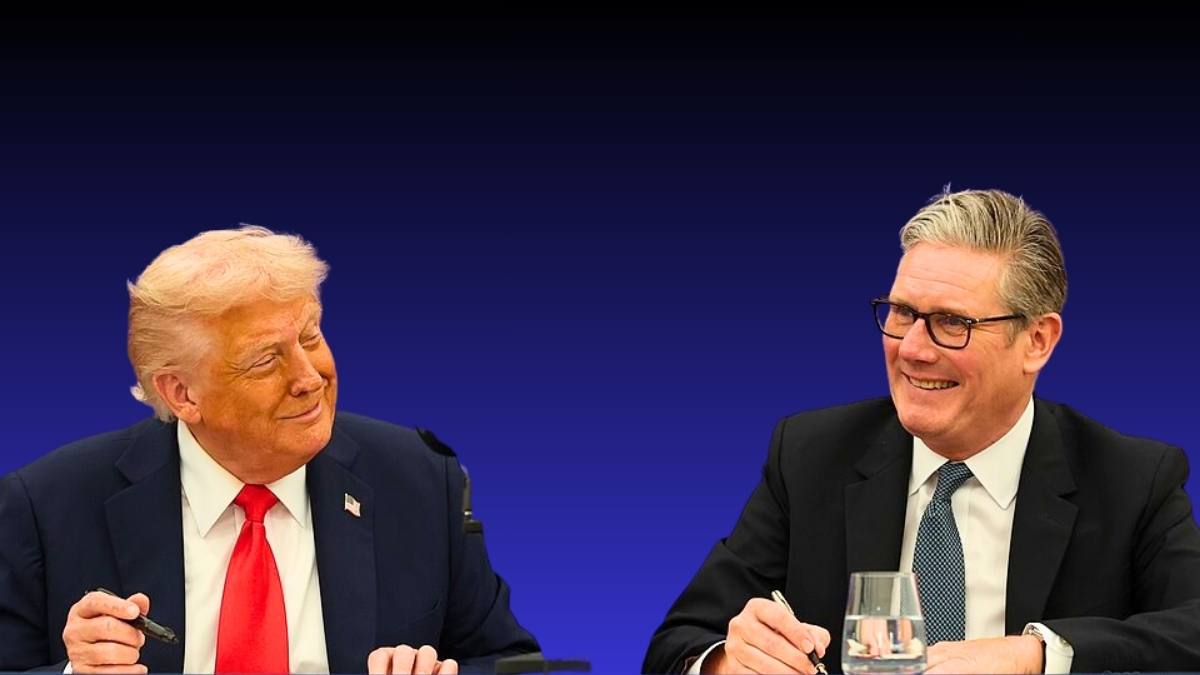
By Selvan Durairaj, WFY Bureau | World Politics | The WFY Magazine, February 2026 Edition
Foreign policy is no longer the quiet theatre where governments bank competence and avoid consequences. As global power becomes louder, less restrained, and more transactional, its effects are spilling back into domestic politics with uncomfortable force. For Britain’s prime minister, Keir Starmer, a carefully managed relationship with an unpredictable White House has so far been treated as a strategic success. But that success is now being contested at home, where opposition parties, restive allies, and a wary public are beginning to ask harder questions about alignment, defence spending, and political judgement. From Venezuela to Greenland, from trade-offs made abroad to anxieties growing inside Westminster, Britain finds itself confronting a familiar but newly sharpened dilemma. How much power can be accommodated before it reshapes domestic politics itself? And how honest can any government be about the price of security in a world that no longer rewards caution?
Urgent Reckoning Now: Starmer and the Cost of Power Politics
It begins, as these things often do, not with a decision but with a discomfort.
A sense, growing quietly across Westminster, that something once taken for granted has stopped holding. That foreign policy, long treated as a specialist domain where competence was sufficient and electoral consequence rare, has returned to the centre of political risk.
Keir Starmer did not inherit a stable world. Few leaders now can claim that. What distinguishes his moment is the speed with which global volatility has begun to leak into domestic judgement. What was once framed as prudence is now scrutinised as passivity. What looked like access is recast as exposure.
At first, the calculation appeared sound. Maintain a steady channel to Washington. Avoid public theatrics. Preserve room for influence when decisions are actually made. In an era of heightened unpredictability from the United States, this approach earned quiet approval across parts of Whitehall and beyond. Britain, it was said, was being taken seriously again.
But seriousness abroad does not always translate into safety at home.
As American power has become more openly assertive, Britain’s proximity has begun to raise questions rather than reassurance. Not because alignment is wrong in principle, but because alignment now carries visible consequences. The assumption that voters will tolerate ambiguity in foreign affairs is weakening. The old rule that international competence buys domestic insulation no longer applies with the same certainty.
This is the political environment Starmer now navigates.
Opposition parties have sensed the shift. They are not challenging the necessity of engagement with Washington so much as the optics of it. The image of closeness, once a diplomatic asset, is being recast as vulnerability. Every American action reverberates back into British debate. Silence becomes a statement. Restraint is read as hesitation.
What complicates matters further is that these pressures arrive alongside a question Britain has postponed for years. Defence spending. Not as an abstract commitment, but as a lived trade-off. How much protection costs. What it displaces. And who bears the burden.
The government insists the direction of travel is clear. More investment. Faster modernisation. Greater readiness. Yet even within official circles, there is unease about whether the public has been prepared for the scale of what is required. The numbers are not abstract. They land on budgets already stretched by domestic demand.
This is where foreign policy becomes political in the most immediate sense.
Britain’s allies are watching. Its rivals are testing. And its voters are beginning to notice that the world beyond the Channel now presses directly on decisions at home. The idea that one can manage global power quietly, without narrative or cost, has begun to unravel.
For Starmer, the danger is not that engagement with Washington is wrong. It is that engagement without explanation leaves a vacuum others are eager to fill. Critics from the right frame caution as weakness. Critics from the left frame pragmatism as complicity. The centre narrows.
And hovering beneath it all is the recognition that defence is no longer a technical file. It is a political wound.
How much Britain is willing to spend to protect itself. What it is willing to sacrifice. And whether its leaders are prepared to say so plainly.
The reckoning is not dramatic. There is no single vote or crisis to mark it. It arrives instead through accumulation. Through pressure from multiple directions. Through the slow erosion of comfortable assumptions.
Foreign policy has come home. And it is asking to be accounted for.
What unsettles many inside government is not the criticism itself, but its unfamiliar direction. Foreign policy was once a domain where opposition held fire, or at least softened its blows. There was an unspoken understanding that unity abroad mattered more than advantage at home. That convention has thinned.
Opponents now treat global engagement as fair political ground. Questions once reserved for select committees are being voiced openly in the Commons, on doorsteps, and across party conferences. Who did the prime minister speak to. When. On what terms. And, crucially, what was conceded without explanation.
This shift is not ideological alone. It is generational. Voters who came of age during financial crisis, pandemic, and war are less inclined to separate foreign affairs from daily consequence. They understand instinctively that choices made in distant capitals return in the form of prices, taxes, and risk.
That awareness has altered the calculus.
The prime minister’s approach has been shaped by experience. His instinct is to steady, not dramatise. To keep channels open. To avoid public confrontation where private influence might work better. In earlier decades, this method carried little penalty. Today, it invites suspicion.
Each American move sharpens the contrast. Military action abroad. Assertive trade language. Renewed claims over territory. None of these are Britain’s decisions, yet all of them colour how Britain’s leadership is judged. Silence is read as acquiescence. Careful phrasing is dissected for intent.
Inside Westminster, there is an unspoken fear that the country is being pulled into a rhythm it did not set. Not because it lacks agency, but because it lacks room. The relationship with Washington is not optional. It never has been. But its terms feel less balanced than before.
This unease is not confined to one party.
Across the chamber, there is little appetite for spelling out alternatives. Critics are quick to question tone and posture, slower to explain how they would manage the same pressures differently. That ambiguity is politically convenient. It allows distance without responsibility.
Yet it also reflects a deeper problem. Britain’s choices are constrained by reality. Its security arrangements. Its intelligence networks. Its economic exposure. These are not easily disentangled. Nor can they be waved away with rhetorical confidence.
What has changed is that the cost of these constraints is becoming visible.
Nowhere is this more evident than in the debate over defence funding. For years, spending commitments were expressed in percentages and pledges. Abstract. Reassuring. Detached from consequence. That era has ended.
Defence now competes directly with domestic priorities. Infrastructure. Health. Education. Social care. The sums involved are no longer marginal. They demand trade-offs that governments prefer not to articulate until forced.
Within official circles, there is frustration that the conversation has lagged reality. Strategic reviews acknowledge the need for expansion. Military leadership signals gaps. Yet political messaging remains cautious. The public is told change is necessary, but rarely how disruptive it may be.
This hesitation carries risk. When the public senses that decisions are being delayed or softened, trust erodes. And when trust erodes, space opens for simpler narratives to take hold.
That is the vulnerability opponents are probing.
They frame the government as overly careful abroad and insufficiently candid at home. They argue that closeness to Washington has limited Britain’s ability to set its own tone. They suggest that strength has been mistaken for discretion.
These arguments land because they intersect with lived anxiety. Households already absorbing economic strain are more alert to how global turbulence might deepen it. Defence, once distant, now feels proximate. Not heroic, but expensive.
The government’s challenge is compounded by timing. These questions arrive not after crisis, but during accumulation. There is no single moment to point to and explain away. Instead, there is a growing sense that the world has accelerated, while domestic politics has not kept pace.
Some within Labour worry that this gap is becoming politically dangerous. They argue privately that diplomacy requires a parallel narrative. That explanation matters as much as execution. That voters will accept difficult choices if they believe they are being spoken to honestly.
Others caution against overcorrection. They fear that loud positioning could damage relationships that still matter. That public signalling risks hardening positions unnecessarily. The instinct to manage rather than perform remains strong.
This internal tension mirrors the wider dilemma. Britain is navigating a world where influence is exercised more openly, while its own political culture remains cautious about confrontation. The mismatch creates friction.
Beyond Westminster, the implications are broader. For allies watching Britain’s posture, clarity matters. Ambiguity can reassure in private, but it unsettles in public. Partners want to know not just where Britain stands, but how firmly it is prepared to stand there.
For a globally dispersed Indian diaspora, this moment resonates differently. Many are accustomed to navigating multiple political cultures. They recognise the signs of transition. The recalibration of alliances. The shifting balance between principle and pragmatism. They understand that such moments rarely announce themselves cleanly.
What they are witnessing in Britain is a familiar pattern. A country adjusting to diminished certainty. A leadership attempting to preserve influence through access. A political system struggling to explain why caution still counts as competence.
The risk for the prime minister is not immediate collapse. It is gradual erosion. Authority thins when decisions are not challenged directly, but reinterpreted continuously. Each act abroad becomes fodder for domestic judgement. Each compromise accumulates symbolic weight.
The old comfort that foreign policy sits apart has gone. What replaces it is messier. More exposed. Less forgiving.
The question facing Britain is not whether alignment with Washington is necessary. It almost certainly is. The question is whether alignment without narrative can survive in a political culture that now demands explanation.
That demand will not fade. It will intensify.
Because the world is not slowing down. And the costs of protection, once deferred, are coming into view.
There is a temptation, when moments like this surface, to search for a decisive verdict. To ask whether the prime minister has chosen wisely or misjudged the balance. Whether proximity delivers influence or quietly narrows it. Those answers, if they exist at all, are not yet available.
What is visible instead is a shift in how foreign engagement is read at home. Actions once buffered by distance now return quickly, stripped of diplomatic context and judged through domestic consequence. The insulation has thinned. Not because the public has become hostile to the world beyond its borders, but because it has become more aware of how closely that world presses back.
The old comfort lay in the belief that competence spoke for itself. That careful handling abroad would be recognised as such, even if it required discretion. That belief is harder to sustain when global actors move loudly and unpredictably, and when restraint is easily mistaken for absence.
Britain is not alone in this. Many democracies are discovering that international alignment is no longer politically neutral. It asks something of the electorate. Money. Attention. Trust. And those asks are arriving at a time when patience is in short supply.
For the prime minister, the challenge ahead is not simply strategic. It is explanatory. How to speak plainly about the limits of choice without sounding diminished. How to argue for engagement without appearing captive to it. How to prepare the country for costs that cannot be indefinitely postponed.
None of this requires grand declarations. In fact, it may require the opposite. A steadier honesty. A willingness to admit constraint without surrendering agency. A recognition that leadership now involves carrying uncertainty openly, rather than smoothing it away.
Foreign policy has stepped back into view, not as spectacle, but as pressure. It lingers in budget lines. In parliamentary exchanges. In the way alliances are discussed at kitchen tables rather than committee rooms.
Whether this moment reshapes British politics decisively remains unclear. But it has already altered the terms of debate. What once sat at the margins now insists on attention. And once attention is claimed, it is rarely surrendered easily.
The world will continue to intrude. The question is not whether Britain can keep it at bay, but how honestly it chooses to speak about the price of living within it.
Disclaimer: This article is based on analysis of publicly available information and evolving international developments. It reflects the editorial perspective of The WFY Magazine and is intended to provide context and interpretation rather than definitive policy judgement. Political circumstances and assessments may change as events continue to unfold.