


The Indus civilisation left behind sophisticated cities and extraordinary objects, but remarkably few clues that can tell us with certainty who its people were, how they were governed or what they believed. Moving beyond the celebrated Dancing Girl, this article explores how archaeologists use bronze figures, stone sculptures, terracotta figurines, seals, toys, animals and traded materials to reconstruct fragments of Harappan life. At the same time, familiar labels such as the “Priest-King” and “Mother Goddess” reveal how easily interpretation can become mistaken for fact when the Indus script remains undeciphered. The larger story is therefore not simply about the brilliance of Harappan art, but about archaeology itself: how seemingly small objects can reveal technology, trade, childhood, society and creativity while leaving some of the civilisation’s greatest mysteries tantalisingly unresolved.
BEYOND THE DANCING GIRL: READING A CIVILISATION THROUGH ITS OBJECTS
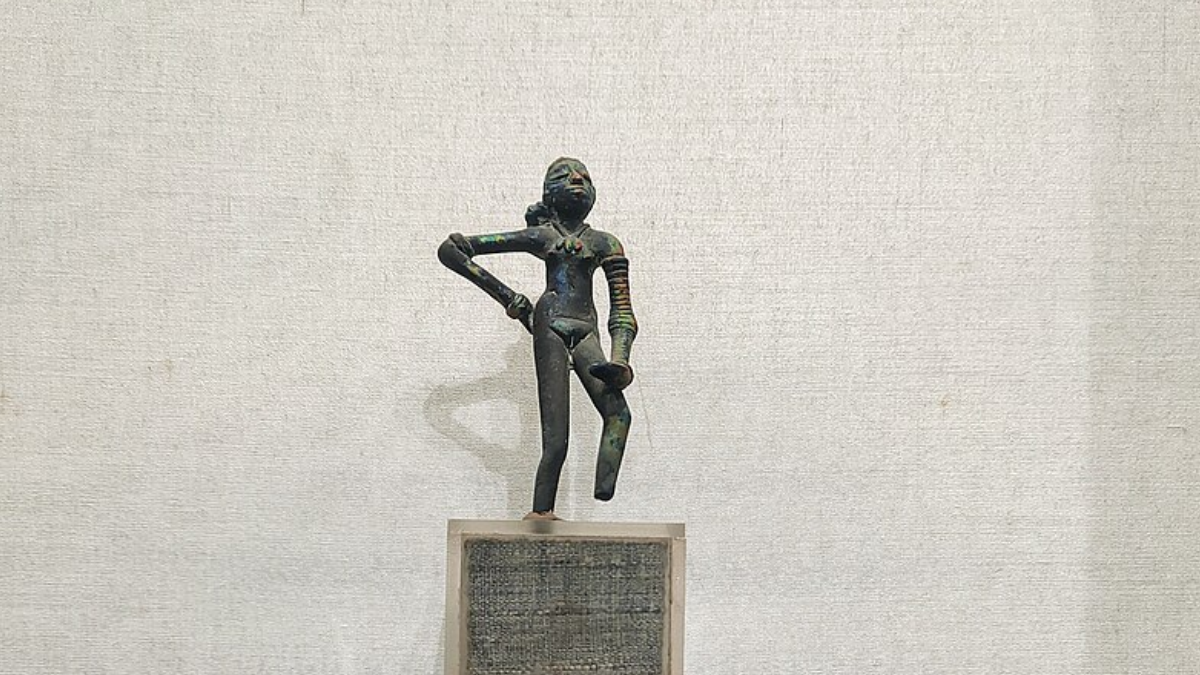
More than four thousand years ago, an artist shaped a small human figure in wax. The figure was slender, confident and strikingly informal, with one hand resting on her hip and the other hanging loosely by her side. Bangles covered much of one arm. Her head was tilted slightly, her posture possessed an almost startling sense of personality, and when the wax model was eventually transformed into bronze, the resulting figure stood only about 10.5 centimetres tall.
Today, we know her as the Dancing Girl of Mohenjo-daro.
She has become one of the most recognisable objects associated with the Indus or Harappan civilisation. Yet the fascination of Harappan art extends far beyond this celebrated bronze figure. Stone portraits whose identities remain unknown, beautifully worked beads, seals covered in undeciphered signs, terracotta women, miniature animals, wheeled carts and children’s toys all survive from a civilisation that flourished across a vast region of South Asia.
These objects matter because the people who made them have left us remarkably few words that we can understand. Their script remains undeciphered. There are no readable chronicles describing their rulers, wars, beliefs or everyday lives. There are no known royal biographies comparable with those of other ancient civilisations. Much of what we know about the Harappans must therefore be reconstructed from the things they built, used, traded, wore, played with and left behind. Beyond the ‘Dancing Girl’ Why I…
Archaeology becomes, in this extraordinary civilisation, an exercise in learning how to listen to objects.
A CIVILISATION THAT WILL NOT INTRODUCE ITSELF
The mature phase of the Indus civilisation, generally dated from approximately 2600 to 1900 BCE, produced some of the ancient world’s most sophisticated urban settlements. Its geographical reach included parts of what are today Pakistan and north-western India, with wider connections extending towards Afghanistan and beyond.
Harappa, Mohenjo-daro and other settlements reveal planned streets, drainage systems, standardised bricks, craft production and systems of weights and measures. Such organisation indicates societies capable of extraordinary coordination.
And yet the people responsible for this achievement remain frustratingly anonymous.
The difficulty begins with their writing. Indus signs occur on seals, tablets, pottery and other objects, but inscriptions are generally extremely short. There is no surviving equivalent of a long royal inscription, religious scripture or historical chronicle that scholars can confidently read. Without an accepted decipherment, archaeologists cannot simply ask the Harappans what their symbols meant, what they called their rulers or what they believed about the figures they created.
That uncertainty should shape how their art is discussed. Archaeology can tell us a great deal, but an attractive interpretation should never be mistaken for a proven fact.
THE GIRL WHO OUTLIVED HER CITY
The Dancing Girl demonstrates just how sophisticated Harappan craftsmanship could be. The bronze figure was made using lost-wax casting, a process in which an object is first modelled in wax, surrounded by a moulding material, heated so that the wax disappears, and then replaced with molten metal.
The significance lies not merely in the technique itself but in the control required to execute a small and detailed figure successfully. Metal had to be prepared and heated, the mould had to survive casting, and molten material had to reach the narrowest parts of the figure. The result was not simply a useful metal object but a piece of figurative art with extraordinary presence.
Her fame, however, can distort our understanding of Harappan creativity. The Dancing Girl is exceptional, but Harappan civilisation did not express itself through monumental sculpture on the scale familiar from ancient Egypt or Mesopotamia. Much of its surviving figurative art is small enough to hold in the hand.
That scale is itself intriguing. Some ancient societies announced authority through colossal statues, temples, tombs and representations of kings. Harappan cities display immense organisational sophistication without providing equally obvious monuments celebrating individual rulers.
The civilisation appears highly organised, yet the people at the top of that organisation remain difficult to identify.
THE MAN WE CALL A KING WITHOUT KNOWING WHETHER HE WAS ONE
Few objects illustrate the danger of archaeological labels better than the famous bearded male figure from Mohenjo-daro.
He is commonly known as the Priest-King. The name is memorable. It is also speculative.
The small steatite sculpture depicts a bearded man wearing a patterned garment over one shoulder. His composed expression, headband and elaborate clothing encouraged early archaeologists to imagine someone possessing religious or political authority. The title subsequently became so familiar that it can sound like an established identification.
But there is no inscription saying who he was. We do not know whether he was a priest, king, merchant, ancestor, deity or something else entirely.
The uncertainty becomes more interesting when placed beside the political mystery of the civilisation itself. Archaeologists have not securely identified the kind of grand royal palace, monumental ruler’s tomb or triumphant royal imagery that characterises several other early urban societies. Modern researchers consequently debate whether Harappan political authority was centralised, distributed among different institutions, organised through regional polities or structured in ways for which we do not yet possess an adequate model. Frontiers
The Priest-King therefore tells us two stories. One concerns the Harappans. The other concerns archaeology itself. Sometimes the names modern observers give ancient objects reveal how strongly we want the past to fit political categories we already understand.
STONE THAT HAD ALREADY TRAVELLED BEFORE IT BECAME ART
The materials used by Harappan craftspeople reveal another dimension of their world. Stone, metal and precious or semi-precious materials did not necessarily originate near the cities in which finished objects were discovered.
The source material describes steatite, carnelian, agate, lapis lazuli and other stones moving through networks connecting different regions, including Gujarat, Rajasthan, Afghanistan and Central Asia. Beyond the ‘Dancing Girl’ Why I…
This changes the way we should look at a small ancient ornament. A bead is not merely decoration. It may represent mining, transport, specialised knowledge, trade relationships, craft workshops and consumer demand operating across considerable distances.
The same applies to metal. Bronze requires more than artistic ability. Copper and alloying materials must be obtained, processed and controlled. A finished bronze object therefore contains within it an invisible network of miners, traders, metalworkers and craftspeople.
Harappan art was connected to an economy.
The beauty of an artefact and the organisation required to produce it cannot easily be separated.
THE BODY IN STONE
Another remarkable Harappan sculpture complicates the picture further. The male torso associated with Harappa differs dramatically from the formal appearance of the so-called Priest-King. Its treatment of the human body is smooth, rounded and strikingly naturalistic.
The contrast reminds us that there was no single Harappan artistic style. Different objects could fulfil different purposes, emerge from different workshops or embody different aesthetic traditions.
It also cautions against reading political systems directly from artistic differences. The source material suggests that stylistic variation between cities might point towards separate centres of authority. That is an interesting possibility, but the evidence does not allow us to move confidently from different sculptures to different forms of government. What the objects demonstrate more securely is diversity within a civilisation that nevertheless maintained striking levels of material standardisation across a very large geographical area. Beyond the ‘Dancing Girl’ Why I…
This combination of unity and variation remains one of the great Harappan puzzles.
THE PEOPLE MADE OF CLAY
If bronze and stone demonstrate specialised craftsmanship and access to valuable resources, terracotta brings us closer to another level of Harappan material life.
Clay was abundant and comparatively accessible. It could be shaped by hand and fired to create human figures, animals, carts, whistles and other objects. Terracotta pieces consequently survive in large numbers, although their distribution and contexts vary significantly between sites.
Among the most famous are elaborately decorated female figurines, often with distinctive headdresses and applied ornaments. Older interpretations frequently called them Mother Goddesses and connected them with fertility worship.
That interpretation remains influential in popular accounts, but contemporary archaeology is considerably more cautious.
Researchers have proposed religious, ceremonial, domestic and other functions, while scholars including Sharri Clark and Shereen Ratnagar have challenged the assumption that female figurines can automatically be identified as mother goddesses. Without readable texts explaining their function, their meaning remains unresolved. Smarthistory
The same caution applies to claims that the abundance of female imagery proves that Harappan society was matriarchal. Archaeologist Richard Meadow has noted that, without deciphered texts or clear burial evidence demonstrating social hierarchy, the evidence does not allow such a conclusion. Harappa
This uncertainty does not make the figurines less interesting. It makes them more interesting because they expose the boundary between evidence and imagination.
WHEN A TOY BECOMES ARCHAEOLOGICAL EVIDENCE
Some of the most human Harappan objects may also be among the smallest.
Archaeologists have recovered miniature carts, animal figures, rattles, whistles and objects with movable components. The source material describes clay bulls, wheeled carts, bird-shaped whistles and playful figures capable of movement. Beyond the ‘Dancing Girl’ Why I…
It is tempting to dismiss such things as archaeological curiosities. Yet a toy can reveal something that a monumental building cannot.
It tells us that children were present.
That simple observation opens an entirely different window onto an ancient civilisation. Someone made objects small enough for young hands. Someone understood movement, amusement and imitation. Children may have encountered miniature versions of animals, carts and other features of the adult world through play.
We must again resist excessive certainty. Not every miniature object was necessarily a child’s toy, and archaeologists must consider ritual and symbolic uses as well. But when objects can reasonably be associated with play, they bring ancient society closer to us in a way that grand architecture rarely can.
Harappa and Mohenjo-daro were not merely archaeological sites waiting to happen. They were places where people woke, worked, cooked, traded, argued, decorated themselves, raised families and watched children play.
ANIMALS, ENVIRONMENT AND THE WORLD AROUND THEM
Harappan craftspeople also represented animals repeatedly. Bulls, dogs, monkeys, elephants and other creatures appear in terracotta, seals and other media.
These images can offer clues about economic activity, symbolic worlds and relationships between humans and animals. The humped bull, for example, appears prominently within Harappan visual culture. Other animal representations may reflect creatures familiar from the surrounding environment or animals possessing social or symbolic significance.
Yet here too interpretation demands restraint. An image of an animal does not automatically tell us whether it was sacred, economically important, feared, admired or simply familiar. Context matters.
This is one reason Indus archaeology continues to fascinate. The artefacts frequently give us enough information to formulate questions but not enough to close them permanently.
THE ABSENCE OF THE COLOSSAL
Perhaps one of the most revealing things about Harappan art is what archaeologists have not found.
There is no securely identified Harappan equivalent of an Egyptian pharaoh’s colossal portrait proclaiming royal divinity. There are no known royal tombs comparable with those of Egypt or Mesopotamia, and no universally accepted palace celebrating an individual dynasty.
This does not prove that the Harappans had no elites or rulers. Differences in houses, possessions and access to materials indicate that Harappan society was not necessarily socially uniform. What is striking is that authority was apparently represented differently, or has survived differently, from the highly personalised royal power visible in several contemporary civilisations.
A major 2026 discussion of Indus social organisation has revived precisely this question, asking whether some Harappan cities may have operated with less pronounced elite domination than other early urban societies. The interpretation remains debated, but the archaeological puzzle is genuine: highly coordinated cities existed without leaving us an obvious cast of monarchs to credit for them. National Geographic
The absence of a visible king may therefore be as archaeologically significant as the presence of the Dancing Girl.
WHAT THE UNREAD SCRIPT KEEPS FROM US
Almost every major question eventually returns to the Indus script.
If scholars could read it with confidence, familiar objects might acquire entirely different meanings. A seal might identify an occupation, institution, individual, commodity or deity. A symbol interpreted as religious might prove administrative. An object given a modern nickname might turn out to represent something nobody had anticipated.
Until then, archaeology must work through material evidence.
That limitation is also what makes Harappan studies intellectually compelling. We possess enough evidence to recognise an extraordinarily sophisticated civilisation, yet not enough to hear its inhabitants explain themselves.
The objects speak, but they do so indirectly.
THE DANGER OF MAKING THE HARAPPANS TOO FAMILIAR
There is an understandable desire to connect Harappan civilisation directly with later South Asian traditions. Similarities in craft practices, motifs, bodily ornamentation, ritual possibilities and material culture invite comparisons across time.
Some continuities may eventually prove significant. Lost-wax metal casting, for example, has a long history in South Asia and remains associated with important living craft traditions. But cultural continuity across several millennia is difficult to demonstrate simply because two techniques resemble one another.
The source article describes modern Dhokra casting as a direct continuation of Harappan lost-wax technology. Beyond the ‘Dancing Girl’ Why I… The comparison is fascinating, but a shared technological principle should not automatically be treated as proof of an uninterrupted craft lineage stretching for 4,500 years.
Respecting the Harappans sometimes requires resisting the temptation to make them too easily into ourselves.
WHY THESE SMALL OBJECTS STILL MATTER
The extraordinary legacy of the Indus civilisation does not rest upon one bronze girl, one bearded man or one mysterious seal. It lies in the accumulation of thousands of objects that allow fragments of an otherwise silent civilisation to become visible.
Bronze reveals technological knowledge. Imported stone reveals trade. Beads reveal craftsmanship and adornment. Terracotta figures expose both artistic practice and the uncertainty of religious interpretation. Toys suggest childhood. Animal representations illuminate relationships with the surrounding world. Standardised objects point towards systems of organisation. The absence of obvious royal monuments forces us to reconsider assumptions about how complex ancient societies had to be governed.
And almost every artefact leaves something unanswered.
That may be the greatest reason Harappan objects continue to surprise archaeologists. Their sophistication is no longer the surprise. We have known for a century that the civilisation possessed advanced cities, skilled craftspeople and extensive networks of exchange. The deeper surprise is how much those objects can tell us while still refusing to reveal precisely who their makers were.
The Dancing Girl remains compelling because she appears astonishingly present after more than four millennia. Her posture seems familiar, almost contemporary. Yet we do not know her name, whether she was actually dancing, whom she represents or why she was made.
The so-called Priest-King is equally silent. The terracotta women will not confirm whether they were goddesses. The toys cannot tell us the names of the children who may have played with them. The seals continue to display words we cannot read.
Perhaps that is why the Indus civilisation retains such power over the modern imagination. Its people left behind enough of themselves for us to recognise their intelligence, artistry and humanity, but not enough for us to possess their story completely.
More than four thousand years later, we are still learning how to read what they left behind.