


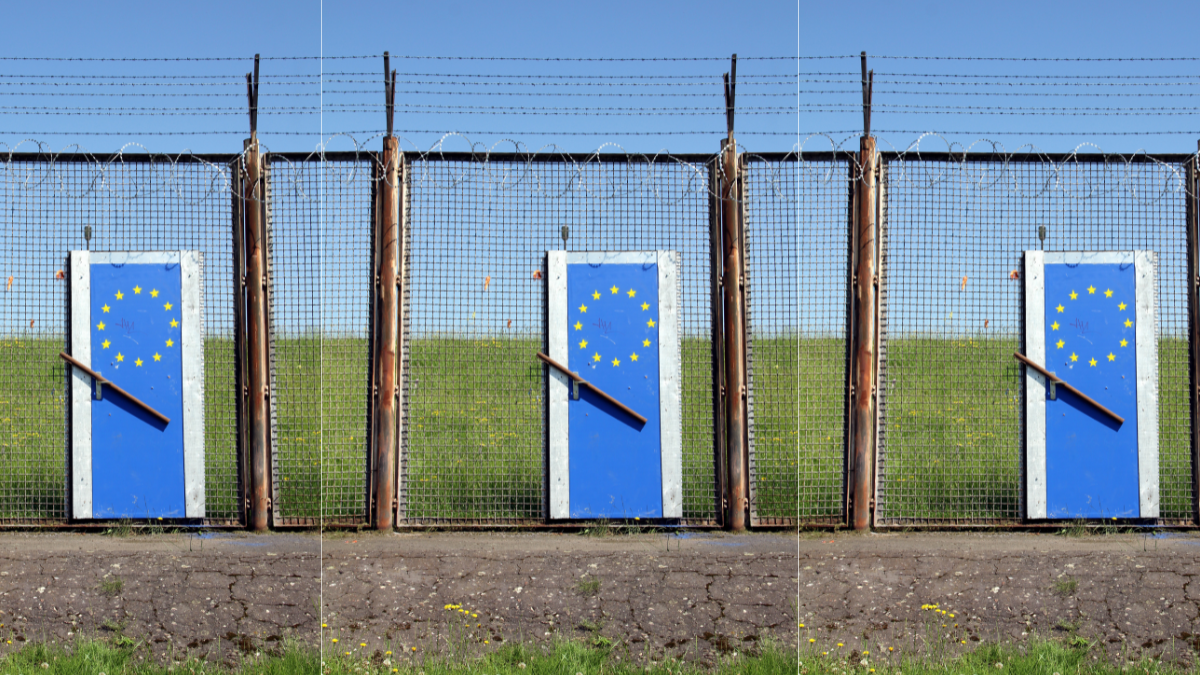
Europe’s migration debate is intensifying as governments seek stronger powers to manage sudden mass arrivals without undermining asylum rights. Greece’s proposal to allow temporary suspension of asylum applications highlights the growing tension between border security and humanitarian obligations. The article examines whether Europe can build a system capable of controlling its borders and responding to genuine emergencies while ensuring that exceptional measures do not permanently weaken refugee protection.
WORLD POLITICS
EUROPE’S MIGRATION DILEMMA: WHEN DOES AN ASYLUM CRISIS BECOME A SECURITY CRISIS?
Europe has spent much of the past decade trying to answer one of the most difficult political questions confronting liberal democracies: how does a state protect its borders while continuing to protect people who genuinely need refuge?
In October 2026, that question acquired new urgency when Greece urged th#asylume European Union to allow member states temporarily to suspend the acceptance of asylum applications during exceptional episodes of mass migration. Greek Migration Minister Thanos Plevris argued that Europe’s recently implemented migration pact had improved the management of migration but did not provide governments with sufficient powers when unusually large numbers of people arrived within a very short period.
The immediate reference was Ceuta, Spain’s enclave on the North African coast, where Spain estimated that more than 72,000 migrants entered during a sudden surge in late July. Most subsequently returned, but around 10,000 remained, intensifying debate within European capitals over whether such an event should be handled primarily through the asylum system or as an exceptional border emergency.
The distinction is much more than administrative. If a person reaches European territory seeking protection, asylum law establishes procedures through which that claim can be considered. If governments instead define an extraordinary movement primarily as a border or national-security event, they may seek different powers to control entry before the conventional asylum machinery begins operating.
Europe is therefore no longer debating migration only in terms of how many people arrive. It is debating something more fundamental: under what circumstances can the character of an arrival change the rules by which Europe responds to it?
THE PARADOX BEHIND EUROPE’S NEW MIGRATION DEBATE
The political urgency surrounding migration might suggest that Europe is experiencing an unprecedented overall surge in irregular arrivals. The broader figures tell a more complicated story.
Irregular arrivals have actually fallen substantially in 2026. The report supplied for this article records a decline of approximately 35 per cent, while returns increased by about 8 per cent during the first half of the year. WP migrant issue greece EU figures similarly show 64,067 irregular arrivals recorded through August, excluding the exceptional Ceuta episode from the Western-route statistics.
This creates an apparent contradiction. If irregular migration is falling, why are governments demanding stronger emergency powers?
The answer lies partly in the difference between volume and concentration. A migration system may be capable of processing a certain number of arrivals distributed over months and across several borders, yet struggle severely when tens of thousands of people appear within days at one geographically constrained location.
For governments, therefore, the issue is increasingly not simply how many people arrive in Europe during a year. It is how quickly they arrive, where they arrive, whether the movement appears spontaneous or organised, and whether existing institutions can continue functioning under sudden pressure.
That distinction is now influencing European migration policy.
FROM ASYLUM MANAGEMENT TO BORDER SECURITY
The language surrounding migration has also changed.
Dutch Migration Minister Bart van den Brink supported the argument that exceptional situations such as Ceuta should be treated as border-management problems rather than ordinary asylum situations. Greece has similarly argued for enhanced border surveillance and the possibility of suspending asylum procedures during extraordinary surges.
EU Migration Commissioner Magnus Brunner has added another dimension. He has argued that when mass movements are deliberately engineered or “weaponised” against Europe, migration can become a security issue, although he has simultaneously insisted that international law and fundamental rights must continue to be respected.
That concept of migration being used strategically is important. European policymakers increasingly distinguish between people moving because of war, persecution, poverty or opportunity and situations in which governments or hostile actors deliberately facilitate migration towards a border to exert political pressure.
The EU’s own migration rules now recognise “instrumentalisation” as a specific category. It refers to circumstances in which a third country or hostile non-state actor encourages or facilitates movements towards an EU border with the intention of destabilising the Union or a member state.
A government clearly has a legitimate responsibility to respond if human movement is being deliberately manipulated as an instrument of coercion. The difficulty is that the people arriving at the border remain individuals. Some may still possess genuine claims to international protection regardless of who encouraged, transported or exploited their journey.
Security policy and refugee protection can therefore collide at exactly the same border
.
THE RIGHT TO SEEK ASYLUM IS NOT THE SAME AS A RIGHT TO ENTER
Public discussion frequently becomes confused because several different principles are treated as though they mean the same thing.
Countries have the right and responsibility to control their borders. Not everyone who arrives irregularly is entitled to remain. An unsuccessful asylum claimant may ultimately be required to leave, and states may take action against smuggling networks and unauthorised entry.
At the same time, international refugee protection rests on the principle that people who claim to face persecution or serious danger must have meaningful access to procedures through which those claims can be examined. The legal issue therefore becomes particularly sensitive when governments propose suspending the acceptance of asylum applications altogether.
Europe’s existing crisis rules already permit substantial flexibility without simply abolishing the asylum process. In recognised crisis situations, registration deadlines can be extended, border procedures can last longer, responsibility rules can be modified and member states facing extraordinary pressure can receive additional flexibility and solidarity. The EU states explicitly that these derogations are intended to operate while applicants’ rights remain protected.
Greece’s proposal consequently goes to the heart of the debate. Governments asking for stronger powers are effectively arguing that there may be circumstances so exceptional that the existing emergency mechanisms remain inadequate.
The counter-question is equally serious: if access to asylum itself can be suspended during precisely the moments when large numbers of desperate people arrive, how can Europe ensure that genuine refugees are not excluded along with everyone else?
CEUTA CHANGED THE CONVERSATION
The events in Ceuta have become politically significant because they demonstrated how quickly a border can move from routine management to emergency conditions.
The European Commission itself acknowledges that the episode showed how sudden mass arrivals can develop rapidly at the EU’s external borders. On 29 September, the Commission presented a five-point plan intended to strengthen Europe’s ability to anticipate and respond to such events, including greater cooperation with partner countries, stronger external-border capabilities, improved intelligence sharing and work on a new European Emergency Response Framework.
The Commission has indicated that the proposed emergency framework would apply only under strictly defined circumstances and could permit time-limited flexibility in standard procedures. It has also repeatedly stated that fundamental rights would continue to apply.
This qualification matters enormously. Emergency powers are often introduced because ordinary procedures genuinely cannot cope with extraordinary events. But emergency powers also possess a tendency familiar throughout political history: measures created for exceptional circumstances can gradually influence what governments consider normal.
Europe must therefore define not merely what powers it requires, but what qualifies as an emergency, who determines that an emergency exists, how long exceptional measures may remain in force and what independent safeguards apply while they operate.
Without those boundaries, the difference between emergency migration management and ordinary migration policy can begin to disappear.
THE SHADOW OF 2015 STILL HANGS OVER EUROPE
Europe’s migration politics cannot be understood without returning to 2015.
More than one million people, many fleeing the Syrian war, arrived in Europe during that period. The humanitarian emergency transformed domestic politics across the continent. Questions of migration became closely connected with national identity, integration, security, welfare systems and the authority of the European Union itself.
Anti-immigration parties gained support in several countries. Mainstream governments subsequently adopted tougher positions on border controls, returns and cooperation with countries outside Europe. The supplied report notes that the political effects of the 2015 crisis continue to shape European policy more than a decade later.
This helps explain why migration remains politically explosive even when arrival numbers fall.
Migration is no longer perceived purely through annual statistics. Voters remember earlier crises. Governments fear losing political control of the issue. Images of overcrowded boats or sudden movements across a border can have political effects disproportionate to their contribution to overall migration numbers.
The politics of migration therefore operates simultaneously in two realities: the statistical reality of how many people are arriving and the psychological reality of whether citizens believe governments remain in control.
Successful migration policy must address both.
WHEN DETERRENCE MOVES BEYOND EUROPE’S BORDERS
Another major change is occurring in Europe’s approach to people whose applications fail or who have no legal right to remain.
EU ministers have moved towards rules allowing member states to establish return hubs outside the Union. The report supplied for this article says Rwanda has held preliminary discussions with some European countries about potentially hosting such arrangements, while Greece, the Netherlands, Germany, Austria and Denmark have been discussing future cooperation.
This reflects a wider movement towards externalisation, in which migration management increasingly takes place beyond Europe’s physical borders.
The logic is understandable from a government’s perspective. If people who have no right to remain can be returned more quickly, asylum systems may become more credible and governments may reduce incentives for irregular migration. Long delays can leave rejected applicants living for years in legal uncertainty while simultaneously weakening public confidence that final immigration decisions are enforceable.
Yet externalisation raises its own questions. Who guarantees conditions in an overseas return facility? Which courts have jurisdiction? What happens if the host country becomes unstable? How are vulnerable people protected? And how can governments ensure that responsibility is not simply being transferred to countries with fewer resources or weaker safeguards?
The effectiveness of return policy will therefore be measured not merely by the number of people removed, but by whether removal systems remain legally defensible and humane.
THE PEOPLE BETWEEN THE POLICIES
Migration debates have an unfortunate tendency to turn human beings into categories.
Governments speak about “flows”, “arrivals”, “returns”, “border procedures” and “instrumentalisation”. Administratively, such terminology is unavoidable. Politically, however, it can obscure the enormous variety among the people represented by those words.
A person fleeing political persecution is not in the same position as someone moving primarily for economic opportunity. A child travelling with family is not in the same position as an adult arriving alone. A victim of trafficking is not the same as a smuggler. Someone manipulated by a hostile government may simultaneously be a genuine refugee.
A functioning migration system therefore has to perform two tasks that appear contradictory but are actually complementary. It must distinguish between people who qualify for protection and those who do not, while treating both categories according to law.
A system that cannot remove people who have no right to remain eventually loses credibility. A system that prevents genuine refugees from presenting their claims loses legitimacy.
Europe needs both.
MIGRATION IS ALSO A DEMOGRAPHIC AND ECONOMIC QUESTION
There is another complication that political debate sometimes overlooks. Europe is not merely a continent concerned about migration. It is also a continent confronting ageing populations, labour shortages and demographic pressures.
European economies continue to require workers in sectors ranging from healthcare and construction to agriculture, hospitality, logistics and technology. Legal migration is therefore likely to remain economically important even as governments become more restrictive towards irregular migration.
This creates a policy challenge. If public debate treats all migration as a single phenomenon, governments can end up discussing asylum seekers, irregular migrants, international students, skilled workers and legal labour migration as though they were interchangeable.
They are not.
One possible long-term answer is therefore to make the distinction clearer: stronger and more credible asylum and border systems alongside better regulated legal routes for work, study and genuine humanitarian protection.
The European Commission’s latest migration strategy itself acknowledges this connection. Its October plan combines tougher border measures with proposals intended to create legal and safe mobility opportunities in cooperation with partner countries.
Border control and legal migration do not have to be opposing policies. Properly designed, each can make the other more credible.
CAN EUROPE SHARE THE BURDEN?
Geography remains one of the EU’s most persistent migration problems.
Countries along the Mediterranean and the Union’s external borders can experience pressures that northern and inland member states do not face to the same degree. Greece, Italy, Spain and other frontline countries have repeatedly argued that migration cannot be treated solely as the responsibility of the country where someone first enters Europe.
The EU’s Migration and Asylum Pact attempts to address this through a permanent solidarity mechanism and common rules. Member states can contribute through relocations or other forms of assistance when another country’s migration system comes under disproportionate pressure.
But solidarity is politically difficult because national governments answer to national electorates. A policy that appears equitable from Brussels may be unpopular domestically, particularly where immigration has become intertwined with debates about housing, public services, integration and cultural identity.
Europe’s migration problem is consequently also a problem of political architecture. The Union possesses a common external border, but migration pressures are experienced locally and political consequences are often national.
THE DANGER OF GOVERNING BY EXCEPTION
Greece’s proposal ultimately raises a question larger than migration.
Democratic governments sometimes need exceptional powers. Wars, pandemics, natural disasters and security emergencies can overwhelm institutions designed for normal circumstances. Migration systems are not immune to the same problem.
The existence of an emergency mechanism is therefore not inherently incompatible with democratic government or human rights. The decisive issue is how narrowly the emergency is defined and how carefully extraordinary powers are constrained.
Europe’s challenge will be to prevent two opposite failures.
The first would be pretending that every mass arrival can be handled comfortably through ordinary administrative procedures even when border and reception systems are genuinely overwhelmed. Governments that cannot respond effectively to exceptional situations risk losing public confidence and creating conditions in which more extreme political solutions become attractive.
The second would be allowing the language of emergency to become a convenient mechanism for weakening asylum protections whenever migration becomes politically difficult.
A credible European policy has to stand between those extremes.
THE REAL TEST OF EUROPE’S MIGRATION POLICY
The debate triggered by Greece is therefore not simply about whether asylum applications should temporarily be suspended. It concerns the type of migration system Europe intends to build after a decade of political upheaval.
The continent clearly wants greater control over its external borders, faster returns for people without permission to remain, stronger action against smugglers and new mechanisms for sudden mass arrivals. Those objectives enjoy increasing political support.
But Europe also defines itself through the rule of law, human dignity and protection for people fleeing persecution. Those principles become most meaningful not when borders are quiet, but when governments are under pressure.
The difficult truth is that border security and refugee protection cannot be solved by choosing one and abandoning the other. A border that governments cannot control will eventually undermine public confidence in asylum. An asylum system that disappears whenever a border comes under pressure risks becoming a right that exists only when it is convenient to honour.
The most important question facing Europe is therefore not whether migration should be treated as a humanitarian issue or a security issue. Under different circumstances, it can be both.
The real test is whether Europe can build a system strong enough to control its borders, flexible enough to survive genuine emergencies and principled enough to recognise that even during a crisis, the person standing at the border still has rights.