


From Scrap to Solar: How a Gujarat Villager Built a Car That Runs on Sunlight
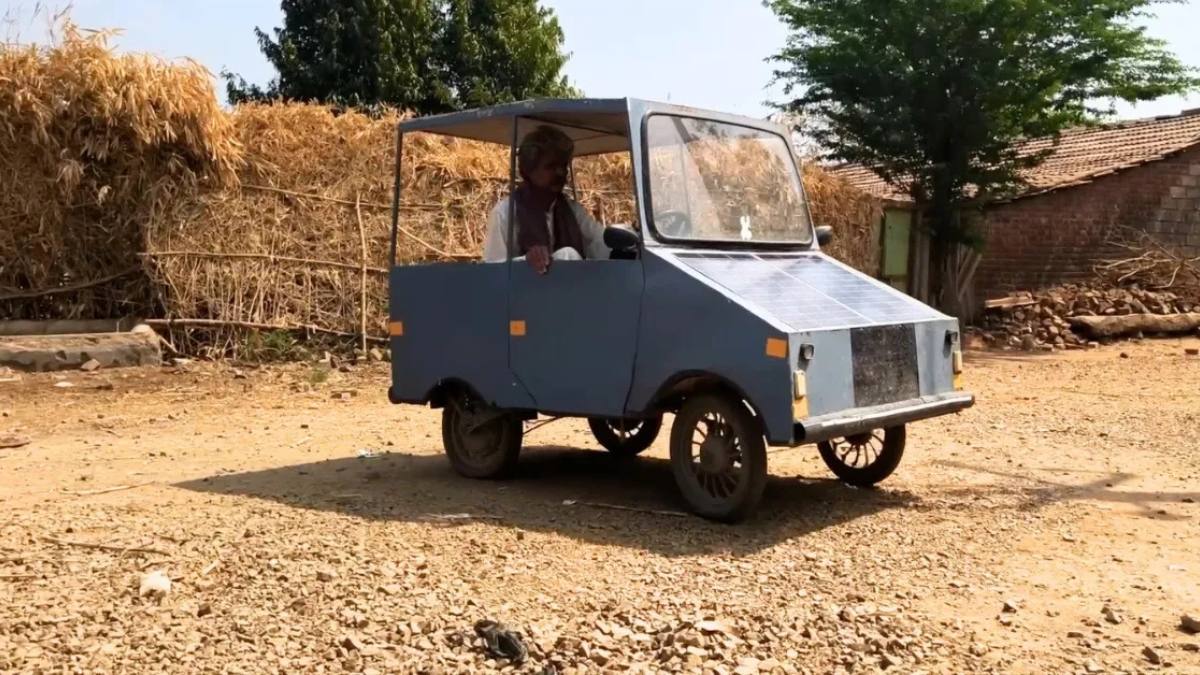
In a quiet village in Gujarat, where the rhythm of life is shaped by seasons, sunlight, and simplicity, an unusual vehicle has begun to turn heads. It does not roar like a conventional engine, nor does it leave behind fumes or noise. Instead, it moves steadily, powered by nothing more than sunlight and the determination of one man.
The creator of this vehicle, Sadhulbhai Chawda, is not an engineer trained in laboratories or a startup founder backed by investors. He is a villager who saw a problem, understood its urgency, and decided to solve it with whatever resources he had at hand. The result is a solar-powered car built almost entirely from scrap, costing no more than ₹30,000.
At a time when conversations around clean energy often revolve around large investments and complex infrastructure, this small vehicle offers a different perspective. It shows that innovation does not always begin in institutions. Sometimes, it begins in a courtyard, with tools, discarded parts, and an idea that refuses to stay idle.
An Idea Born from Necessity
For many in rural India, mobility is not just about convenience. It is closely tied to livelihood, access to markets, healthcare, and daily survival. Rising fuel prices have only made this more difficult, placing a steady burden on households that rely on two-wheelers or shared transport.
It is in this context that Sadhulbhai’s innovation must be understood. His car is not a hobby project. It is a response to a real and persistent challenge. The need for an affordable, reliable, and low-cost mode of transport pushed him to experiment.
Instead of waiting for a solution from outside, he began working with what was available around him. Old bike parts, unused metal, worn-out tyres, and electrical components were gradually brought together. Piece by piece, the structure began to take shape.
There was no blueprint in the conventional sense. The process was guided by trial, error, and an instinctive understanding of how things work. Over time, what started as scattered scrap transformed into a functional vehicle.

Engineering Without Formal Training
One of the most striking aspects of this story is the way the vehicle has been assembled. Without access to advanced tools or technical manuals, Sadhulbhai relied on observation and improvisation.
The chassis was built using scrap iron, welded together to create a sturdy frame. Components from old electric bikes were repurposed to power the vehicle. Even the wheels, sourced from discarded scooters, were adapted to fit the design.
The car may not resemble a polished commercial product, but its simplicity is precisely what makes it effective. Every part serves a clear purpose. There is no excess, no unnecessary complexity. It is a machine built for function, not for display.
This kind of grassroots engineering reflects a deeper tradition in rural India, where repair, reuse, and reinvention are part of everyday life. Objects are rarely discarded without a second thought. Instead, they are reimagined, often in ways that extend their usefulness far beyond their original purpose.
Powered by the Sun
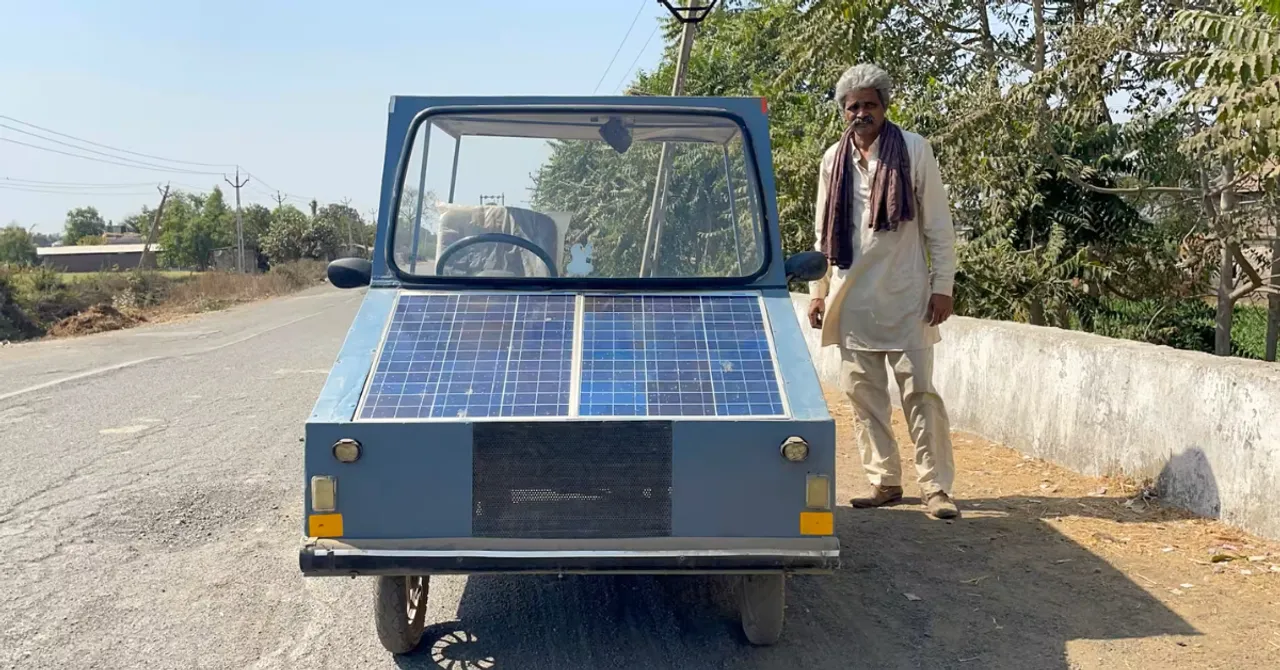
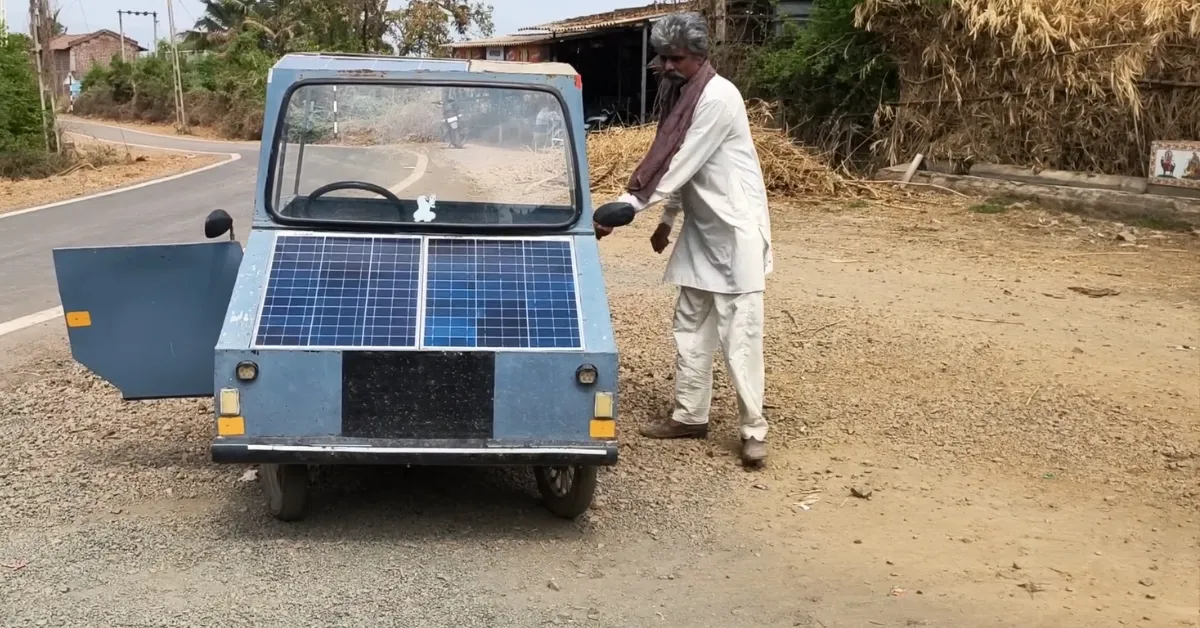
At the heart of the vehicle are two solar panels mounted on its surface. These panels capture sunlight and convert it into electrical energy, which is then stored in batteries.
What makes the design particularly practical is that charging happens continuously during the day, even as the car is in motion. This allows the vehicle to operate without relying on external charging infrastructure, a crucial advantage in rural areas where such facilities may be limited.
Once fully charged, the car can travel between 50 and 60 kilometres. For village use, this range is more than sufficient, covering daily commutes, market visits, and short-distance travel.
The stored energy also allows the car to function after sunset. This ensures that mobility is not restricted to daylight hours, making it a viable option for a range of everyday needs.
Designed for Local Conditions
Unlike high-end electric vehicles designed for urban environments, this car has been built with village roads in mind. Its speed, ranging between 30 and 40 kilometres per hour, is modest but appropriate for the terrain.
The vehicle can seat three people comfortably, making it suitable for small families or shared travel. Inside, the design remains simple but thoughtful. A small fan provides relief from the heat, while a basic music system adds a touch of familiarity and comfort.
These details, though modest, reflect an understanding of user needs. The car is not just about movement. It is about making that movement comfortable and practical within the context of rural life.
Low Cost, Low Maintenance
Perhaps the most remarkable aspect of the project is its cost. Built for approximately ₹25,000 to ₹30,000, the car stands in stark contrast to conventional vehicles, both electric and fuel-based.
Maintenance requirements have also been minimal. Over several years of use, the vehicle has required only a single battery replacement. This level of durability, achieved with limited resources, speaks to the robustness of the design.
For many rural households, affordability is the deciding factor in adopting new technology. By keeping costs low, this innovation opens up possibilities that would otherwise remain out of reach.
A Different Kind of Sustainability
Much of the global conversation around sustainability focuses on large-scale solutions, industrial transitions, and policy frameworks. While these are important, stories like this highlight another dimension.
Sustainability can also be local, small-scale, and deeply personal. It can emerge from necessity rather than strategy. It can be built from what is available rather than what is imported.
In this case, the use of scrap materials reduces waste, while solar energy eliminates fuel costs and emissions. The result is a system that is both environmentally and economically sustainable.
It also challenges the idea that innovation must always be expensive or technologically complex. Sometimes, simplicity can be the most effective solution.
Lessons Beyond the Village
While the car is designed for rural use, its implications extend far beyond a single village. It raises important questions about how mobility solutions are developed and who they are designed for.
Can similar low-cost models be adapted for other regions?
Can grassroots innovations be supported and scaled without losing their essence?
Can policy frameworks recognise and encourage such efforts?
These questions are particularly relevant in a country like India, where diversity in geography and income levels requires flexible and inclusive approaches to development.
Recognition and the Road Ahead
Innovations like this often begin quietly, without immediate recognition. Yet their impact can grow over time, especially when they resonate with broader needs.
There is potential for such ideas to be refined, supported, and integrated into larger systems. With the right backing, they could inspire new approaches to rural mobility and sustainable design.
At the same time, it is important to preserve the spirit in which they are created. The strength of this innovation lies not just in its outcome, but in the process behind it, the willingness to experiment, to adapt, and to build with limited means.

Conclusion
Sadhulbhai Chawda’s solar car is not just a vehicle. It is a statement. It shows that meaningful innovation does not always require advanced degrees, large investments, or sophisticated infrastructure.
Sometimes, it requires a clear understanding of a problem and the determination to solve it with whatever is available.
In a world searching for cleaner, more affordable ways to move, this small car offers a powerful reminder. The future of mobility may not come from a single breakthrough. It may emerge from many such efforts, scattered across places where the need is greatest and the solutions are closest to the ground.
From scrap to solar, this is not just a story of a machine. It is a story of possibility.