


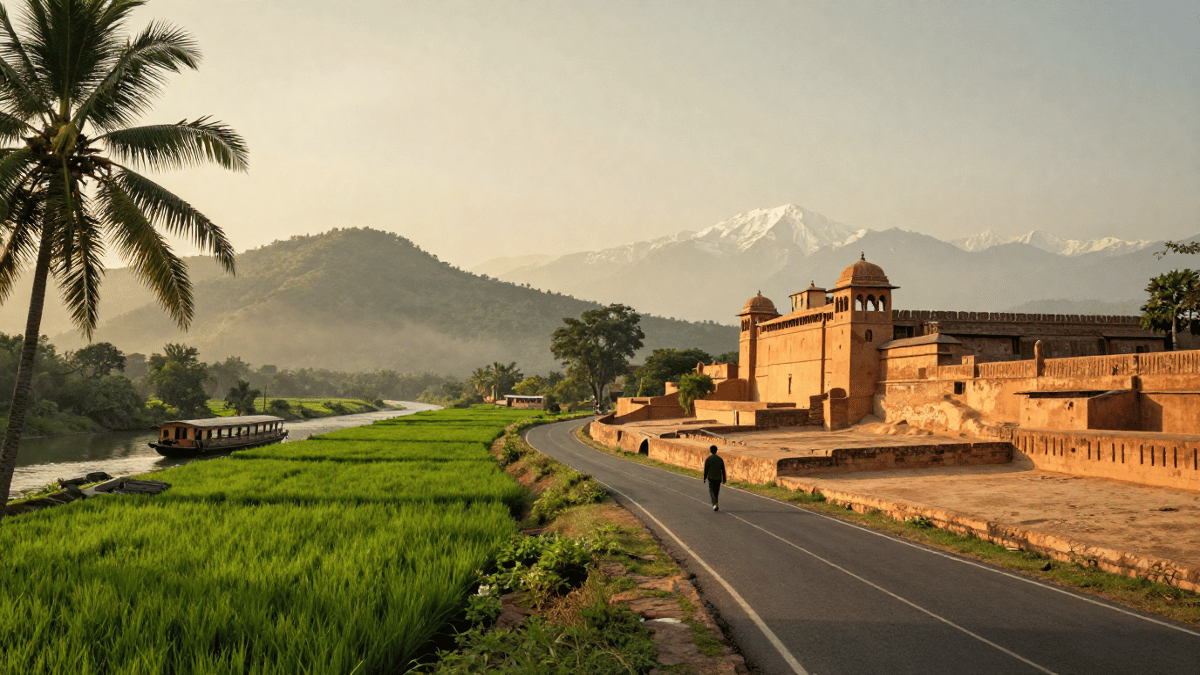
Across India, Through Memories: A Traveller’s Journey from Kerala to the North
From Kerala’s familiar landscapes to the historic monuments of northern India, one traveller reflects on the places, people, traditions and family experiences that have shaped his understanding of the country and created memories to cherish.
The Journey Begins at Home
For me, travelling has always been more than moving from one place to another. Every journey offers an opportunity to observe people, understand different ways of life and collect memories that remain long after returning home. Living in Kerala, I have been fortunate to experience the cultural richness of my own state and to visit several other parts of India, including Karnataka, Goa, Maharashtra, Delhi, Rajasthan and Uttar Pradesh.
Each destination has offered something different. Some places have impressed me with their temples and religious traditions, while others have remained in my memory because of their architecture, historical significance, landscapes or food. Travelling with family has added another dimension to these experiences. Places visited during childhood or earlier years can acquire a new meaning when revisited with one’s children.
I have learnt that a memorable journey does not always depend on luxury hotels, expensive arrangements or a tightly packed itinerary. Sometimes, it is a conversation with a local person, a simple meal, an unexpected view or a quiet moment at a historic site that makes a trip special.
Kerala: The Comfort of Familiar Landscapes
Kerala is the state where I live, and its landscapes have a special place in my travel memories. Its combination of greenery, rivers, backwaters, coastal areas and religious traditions makes travelling within the state rewarding. The experience of moving through Kerala is also shaped by its local languages, food habits and community life.
As someone from Dharmadam in the Thalassery region of Kannur district, I appreciate how local history and cultural practices influence everyday life. Travelling within Kerala also reminds me that a familiar state can contain many different experiences. The character of a coastal town may differ from that of a hill destination, while food, festivals and customs can vary from one locality to another.
For a traveller, it is worth looking beyond the best-known attractions. Local markets, traditional places of worship, neighbourhoods and ordinary conversations can help visitors understand the character of a place. They also provide a more personal connection with the destination.
Karnataka: A Neighbour with Many Stories
My travels in Karnataka have introduced me to another rich cultural landscape. Although Karnataka shares a border with Kerala, its linguistic and regional diversity gives it a distinct character. Kannada is widely used, while other languages are also heard in different parts of the state.
Karnataka offers a variety of experiences, from historic sites and temples to urban centres and coastal destinations. Its architecture and religious traditions reflect different periods of Indian history. The experience of travelling through the state also demonstrates how geography, language and local customs shape the identity of a region.
For a visitor from Kerala, many things may feel familiar, yet there are always differences to discover. Food is one example. Ingredients, methods of preparation and the balance of flavours change across regions, even when dishes share certain similarities.
My journeys have reinforced my belief that neighbouring states should not be understood merely through their geographical proximity. Each has its own history, cultural expressions and everyday rhythms, and travelling is one of the simplest ways to appreciate these differences.
Goa: Temples, Heritage and Memories
Goa occupies a special place in my understanding of the Konkan region. Its coastal setting, religious traditions and historical connections make it an important destination for those interested in western India’s cultural heritage.
My visits to Goa have included places of worship and sites associated with its religious and cultural life. Temples such as Shri Mangeshi Temple are among the destinations that draw visitors interested in the region’s traditions. Such places are not simply tourist attractions; for many people, they are living centres of worship, family memory and community identity.
Goa also has a strong connection with the history of Konkani-speaking communities. For people whose family histories are connected with the Konkan coast, visiting the region can be an opportunity to reflect on language, migration and cultural continuity. Konkani itself has a rich literary and spoken tradition, expressed through different scripts and regional varieties.
At the same time, Goa should not be reduced to a single cultural image. Its beaches, towns, religious institutions, food traditions and local communities offer different perspectives on the state. A thoughtful visitor benefits from exploring these dimensions rather than limiting a trip to a few popular attractions.
Mumbai: The Energy of a Great City
Mumbai presents a very different travel experience. It is a city of movement, ambition and contrasts, where people from different linguistic, regional and cultural backgrounds live and work alongside one another.
For many Indians, Mumbai is associated with employment, business, cinema and the hope of building a better future. It is also an important destination for communities whose members have migrated from different parts of the country. People bring their languages, food habits, festivals and memories with them, contributing to the city’s diverse social life.
What interests me about a city like Mumbai is the relationship between migration and belonging. People may leave their ancestral homes for education, work or family reasons, yet retain connections with their places of origin. These connections are often maintained through visits, friendships, religious gatherings, food and language.
A visit to a large city can be tiring because of traffic, crowds and the distances between attractions. Planning transport and allowing sufficient time for each destination are therefore important. Rather than attempting to see everything in a single day, travellers can enjoy the city more comfortably by choosing a manageable itinerary.
Delhi: Where History Meets Modern India
Delhi was one of the important destinations on my travels. Visiting the national capital offers an opportunity to encounter India’s political institutions, historical monuments and contemporary urban life in one place.
I visited several places in Delhi and experienced the scale and variety of the city. Its historic structures reflect different periods, while its modern avenues, public buildings and busy neighbourhoods reveal the character of a capital that continues to change.
For a visitor, Delhi can be both fascinating and demanding. The distances between attractions, traffic conditions and the number of people visiting major sites make practical planning essential. It is useful to group nearby attractions together, check opening hours and allow extra time for travel.
The city also encourages reflection on India’s diversity. People from different states come to Delhi for education, employment, administration and business. Their presence makes the capital a meeting point for many languages and regional identities.
My experience of travelling through different parts of India helped me appreciate this diversity more clearly. Each region contributes something distinctive to the national experience, and Delhi provides a setting in which many of these differences become visible.
Rajasthan: Forts, Palaces and Childhood Memories
Rajasthan holds a particularly memorable place in my travel experiences. I visited historical sites in the state during childhood and later returned to some places with my family. Revisiting destinations after many years can be a special experience because the place remains familiar while one’s own understanding changes.
The Hawa Mahal in Jaipur is one of Rajasthan’s best-known landmarks. Its distinctive façade and architectural design make it instantly recognisable. Seeing such a monument in person offers a different experience from looking at photographs in books or on a screen.
Rajasthan’s forts are equally impressive. Their massive walls, gateways, courtyards and elevated positions reveal the importance of defence, political authority and royal life in earlier periods. These structures also invite visitors to think about the people who built, maintained and inhabited them.
When I visited historical sites with my family, my children also enjoyed seeing these places. Sharing travel experiences across generations is rewarding because children can encounter history beyond the classroom. A fort or palace becomes more meaningful when they can observe its scale and architecture directly.
However, Rajasthan is a large state, and its attractions are spread across different cities and regions. Travellers should avoid trying to cover too many destinations in a short period. Comfortable transport, sufficient rest and a realistic schedule can make the experience more enjoyable.
Uttar Pradesh: Experiencing the Taj Mahal
My travels also took me to Uttar Pradesh, where I visited the Taj Mahal. It is one of India’s most recognised monuments and an important part of the country’s architectural heritage.
Seeing the Taj Mahal in person is different from viewing it in photographs. Its proportions, the details of its construction and the surrounding setting create an experience that cannot be fully conveyed through a picture alone. The monument is also a reminder of how architecture can communicate ideas about love, memory, artistic achievement and power.
For visitors, a trip to the Taj Mahal benefits from advance planning. Checking current entry arrangements, visiting hours and local transport options can help avoid unnecessary difficulties. It is also worth allowing enough time to appreciate the monument rather than treating the visit simply as an opportunity to take photographs.
The visit became another meaningful part of my broader experience of India. From the temples and coastal traditions of the south and west to the monumental architecture of the north, the country offers many ways to explore its past and present.
Food: A Journey Within the Journey
One of the pleasures of travelling across India is discovering regional food. Cuisine often reflects a place’s climate, agricultural produce, religious practices, history and local preferences. Even familiar ingredients can be prepared in very different ways.
Kerala’s food traditions include rice-based dishes, coconut preparations and a variety of vegetarian and non-vegetarian meals. Karnataka and Goa have their own distinctive culinary traditions, while Mumbai offers food influenced by many communities. Delhi and Uttar Pradesh provide further opportunities to experience different regional preparations, and Rajasthan’s cuisine reflects the conditions and traditions of its own landscape.
I enjoy observing these differences because food can reveal much about local culture. A meal may also lead to conversations with people about their home region, family customs and favourite dishes.
However, travellers should remember that not every regional dish suits every person. Ingredients, spices, oil content and methods of preparation can differ considerably from what one is accustomed to eating. Trying local food is part of the experience, but it is sensible to make choices according to one’s health and personal needs.
Those who have dietary restrictions or find it difficult to adjust to unfamiliar food may wish to carry suitable snacks or familiar food for emergencies. Drinking safe water and choosing hygienic places to eat are also important precautions.
Health and Comfort on the Road
Travel is enjoyable when health and comfort receive adequate attention. I have experienced physical discomfort during two or three trips, which reminded me that even a well-planned journey can become difficult if basic precautions are overlooked.
Travellers who take regular medication should carry an adequate supply for the journey, preferably in its original packaging. Keeping a list of medicines and relevant medical information can also be useful. People with existing health conditions should seek appropriate medical advice before undertaking demanding journeys.
It is sensible to identify hospitals or clinics near the places where one plans to stay, particularly when travelling with older family members or people who may need regular medical attention. Keeping important contact details readily available can save time in an emergency.
Adequate sleep, regular meals, safe drinking water and breaks during long journeys can make a significant difference. In hot weather, avoiding unnecessary exposure to the midday sun and maintaining hydration are useful precautions. Travellers should also consider the physical demands of climbing steps, walking long distances and visiting crowded sites.
These measures do not remove every difficulty, but they help make travel more comfortable and responsible. Enjoyment should never come at the cost of ignoring one’s health.
Travelling with Family and Preserving Memories
Family travel has a special value because it creates shared memories. A place visited alone may remain a personal recollection, but a place experienced with family becomes part of a common story that can be remembered and discussed for years.
My experiences of visiting Rajasthan during childhood and returning to historical places with my family illustrate this connection. The same monument can mean different things at different stages of life. Children may initially be interested in the size of a fort or the appearance of a palace, while adults may reflect on its history, design and cultural significance.
Photographs help preserve these moments, but memories are also shaped by conversations, unexpected experiences and the small details of a journey. Keeping a travel diary or writing about a visit can help retain these details and share them with others.
As someone who enjoys reading and writing, I find that travel also provides material for reflection. A journey can encourage a person to look more carefully at familiar assumptions, listen to different perspectives and recognise the variety of experiences that make up Indian life.
A Few Lessons for Fellow Travellers
My travels across different parts of India have taught me several practical lessons. First, it is better to plan a journey according to the time available rather than trying to visit every attraction. A slower trip can be more satisfying than a rushed itinerary.
Second, local customs deserve respect. Visitors should dress appropriately at religious places, follow photography restrictions and be considerate of people who are worshipping or going about their daily lives. Learning a few local words and speaking politely can also make interactions more pleasant.
Third, travel arrangements should remain flexible. Weather, transport delays, crowds and health can affect a schedule. Leaving some room for changes reduces stress and allows unexpected discoveries to become part of the experience.
Finally, travellers should remember that a destination is more than its famous monuments. The people who live there, the food they prepare, the languages they speak and the traditions they maintain are equally important to understanding a place.
India: A Journey That Continues
From Kerala and Karnataka to Goa and Mumbai, and from Delhi to Rajasthan and Uttar Pradesh, my journeys have given me many different impressions of India. The places vary in language, landscape, architecture and food, yet each contributes to the country’s remarkable cultural variety.
Travel has also taught me that there is no single way to experience a place. A child, a parent, a history enthusiast and a person interested in food may all discover different meanings in the same destination. What matters is the willingness to observe, learn and approach unfamiliar experiences with an open mind.
For me, the most valuable part of travelling is not the number of places visited but the memories and understanding gained along the way. Every journey adds another chapter to one’s personal story. Even after returning home, the experience continues through photographs, conversations, reading and writing.
India offers countless destinations still waiting to be explored. I hope to continue travelling whenever circumstances permit, discovering new places while revisiting those that have already become part of my memories. The road may lead to another city, another temple, another historical monument or simply a conversation with a stranger. Each has the potential to make the journey worthwhile.
Disclaimer: This article reflects the author’s personal travel experiences and observations. Travel conditions, entry arrangements, transport services and local regulations may change. Readers are advised to verify relevant information before travelling and make appropriate arrangements based on their individual needs and circumstances.