


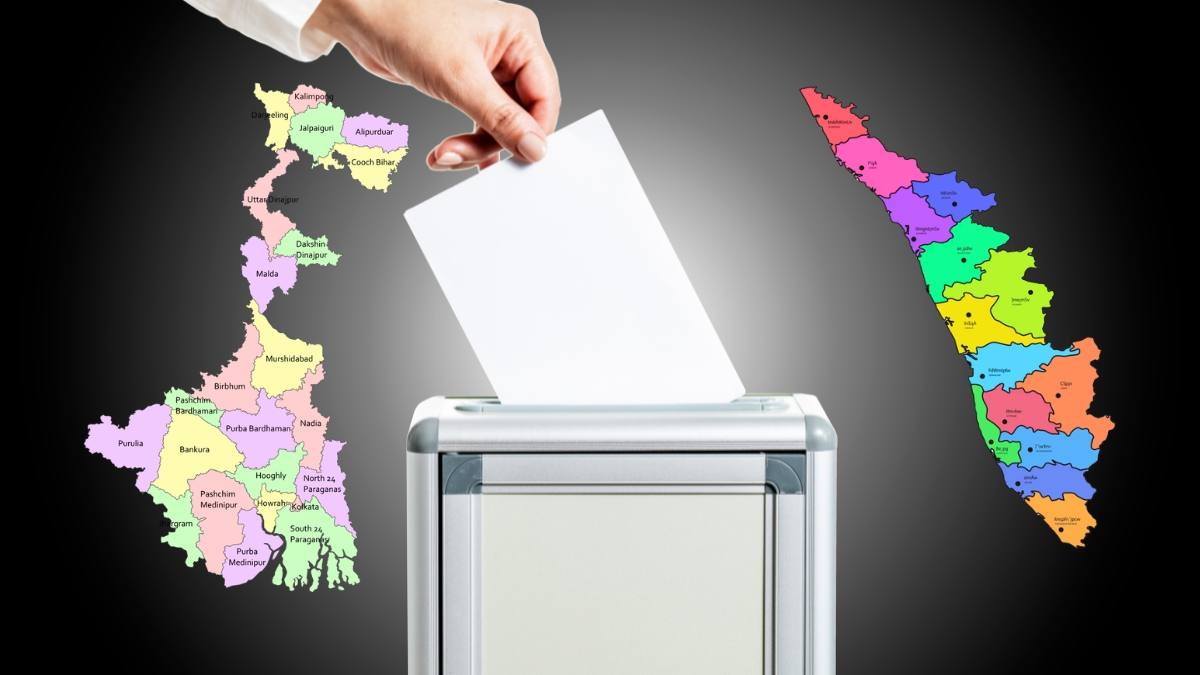
Kerala and West Bengal Elections 2026: A Battle Beyond Ballots
India’s 2026 assembly elections in Kerala and West Bengal are not just routine political exercises. They are unfolding as decisive contests that could shape regional politics, influence national narratives, and test the strength of political ideologies in two of India’s most politically aware states.
Both states have historically followed distinct political paths. Kerala has largely alternated between alliances, while West Bengal has seen long phases of dominance by single political forces. The upcoming elections, however, present a more complex picture, marked by evolving voter expectations, aggressive campaigning, and shifting political strategies.
Election Schedule and Context
The Election Commission of India has scheduled the 2026 assembly elections across several states, including Kerala and West Bengal, in April. Kerala will vote in a single phase, while West Bengal will see polling in two phases on April 23 and April 29, with counting scheduled for early May. (The Indian Express)
These elections come at a time when India is navigating economic pressures, global uncertainties, and internal political recalibrations. As a result, the stakes are high, not only for the parties contesting but also for the larger democratic narrative.
Kerala: Can the Left Make History?
KERALA – HISTORICAL RESULTS
Kerala Assembly Election Results Comparison
| Year | LDF (Left) | UDF (Congress-led) | NDA (BJP-led) | Others | Total Seats |
| 2016 | 91 | 47 | 1 | 1 | 140 |
| 2021 | 99 | 41 | 0 | 0 | 140 |
Key Insight:
- LDF made history in 2021 by winning 99 seats and retaining power, breaking Kerala’s traditional alternating pattern. (Wikipedia)
- UDF weakened slightly, while BJP lost its only seat.
Kerala’s political landscape is dominated by two major alliances. The ruling Left Democratic Front led by Chief Minister Pinarayi Vijayan is seeking an unprecedented third consecutive term. This itself is unusual in a state known for its tradition of alternating governments. (The Economic Times)
The Left government is projecting what it calls a governance model based on welfare schemes, infrastructure development, and administrative efficiency. Supporters argue that it has provided stability and continuity in governance.
However, the challenge before the LDF is significant. There are growing concerns about anti-incumbency, economic constraints, and the sustainability of welfare programmes. Critics argue that there is a gap between policy announcements and ground realities.
The Congress-led United Democratic Front sees this as an opportunity. It is positioning itself as a credible alternative, promising enhanced welfare measures, including higher pensions and expanded social support schemes. (The Times of India)
At the same time, the Bharatiya Janata Party, though historically weaker in Kerala, is attempting to expand its presence. Certain constituencies, such as Nemom, are emerging as key battlegrounds where a three-way contest is expected. (The Indian Express)
The election in Kerala is therefore not just about who forms the government. It is also a referendum on whether continuity can overcome the state’s long-standing pattern of political change.
KERALA – 2026 SEAT PROJECTION
Kerala 2026 Seat Projection (Estimated Trends)
| Alliance | Projected Seats Range | Notes |
| LDF | 75 – 95 | Strong base, but facing mild anti-incumbency |
| UDF | 40 – 60 | Trying comeback with welfare promises |
| NDA | 0 – 5 | Limited but attempting expansion |
Interpretation:
- LDF still ahead but reduced margin likely
- UDF’s chances depend on vote consolidation
- BJP may improve vote share but seats uncertain
West Bengal: A High-Intensity Contest
WEST BENGAL – HISTORICAL RESULTS
West Bengal Assembly Election Results Comparison
| Year | TMC | BJP | Congress | Left | Others | Total Seats |
| 2016 | 211 | 3 | 44 | 26 | 10 | 294 |
| 2021 | 213 | 77 | 1 | 0 | 3 | 294 |
Key Insight:
- TMC retained dominance with 213 seats in 2021 (Wikipedia)
- BJP surged dramatically from 3 to 77 seats (Wikipedia)
- Left and Congress collapsed electorally
If Kerala represents a structured political contest, West Bengal represents a charged and intense battle.
The state is witnessing a direct confrontation between the ruling Trinamool Congress led by Mamata Banerjee and the Bharatiya Janata Party, which is making a strong push to gain power. (Wikipedia)
The BJP has made it clear that it will campaign in the name of Prime Minister Narendra Modi, even without projecting a clear chief ministerial candidate. (The Times of India)
On the other hand, the Trinamool Congress is focusing on its governance record, welfare schemes, and regional identity. However, the campaign has been marked by allegations, counter-allegations, and concerns over electoral practices.
Recent developments have highlighted the intensity of the contest. The Election Commission has taken strict action against officials over law and order issues during political events, indicating the sensitivity of the situation. (The Times of India)
There are also concerns about voter list management, with allegations of irregularities and fears that some voters may lose their voting rights due to administrative delays. (The Times of India)
These developments reflect a larger issue. Elections in West Bengal are not just about governance but also about political dominance, identity, and control of the narrative.
WEST BENGAL – 2026 SEAT PROJECTION
West Bengal 2026 Seat Projection (Estimated Trends)
| Party | Projected Seats Range | Notes |
| TMC | 190 – 230 | Still dominant, strong rural base |
| BJP | 60 – 100 | Main challenger, fluctuating support |
| Congress + Left | 5 – 20 | Limited revival possibility |
| Others | 0 – 5 | Minimal impact |
Interpretation:
- Contest remains bipolar: TMC vs BJP
- Even a 2–3% vote swing can flip 20–30 seats
- Around 35 seats were close contests in 2021 (The Times of India)
Key Issues Shaping the Elections
Across both states, certain themes are emerging as central to the campaigns.
1. Welfare vs Fiscal Reality
All major parties are promising welfare schemes, from pensions to subsidies. However, voters are increasingly questioning whether these promises are financially sustainable.
2. Governance and Credibility
In Kerala, the focus is on administrative performance. In West Bengal, the debate revolves around law and order, corruption, and institutional integrity.
3. Identity and Narrative
West Bengal’s election is heavily influenced by questions of regional identity and political ideology. Kerala, while more policy-driven, also reflects ideological debates, particularly within Left politics. (The Times of India)
4. National Influence
The presence of national leaders in campaigning highlights the growing overlap between state and national politics. The outcome of these elections will be closely watched across the country.
Key Swing Factor Table
Key Swing Factors – Kerala vs Bengal
| Factor | Kerala | West Bengal |
| Political Pattern | Alternating traditionally | Dominance with strong challenger |
| Main Contest | LDF vs UDF | TMC vs BJP |
| Role of BJP | Emerging | Strong challenger |
| Key Issue | Governance & welfare | Identity, power, law & order |
| Swing Seats | Moderate | High (many close contests) |
The Voter at the Centre
Despite the noise of political campaigns, the real focus remains on the voter.
In Kerala, voters are weighing stability against the desire for change. In West Bengal, they are navigating a highly polarised environment while deciding their political future.
There is also a generational shift. Younger voters are increasingly looking at issues such as employment, development, and quality of life rather than purely ideological considerations.
At the same time, traditional factors such as caste, community, and local leadership continue to play a role, especially in closely contested constituencies.
VOTE SHARE INSIGHT
- TMC vote share in 2021: ~48%
- BJP vote share: ~38% (India Today)
Meaning:
Even with a 10% gap, BJP still won 77 seats
Shows high polarisation + efficiency of vote distribution
Beyond the Results
The significance of these elections goes beyond who wins or loses.
In Kerala, a third consecutive term for the Left would redefine the state’s political pattern. In West Bengal, a change in power would mark a major shift in the state’s political history, while a continuation would reinforce the current leadership.
More importantly, these elections reflect the evolving nature of Indian democracy. Voters today are more informed, more vocal, and more demanding. Political parties are being forced to adapt, not just in their promises but in their approach to governance.
The Kerala and West Bengal elections of 2026 are not merely contests for power. They are reflections of changing political dynamics, shifting voter expectations, and the ongoing dialogue between governance and ideology.
As the campaigns intensify and polling dates approach, one thing remains certain. The outcome will not only determine the future of these two states but will also offer insights into the direction in which Indian politics is moving.
In the end, it is not just about who wins the election. It is about how the mandate is earned and what it represents for the people.