


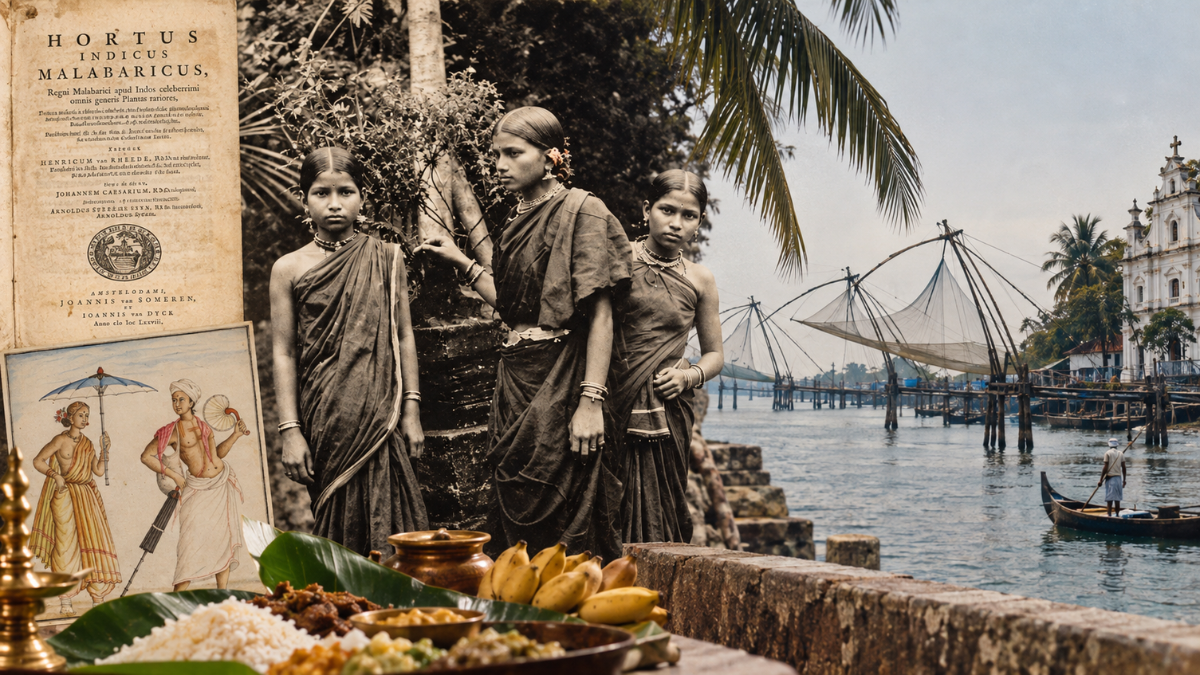
Konkani in Kerala: Memory, Migration and a Living Cultural Tradition.
By V. Rajesh Mohan Rao
A language often travels farther than the people who speak it. When communities move from one place to another, they carry not only their words but also their memories, food, customs, stories and ways of living. The history of Konkani is a good example of such a journey.
Konkani is spoken in different parts of India, particularly along the western coast. Goa, Karnataka, Kerala and Maharashtra have important Konkani-speaking communities, while people with Konkani linguistic and cultural backgrounds are also found in other parts of the country. The spread of the language is closely connected with migration, trade, social movements and the changing history of the Konkan region.
Kerala has its own place in this long story.
For generations, Konkani-speaking families have been part of Kerala’s social and cultural life, particularly in and around Kochi. Over time, they have lived alongside Malayalam-speaking communities and participated in the wider life of Kerala. Their presence is a reminder that the cultural history of Kerala has never been created by one language alone.
The story becomes more interesting when we look at the everyday life of these communities. Language is heard at home and in places of worship, but culture is also experienced through food, festivals, family traditions, literature and relationships with neighbouring communities.
Among the important figures connected with the intellectual history of Konkani is N. Purushotham Mallya. A scholar, poet and historian, he devoted a substantial part of his life to Konkani language and cultural studies. His work belongs to a period when preserving linguistic history depended greatly on the patience of individual scholars who collected, studied and documented materials for future generations.
The importance of such work becomes clear when we consider the complicated history of Konkani itself. The language has developed across different geographical regions and has been written in more than one script. Devanagari has an important role in modern Konkani literature, while other scripts have also been used by different Konkani-speaking communities. This diversity reflects the historical movement of the language rather than a lack of unity.
The constitutional recognition of Konkani as one of the languages included in the Eighth Schedule in 1992 was another significant stage in this history. It gave greater national recognition to a language whose speakers were spread across different states. Konkani’s recognition also reflected the broader linguistic character of India, where language communities do not always correspond neatly to political boundaries.
Migration is central to understanding this history.
Different Konkani-speaking communities moved from the Konkan region to places along the western and southern coast during different periods. The Gaud Saraswat Brahmin community, among other Konkani-speaking groups, has an important place in this history. As communities settled in new places, they adapted to local circumstances while retaining aspects of their linguistic and cultural heritage.
Kerala provided one such cultural space.
In Kerala, Konkani traditions encountered Malayalam and the many other cultural traditions already present in the state. This interaction did not simply replace one culture with another. Instead, it created forms of coexistence that can be seen in language, food, social relationships and religious life.
Food perhaps provides one of the most visible examples of this cultural memory.
Traditional Konkani dishes associated with different communities include dalitoy, gheshi, valval, ambatt, bibbya upkari, modak, saatta, surnoli and godshe. These foods are more than recipes. They often carry memories of family, festivals and places from which earlier generations came.
At the same time, Konkani-speaking families living in Kerala have naturally encountered Kerala’s own food traditions—puttu, appam and stew, parotta, idli, dosa, idiyappam and the traditional sadya. Such interaction between food traditions is a small but meaningful example of how cultures live together in everyday life.
The same can be seen in the religious and social landscape. Konkani-speaking communities have maintained their own institutions and traditions while participating in the larger social life around them. Kerala’s temples, churches and mosques, educational institutions and neighbourhoods have historically brought people from different linguistic and cultural backgrounds into contact with one another.
This is why the history of Konkani in Kerala should not be viewed only as the history of a minority language. It is also part of Kerala’s wider social history.
The contribution of scholars such as N. Purushotham Mallya becomes particularly meaningful in this context. When a language has travelled through several regions and communities, documentation becomes essential. Without written records, historical memories can gradually disappear.
A language survives first through its speakers. But long-term survival also depends on reading, writing, teaching, publishing and documentation.
This challenge is particularly relevant today.
Young people belonging to smaller linguistic communities often live in an environment dominated by larger languages. Education, employment and digital communication naturally encourage the use of widely spoken languages. There is nothing unusual about this process. Yet it also raises an important question: how can a community maintain its linguistic memory while participating fully in modern society?
Digital technology provides some new possibilities. Websites, online magazines, digital archives and social media can make Konkani literature and cultural materials accessible to people who may live far away from traditional centres of the community. A story, poem, historical document or oral memory can now reach readers in another city or even another country.
But technology by itself cannot keep a language alive.
People must continue to use the language. Families must speak it. Writers must write it. Readers must read it. Teachers and cultural organisations must create opportunities for younger generations to encounter it. Universities, libraries and archives can also contribute by documenting literature and historical materials.
The experience of Konkani in Kerala offers an important lesson in this regard. A language can retain its identity while living alongside another dominant language. Cultural adaptation does not necessarily mean cultural disappearance. Communities can adopt new influences while continuing to preserve older memories.
This is visible in the lives of Konkani-speaking people who have made Kerala their home. Their identity may contain memories of Goa, Karnataka, Maharashtra or the wider Konkan region, while their everyday experiences are deeply connected with Kerala. Over generations, these different geographical memories can become part of a single lived cultural experience.
The life and scholarship of N. Purushotham Mallya can be understood within this larger journey. His contribution was not simply about preserving words. It was about recording a cultural world and making it available for those who would come later.
Remembering such scholars is therefore important not only to Konkani speakers but also to anyone interested in India’s linguistic history.
India’s linguistic diversity exists in ordinary places, in homes, markets, schools, places of worship, kitchens and neighbourhoods. Languages meet one another every day. People borrow words, share food, develop friendships and create new cultural practices. These interactions rarely appear in official histories, but they are an essential part of the country’s social history.
Konkani in Kerala is one such story.
It is a story of movement, settlement, adaptation and memory. It is also a story of how a language can travel across geographical boundaries and continue to carry the memories of its speakers.
The responsibility of preserving that memory belongs not only to the community itself. Writers, researchers, educational institutions, cultural organisations and the media all have a role in ensuring that smaller linguistic traditions are documented and given space.
The future of Konkani will ultimately depend on its continued use by new generations. If young people can see their language not merely as something inherited from their grandparents but as a language capable of expressing contemporary literature, ideas, experiences and creativity, its future can remain connected to both its history and the present.
The journey of Konkani from the Konkan coast to Kerala and other parts of India is therefore more than a story of migration. It is a story of cultural continuity.
Every language carries memories. When those memories are recorded, read and passed from one generation to another, they become part of the larger history of a country.
N. Purushotham Mallya’s work belongs to that continuing effort to preserve such a history.