


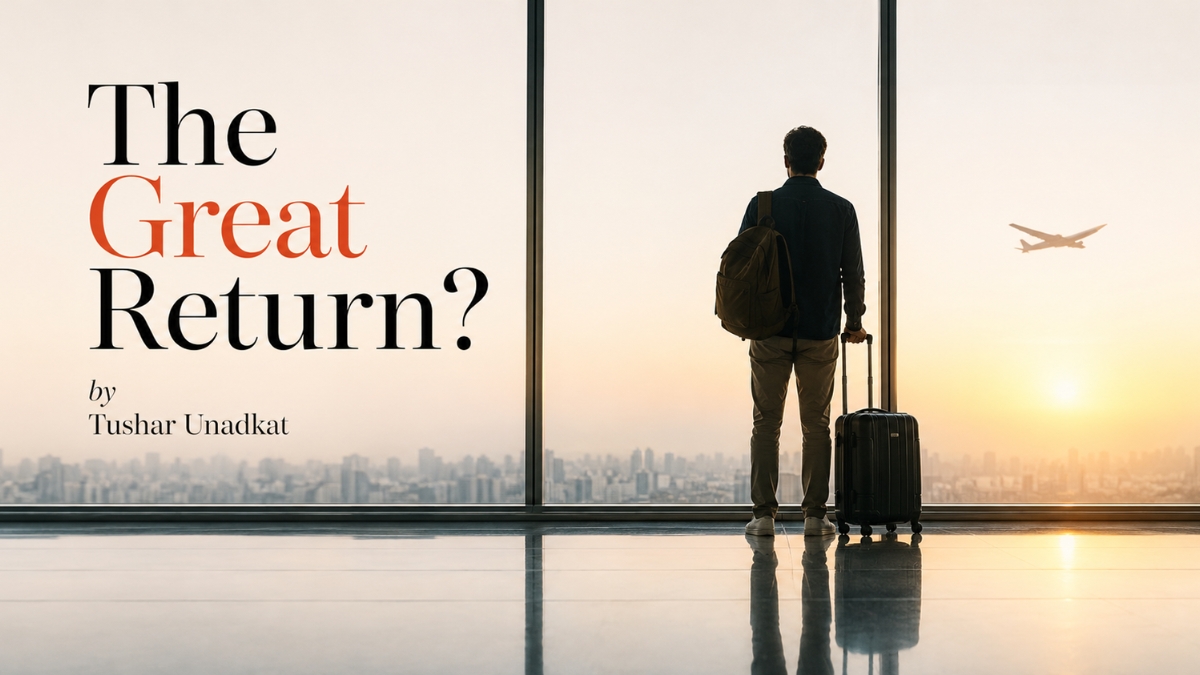
After decades of building lives abroad, a growing number of Indians are looking back toward home. But returning to India is not simply a journey across borders. It is a journey back to a version of ourselves that may no longer exist.
For years, the dream was simple.
Leave India.
Study abroad. Build a career. Buy a home. Secure a passport. Give your children opportunities you never had. Send money home. Visit every summer, every Diwali, every wedding. Keep one foot in India while building the rest of your life somewhere else.
For generations of Indians, migration was synonymous with progress.
The farther you went, the more successful the story seemed.
London. Toronto. New York. Dubai. Melbourne. Singapore.
Home became the place you left behind.
Now something curious is happening.
Some Indians are beginning to turn around.
Not necessarily because they failed abroad.
Not because India suddenly became perfect.
And certainly not because the diaspora dream was a mistake.
They are returning for something harder to measure: parents getting older, children growing up without knowing the India their parents remember, the desire to build something closer to home, the exhaustion of living permanently between cultures—or simply the quiet realization that after spending decades searching for a better life, they have begun asking a different question:
What does a meaningful life actually look like?
That may be the beginning of a new chapter in the Indian diaspora story.
But perhaps we should call it something other than reverse migration.
Because people are not simply moving back.
They are coming home to a country that has changed.
And, often, to a self that has changed even more.
The country we left is not the country we remember
Every immigrant carries two Indias.
There is the India that exists on the map.
And then there is the India preserved in memory.
It is the smell of monsoon rain on hot pavement. The sound of a pressure cooker in the kitchen. A mother calling from another room. Cousins arriving without calling first. Neighbors knowing everyone’s business. Weddings that seem to involve half the city. Street food eaten standing beside a car. Grandparents whose homes were always open.
For someone who left India twenty or thirty years ago, that India can become almost sacred.
But memory freezes places. For the third, it can become a question. Countries do not stay frozen.

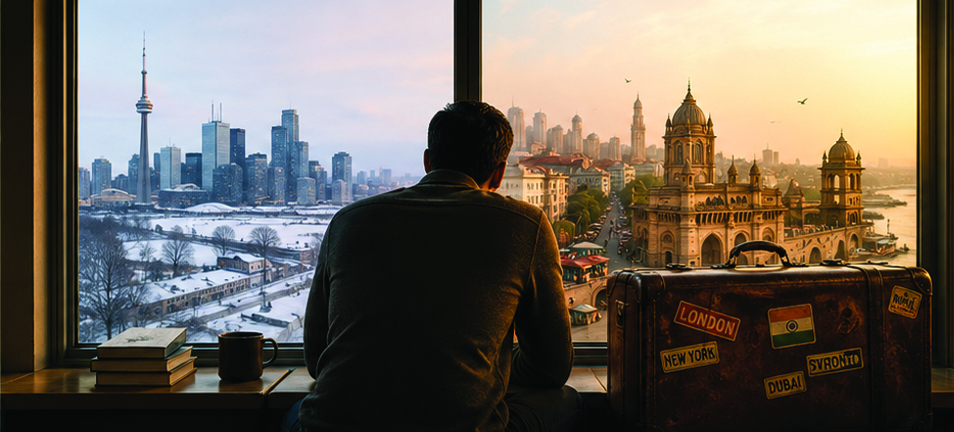
The India that many members of the diaspora left behind in the 1980s, 1990s or early 2000s has been transformed by technology, infrastructure, entrepreneurship, consumer culture and a new generation of globally connected Indians.
India now has an enormous startup ecosystem, global capability centers, sophisticated digital infrastructure and a rapidly expanding middle and affluent class.
The economic argument for returning is therefore different from what it was a generation ago.
A professional who once had to leave India to access opportunity may now be able to build a globally relevant company from Bengaluru, Hyderabad, Mumbai, Delhi, Ahmedabad or Chennai.
A researcher can collaborate across continents without permanently relocating.
An entrepreneur can raise capital internationally while operating in India.
A family can remain globally connected without necessarily being geographically divided.
India is no longer simply the country from which talent departs.
Increasingly, it is also a country that talent can return to.
But there is a catch.
You can return to a country. You cannot necessarily return to a past.
The parents waiting at home
Perhaps the most powerful reason people return has nothing to do with GDP.
It is a face.
A mother who has grown older.
A father whose voice sounds a little weaker on the phone.
A birthday missed.
A hospital visit attended through WhatsApp video.
The diaspora has mastered the technology of presence without physical presence.
We can send money in seconds.
Order groceries for our parents.
Book their medical appointments.
Arrange a driver.
Send flowers.
Attend a family ceremony through a screen.
But there is one thing technology cannot completely solve:
being there.
The arithmetic of migration changes as parents age.
When you are 25, being 8,000 miles away can feel like freedom.
At 55, it can feel like a distance you suddenly notice.
The question is no longer:
Where can I earn the most?
It becomes:
How many more years do I have with them?
That is a very different calculation.
And it is one that no immigration consultant, financial planner, or career coach can make for you.
Then there are the children.
For the first generation, India is memory.
For the second, it is inheritance.
For the third, it can become a question.
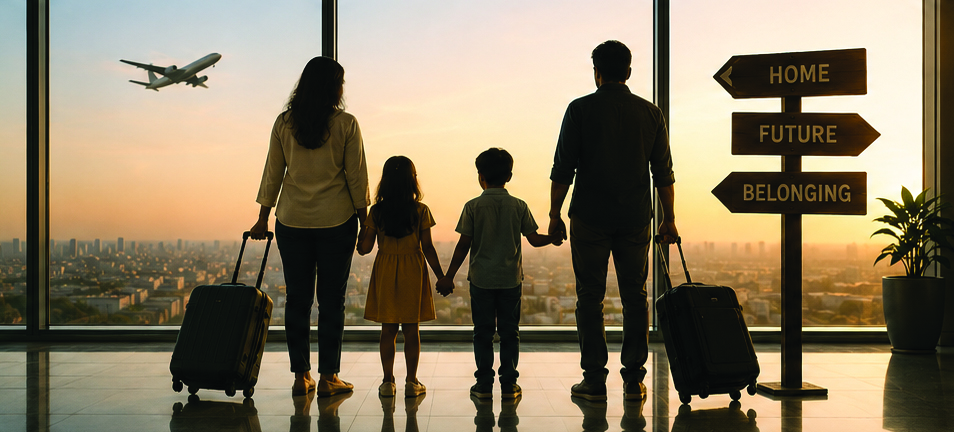
Children born in Toronto, London, New York, Dubai or Melbourne may know India through grandparents, food, weddings, Bollywood, cricket, Instagram and summer holidays.
But what happens when those connections become thinner?
What happens when the grandparents are gone?
What happens when the children no longer speak the language?
Some parents are beginning to wonder whether cultural inheritance can survive entirely through annual vacations and family WhatsApp groups.
For them, returning is not necessarily about giving their children “a more Indian upbringing.”
It is about allowing them to experience something that cannot be taught in a classroom:
belonging.
But there is another irony.
The children may not want to return.
And the parents who spent their youth trying to give their children global opportunities may discover that their children feel most at home somewhere else.
The great return, therefore, may become a negotiation between generations.
The immigrant’s paradox
There is a particular cruelty in migration.
You leave because you want a better life.
Then you spend years building that life.
Eventually, you become successful enough to miss the life you left.
That is the immigrant paradox.
The more established you become abroad, the more complicated returning can be.
You have a mortgage.
A career.
Children.
Friends.
Citizenship.
A social network.
A professional identity.
Perhaps elderly parents in India.
Perhaps property.
Perhaps investments.
You are no longer simply Indian.
But you are not entirely something else either.
You have become something in between.
A global Indian.
And that identity changes the meaning of home.
Returning is not the same as belonging
This is where the romantic version of the return story breaks down.
India can feel exhilarating when you arrive after years abroad.
The food tastes better.
Family feels closer.
Life can feel richer, louder, warmer.
But after the holiday ends, the differences become visible.
Traffic.
Bureaucracy.
Pollution.
Noise.
Professional hierarchies.
Infrastructure gaps.
Social expectations.
Privacy.
Gender roles.
Work culture.
The absence of systems that immigrants may have come to rely upon abroad.
One recent study of Indian return migration found precisely this tension: some returnees successfully reintegrated and built businesses, while others experienced unemployment, stigma, frustration and difficulty adapting to economic and social conditions after returning.
And perhaps most revealingly, research published in 2026 on Indian scientists and engineers found that return decisions are shaped by a complex mix of family, career opportunities, entrepreneurship, immigration pressures, and cultural affinity. Those who remain abroad, meanwhile, often cite stronger career prospects, better work environments, and a higher quality of life.
There is no universal answer.
There is only a personal one.
The returnee is not coming back empty-handed
For decades, the phrase “brain drain” described the Indian who left.
But perhaps we have misunderstood the transaction.
People who leave India don’t necessarily stop being connected to India.
They carry knowledge.
Networks.
Capital.
Ideas.
Professional standards.
Relationships.
Cultural fluency.
They learn how another country works, and then bring that knowledge into conversations with home.
The returnee can therefore become something more interesting than a migrant who has reversed direction.
They can become a bridge.
Interestingly, new research on Indian high-tech startups complicates the traditional belief that returning diaspora entrepreneurs automatically outperform domestic founders. A 2026 Observer Research Foundation study found that domestically founded teams were more strongly associated with funding, valuation and revenue outcomes, while returnees often contributed more effectively as accelerators and collaborators within locally founded ventures.
That finding matters.
Because perhaps the future of the diaspora is not:
Leave. Return.
It is:
Leave. Learn. Connect. Build. Return when—and if—it makes sense.
Home does not have to be a binary choice.
India may not be asking us to come back permanently
This may be the biggest change of all.
The old migration model was binary.
You were either in India or abroad.
The new Indian diaspora is increasingly transnational.
Someone might live in Toronto, run a company in Bengaluru, invest in Ahmedabad, spend three months in Dubai and visit family in Mumbai.
A scientist might work between Boston and Hyderabad.
An entrepreneur might raise capital in London and build a team in India.
A retired couple might divide their year between Vancouver and Goa.
A second-generation Indian might live in Melbourne but spend every summer in Delhi with their grandparents.
The question is no longer simply:
Where do you live?
It is:
Where do you belong, where do you contribute, and where do you want to spend the years that matter most?
That is a much more complicated—and much more interesting—definition of home.
Perhaps the real return is emotional.
There is a danger in romanticizing the movement back to India.
Not everyone should return.
For some, the country they built their lives in truly is home.
For others, returning may expose rather than resolve the loneliness they carried abroad. Recent accounts of young Indians returning after years overseas have highlighted precisely this phenomenon: coming back can bring unexpected feelings of disconnection because the person returning is no longer the person who left.
That may be the most important truth in this entire conversation.
Home changes because we change.
The India you miss may not exist anymore.
And the person who misses it may not exist either.
Yet something survives.
A language.
A recipe.
A song.
A childhood street.
A parent’s voice.
A memory of sitting on a balcony during a summer evening.
A sense that somewhere, underneath the passports and professions and carefully constructed lives, there is a place that still knows your original name.
Maybe that is why people return.
Not because India has become perfect.
Not because life abroad has become unbearable.
But because success eventually forces us to ask questions that money cannot answer.
Where do I want to grow old?
Who do I want around my table?
What do I want my children to remember?
Whose funeral do I want to be able to attend?
What will I regret more: leaving a comfortable life, or missing the remaining years of the people who gave me my first one?
And perhaps the most difficult question of all:
If I spend my entire life building a life somewhere else, at what point does “someday I’ll go home” become a promise I can no longer keep?
The Great Return?
Maybe there won’t be one.
Maybe millions of Indians will continue building extraordinary lives abroad.
Maybe others will return permanently.
Some will return temporarily.
Some will move back and leave again.
Some will never return physically but will invest, mentor, create, teach, and build from thousands of kilometers away.
The next chapter of the Indian diaspora may therefore not be defined by one-way migration.
It may be defined by mobility.
India is changing.
The diaspora is changing.
And the meaning of home is changing with them.
For the first generation of migrants, home was somewhere they left.
For their children, it may be somewhere they visit.
For the next generation, perhaps home will no longer be a single country at all.
It will be a network of people, memories, opportunities and relationships stretching across continents.
And somewhere within that network will always be India.
Waiting.
Not necessarily for us to come back.
But perhaps for us to finally understand that leaving home and returning to it are not opposite journeys.
Sometimes, they are two parts of the same story.
Images by DALL-E
References
- India’s Ministry of External Affairs — Population of Overseas Indians
- Observer Research Foundation — The Indian Returnee Paradox
- SAGE — Why Stay, Why Return: Mobility Choices of Indian Scientists and Engineers
- Comparative Migration Studies — Indian Return Migration Research.
- Financial Times — India raises $40bn from diaspora