



I. The Quiet Shift in Global Power
In 2026, power no longer looks the way it used to.
It is less about borders and more about networks. Less about geography and more about access. Less about where you are from and more about where you are positioned.
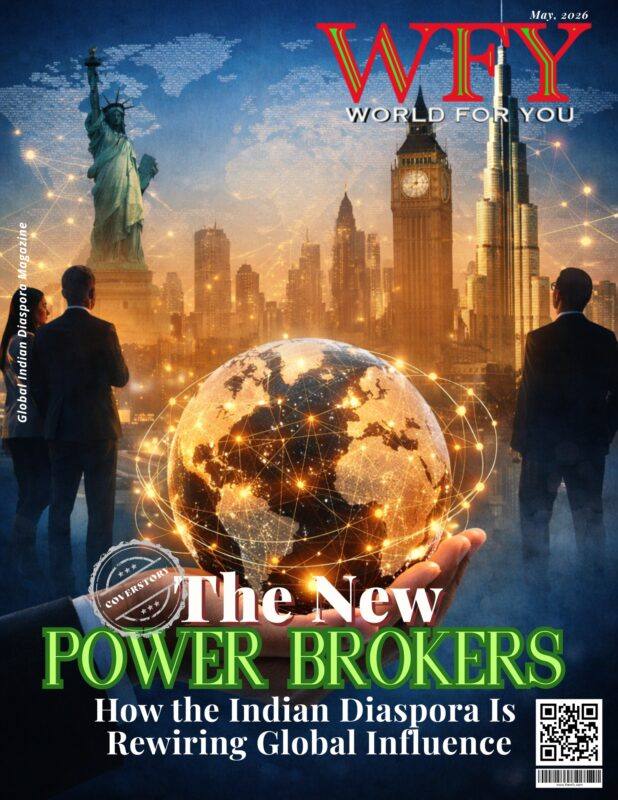
And in this evolving architecture of influence, few networks are as expansive—or as quietly consequential—as the Indian diaspora.
Numbering over 35 million people worldwide, including approximately 18.5 million first-generation migrants, the Indian diaspora is the largest transnational community of its kind (Ministry of External Affairs, Government of India; World Bank migration data).
For decades, its story has been told in familiar terms: a narrative of migration, resilience, and upward mobility. It is a story of engineers, doctors, entrepreneurs, and CEOs. A story of integration and achievement.
But that story is no longer sufficient.
What we are witnessing today is something more profound. The Indian diaspora is no longer simply participating in global systems—it is increasingly shaping them.
From boardrooms to venture capital networks, from artificial intelligence labs to cultural industries, the diaspora has moved from presence to influence.
This is not just a story about success.
It is a story about power.
II. From Migration to Multiplication
The early waves of Indian migration were shaped by necessity—labor mobility, post-colonial displacement, and the search for economic opportunity. Later, policy shifts such as the U.S. Immigration and Nationality Act of 1965 opened doors for skilled migration, particularly in science, medicine, and engineering.
Over time, these migrants built something more enduring than individual success.
They built networks.
Professional associations, alumni groups, family ties, and informal mentorship systems created dense webs of connection across continents. These networks enabled not just survival, but acceleration.
Today, those same networks underpin a far more powerful reality: the multiplication of influence across borders.
One of the clearest indicators of this influence is financial.
India has remained the world’s largest recipient of remittances, receiving over $135 billion in 2024–25, according to Reserve Bank of India (RBI) data.
This accounts for roughly 14% of global remittance flows, a remarkable concentration of transnational capital.
But remittances tell only part of the story.
Increasingly, diaspora capital is moving beyond household transfers into venture investment, startup funding, and cross-border entrepreneurship. Indian-origin investors are active in Silicon Valley, London, Toronto, Singapore, and Dubai—often acting as bridges between global capital and Indian innovation.
The result is a feedback loop:
- Talent flows outward
- Capital flows inward
- Ideas circulate globally
The diaspora is no longer exporting talent.
It is exporting—and recycling—influence.
III. The CEO Era—and What Comes After
The rise of Indian-origin CEOs has been one of the most visible markers of diaspora success.
Leaders such as Sundar Pichai, Satya Nadella, Arvind Krishna, Shantanu Narayen, and Neal Mohan represent an unprecedented concentration of leadership at the highest levels of global business.
For years, this was seen as the pinnacle of diaspora achievement.
But it may, in fact, represent a transition point—not an endpoint.
The CEO era was about integration into existing power structures.
What is emerging now is the creation of new ones.
Indian-origin founders are building companies that operate across geographies from inception. Venture capitalists are backing global startups while maintaining deep ties to India. Diaspora networks are actively shaping startup ecosystems in cities like Bangalore, Toronto, London, and Dubai.
Research from institutions such as Stanford and Harvard has consistently shown that immigrants—and particularly Indian-origin entrepreneurs—play an outsized role in startup creation and innovation in the United States.
This shift—from leadership within systems to ownership of systems—marks a fundamental change.
It is no longer about representation.
It is about control.
IV. The AI Moment—and Diaspora Acceleration
If there is one force accelerating the diaspora’s influence, it is artificial intelligence.
AI has become the defining technological battleground of the 21st century, concentrating power in a handful of companies and ecosystems. Within those ecosystems, Indian-origin leaders, engineers, and researchers are highly represented.
But the significance of this presence goes beyond numbers.
AI is inherently network-driven. It depends on:
- high-skill talent pools
- access to capital
- cross-border collaboration
All areas where diaspora networks excel.
Indian engineers are deeply embedded in leading AI labs and companies, while Indian founders are building AI startups that leverage both global funding and Indian technical talent.
This dual positioning creates a strategic advantage:
- access to advanced markets
- scalability through distributed teams
- cost efficiency without compromising expertise
It also enables diaspora actors to influence both innovation and deployment.
In practical terms, this means the diaspora is not just participating in the AI revolution—it is helping to shape its trajectory.
V. Culture as Power: The Soft Influence Revolution
For decades, diaspora influence was measured primarily in economic terms.
That framework is now incomplete.
Cultural power—once secondary—is becoming central to global influence.
Streaming platforms, social media, and digital content have transformed how stories travel. Indian-origin creators are increasingly shaping global narratives across film, television, comedy, literature, and fashion.
Figures like Mindy Kaling and Dev Patel have contributed to a shift in representation, while artists like Diljit Dosanjh have taken South Asian cultural expression to global stages.
Meanwhile, South Asian aesthetics in fashion, beauty, and cuisine are gaining mainstream visibility. Publications such as Vogue Business have documented the growing global influence of South Asian design and streetwear.
This is not simply about visibility.
It is about reinterpretation.
Second- and third-generation diaspora voices are reshaping what it means to be “Indian” in a global context—moving beyond stereotypes toward more layered, complex narratives.
Culture shapes perception.
And perception shapes power.
VI. The Return Loop: Capital, Identity, and Reconnection
One of the most important shifts in the diaspora story is the emergence of what might be called the return loop.
Historically, migration was seen as a one-way journey.
Today, it is increasingly multidirectional.
Diaspora individuals are:
- investing in Indian startups
- mentoring founders
- launching cross-border ventures
- in some cases, returning to India
This is not simply a return—it is a re-engagement.
India’s economic growth, expanding startup ecosystem, and digital infrastructure have made it an attractive destination for diaspora capital and expertise.
According to reports by Indiaspora and other policy organizations, diaspora engagement is increasingly focused on investment, philanthropy, and policy collaboration, rather than just remittances.
This creates a powerful cycle:
- Global experience flows into India
- Innovation scales within India
- Diaspora networks amplify it globally
The result is a system that is both national and transnational at once.
VII. Identity Without Borders
Beyond economics and culture lies a deeper transformation: identity.
For earlier generations, identity was often defined by distance—between homeland and host country.
For younger generations, identity is fluid.
They are not choosing between being Indian and being American, British, or Canadian. They are navigating hybrid identities that reflect multiple influences simultaneously.
This creates new forms of expression:
- cross-cultural storytelling
- global professional identities
- transnational communities
But it also introduces tension.
Questions of belonging, authenticity, and representation remain complex. Diaspora individuals often navigate expectations from multiple directions—family, society, and self.
At the same time, rising nationalism and shifting immigration policies in many countries have made identity more politically charged.
The diaspora is more visible than ever.
And therefore, more scrutinized.
VIII. The Backlash Factor
Influence rarely expands without resistance.
As the Indian diaspora’s presence grows across sectors, it increasingly intersects with broader global debates—immigration, economic competition, cultural identity, and geopolitical alignment.
This has led to:
- tighter immigration discussions in Western economies
- scrutiny of high-skilled visa programs
- debates about representation and access
These tensions are not unique to the Indian diaspora, but its scale and visibility make it a focal point.
Navigating this environment will require balance.
The diaspora’s strength lies in its ability to operate across systems. That strength will be tested in an era of rising fragmentation.
IX. Beyond Success: Toward Stewardship
The most important shift may not be economic—but philosophical.
The first phase of diaspora growth was about success.
The next phase is about stewardship.
What does it mean to hold influence responsibly across borders?
How should diaspora leaders engage with global challenges—climate change, inequality, technological ethics?
There are early signs of this transition:
- increased philanthropic initiatives
- mentorship networks
- cross-border policy engagement
But the scale of diaspora influence now demands greater intentionality.
The diaspora is no longer an outsider.
It is part of the system.
And with that comes responsibility.
X. The Future: A Distributed Power Network
The trajectory is clear.
The Indian diaspora is evolving into a distributed global power network.
It is:
- decentralized
- interconnected
- adaptive
It connects capital, talent, and ideas across borders in ways that traditional institutions cannot.
This represents a new model of influence:
- not hierarchical, but networked
- not territorial, but transnational
- not static, but dynamic
In this model, the diaspora is not just participating in global change.
It is leading it.
XI. Conclusion: A New Narrative
For decades, the story of the Indian diaspora followed a familiar arc: migration, struggle, success.
That narrative no longer captures the full picture.
The new story is more complex—and more consequential.
It is about systems, not just individuals.
Influence, not just achievement.
Connection, not just identity.
The Indian diaspora is no longer simply part of the global story.
It is helping write it.

References
- Ministry of External Affairs, Government of India
- World Bank – Migration and Remittances Data
- Reserve Bank of India – Remittance Data
- Indiaspora Reports
- Stanford Graduate School of Business – Immigrant Entrepreneurship
- McKinsey Global Institute
- OECD Migration Outlook
- Vogue Business – South Asian cultural influence