


By Ritabhari Chatterjee, WFY Bureau | Lifestyle | The WFY Magazine, February 2026 Edition
And how friendship is quietly becoming the celebration
It does not always begin with disappointment.
Sometimes it begins with exhaustion.
By early February each year, the language around Valentine’s Day becomes impossible to avoid. Restaurants advertise fixed menus. Online platforms push gift guides. Social media fills with images of flowers, surprises, declarations. For many, the day is pleasant enough. For others, it carries a familiar weight: expectation, comparison, and the sense that one’s emotional life is being publicly measured.
In recent years, a growing number of women have begun to step sideways from that pressure. Not by rejecting romance altogether, and not by framing themselves against it, but by choosing to celebrate something else alongside it. Friendship. Presence. Time shared without performance.
This choice has increasingly found a name: Galentine’s.
What began as a light cultural reference has slowly settled into something more grounded. For women across age groups, relationship statuses, and geographies, Galentine’s has become a way to reclaim agency over how connection is marked, and who it centres.
What Galentine’s Means, and where it comes from
At its simplest, Galentine’s refers to a celebration of friendship among women, usually observed around Valentine’s Day. It is often marked on 13 February, but the date itself is not essential. The emphasis is not on romance, gifts, or grand gestures, but on companionship and shared experience.
The term first entered popular usage through Western television in the early 2010s, but its wider appeal has less to do with pop culture and more to do with timing. As social expectations around relationships have shifted, the idea of celebrating non-romantic bonds has felt increasingly relevant.
Importantly, Galentine’s is not positioned as an alternative for those without partners. Many women who participate are married, in long-term relationships, or otherwise content in their personal lives. The distinction lies not in what is absent, but in what is being foregrounded.
Friendship, in this framing, is not a placeholder. It is the point.
Why Valentine’s Day feels different now
To understand the rise of Galentine’s, it helps to look at how Valentine’s Day itself is experienced today.
Romantic relationships are no longer the only marker of adulthood or success, yet public rituals around romance have not evolved at the same pace. Valentine’s Day still carries an implicit script: couples, gestures, visibility. Those who fall outside that script, temporarily or permanently, are often left to interpret the day in private.
Even within relationships, expectations can feel misaligned. Some partners value the symbolism of the day; others see it as routine or commercial. The result can be quiet disappointment rather than open conflict, a sense of being emotionally out of step.
For women navigating careers, caregiving, family responsibilities, and changing social structures, the idea of a single day carrying so much emotional weight can feel disproportionate. Galentine’s, by contrast, offers flexibility. It can be large or small. Planned or spontaneous. Loud or understated.
There is no fixed script to follow.
Friendship as emotional infrastructure
Across cultures, women have long relied on friendships as sources of stability, advice, and emotional labour. What has changed is the willingness to acknowledge this openly, and to treat friendship as something worthy of celebration in its own right.
In Indian and diaspora contexts, this shift is particularly visible. Urban mobility, delayed marriage, migration, and changing family structures have altered how support systems function. Friends often fill gaps once occupied by extended family or neighbourhood networks.
For a marketing professional in Bengaluru, Galentine’s might mean taking a day off to attend a ceramics workshop with colleagues she has grown close to over years of shared deadlines. For a healthcare worker in London, it might mean a long lunch with friends who understand the cultural dissonance of living away from home. For a divorced mother in Pune, it might simply be an afternoon walk and tea with women who have witnessed different chapters of her life without judgement.
None of these moments are dramatic. That is precisely the point.
How Galentine’s is being celebrated
There is no standard format for Galentine’s, and that adaptability is part of its appeal. Celebrations tend to mirror the lives of those organising them.
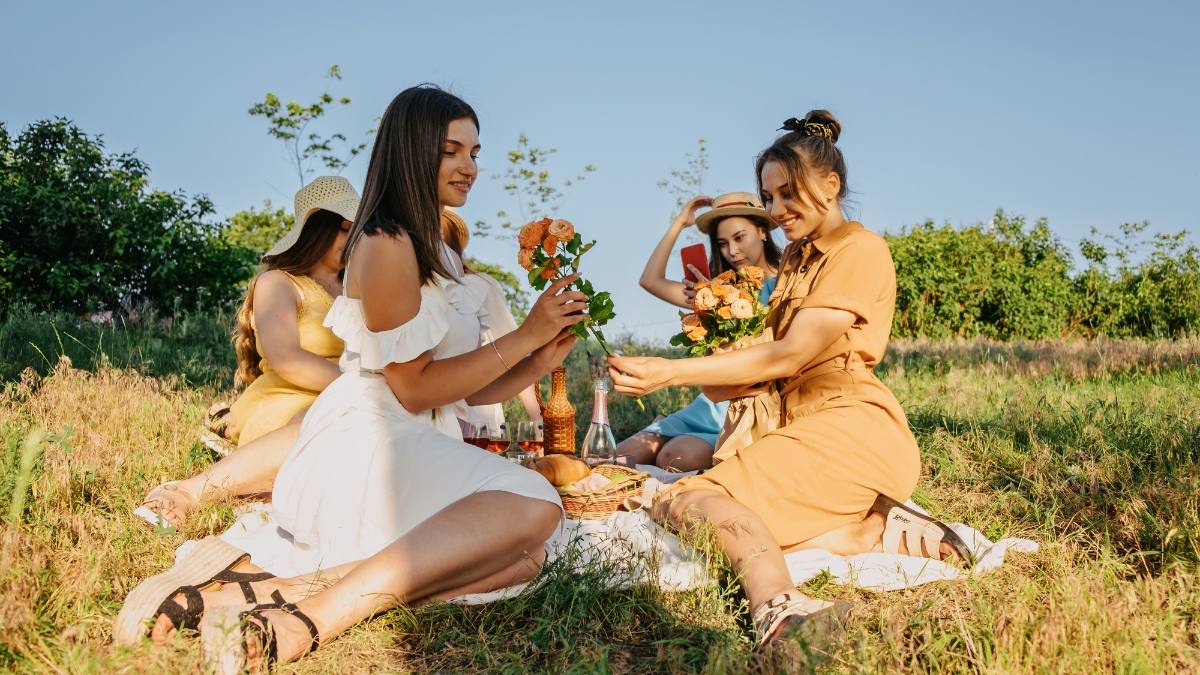
Some women choose structured activities: art classes, fitness sessions, cooking workshops, or book discussions. These offer a shared focus and a sense of doing something tangible together. Others prefer unstructured time: a home-cooked meal, a café visit, or an evening without phones.
In diaspora communities, Galentine’s gatherings often become spaces of cultural familiarity. Food plays a central role. So does language. The absence of formal expectations allows conversations to move easily between the personal and the practical.
Notably, many women describe these gatherings as restful rather than stimulating. There is little pressure to document the moment or perform happiness. The value lies in presence, not presentation.
Not a rejection of romance
It is important to be clear about what Galentine’s is not.
It is not a protest against romantic relationships. It is not an expression of cynicism. It does not require a stance on marriage, partnership, or love.
For many women, Galentine’s exists comfortably alongside Valentine’s Day. Some celebrate both. Others choose one over the other depending on their circumstances that year.
What Galentine’s challenges is not romance itself, but the assumption that romance must always take precedence over other forms of connection. It creates space for nuance, acknowledging that emotional lives are layered and that fulfilment does not flow through a single channel.
The role of intention
One recurring theme in conversations around Galentine’s is intention.
Unlike routine socialising, Galentine’s gatherings are often planned deliberately. Time is set aside. Work is paused. Distractions are limited. In a culture of constant connectivity, this intentionality carries weight.
For some, the act of planning becomes a form of self-care. Choosing how to spend the day, and with whom, is itself meaningful. It signals that friendships are not incidental, but chosen and maintained.
This is particularly relevant for women whose schedules are otherwise dictated by obligation. Galentine’s offers a brief interruption, a reminder that connection can be curated rather than reactive.
A quieter cultural shift
Galentine’s has not grown through campaigns or advocacy. Its spread has been informal, often passed through conversation rather than promotion. That quietness may explain its staying power.
Rather than positioning itself as a movement, Galentine’s operates as a practice. It adapts to context. It does not demand allegiance. It allows participants to opt in or out without consequence.
In that sense, it reflects a broader cultural recalibration. One in which relationships are valued for their function rather than their label, and where emotional wellbeing is pursued through balance rather than spectacle.
What this might mean going forward
Whether Galentine’s continues to grow or settles into a niche tradition is difficult to predict. Cultural practices rarely follow straight lines. What seems clear, however, is that the underlying need it addresses is not temporary.
As social lives become more fragmented and expectations more complex, the desire for grounded, low-pressure connection is likely to persist. Galentine’s offers one model for how that connection can be honoured without competition or comparison.
It does not replace romance. It does not redefine love. It simply makes room.
Sometimes, that is enough.
Disclaimer: This article is based on observed social trends, cultural patterns, and composite scenarios created for illustrative purposes. It is intended for informational and reflective reading only. Individual experiences of relationships and celebrations may vary widely based on personal, cultural, and social contexts.