Dhaniya Panjiri: The Fragrant Janmashtami Offering from North India
WFY Bureau I From the Kitchens of India I Featured
As India prepares to celebrate Krishna Janmashtami on 4 September 2026, kitchens across northern India will begin filling with the warm fragrance of roasted coriander, ghee, nuts and cardamom.
Dhaniya Panjiri is a traditional Janmashtami preparation associated particularly with households in Uttar Pradesh, Rajasthan, Haryana, Punjab and parts of Delhi. It is offered to Lord Krishna after the midnight worship and subsequently distributed as prasad.
Unlike the wheat-based panjiri commonly prepared during winter or after childbirth, the Janmashtami version uses ground coriander seeds. Since many devotees avoid ordinary grains while fasting, roasted coriander provides the preparation with its distinctive body and aroma.
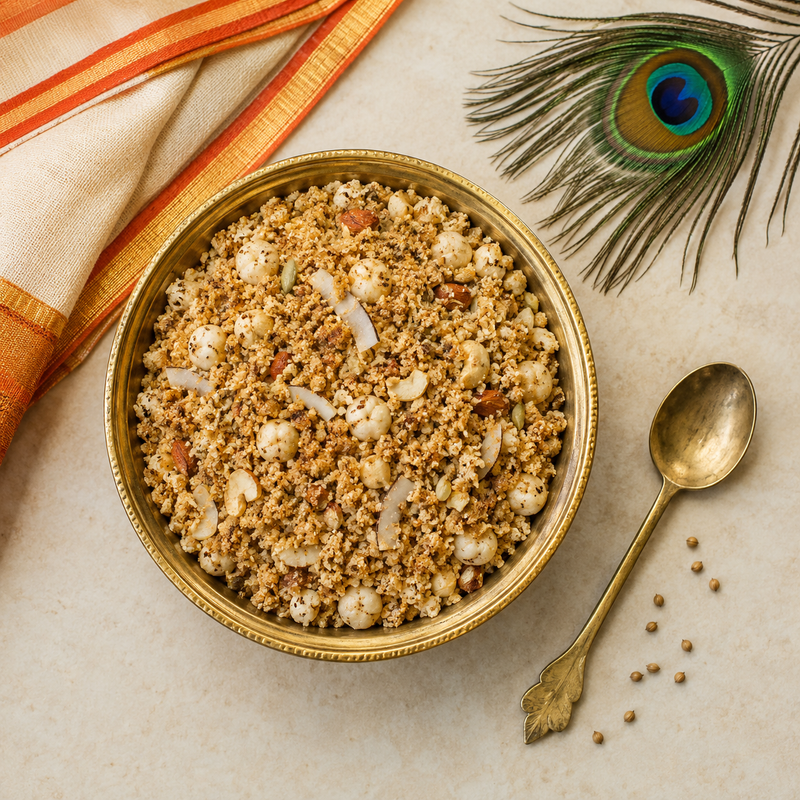
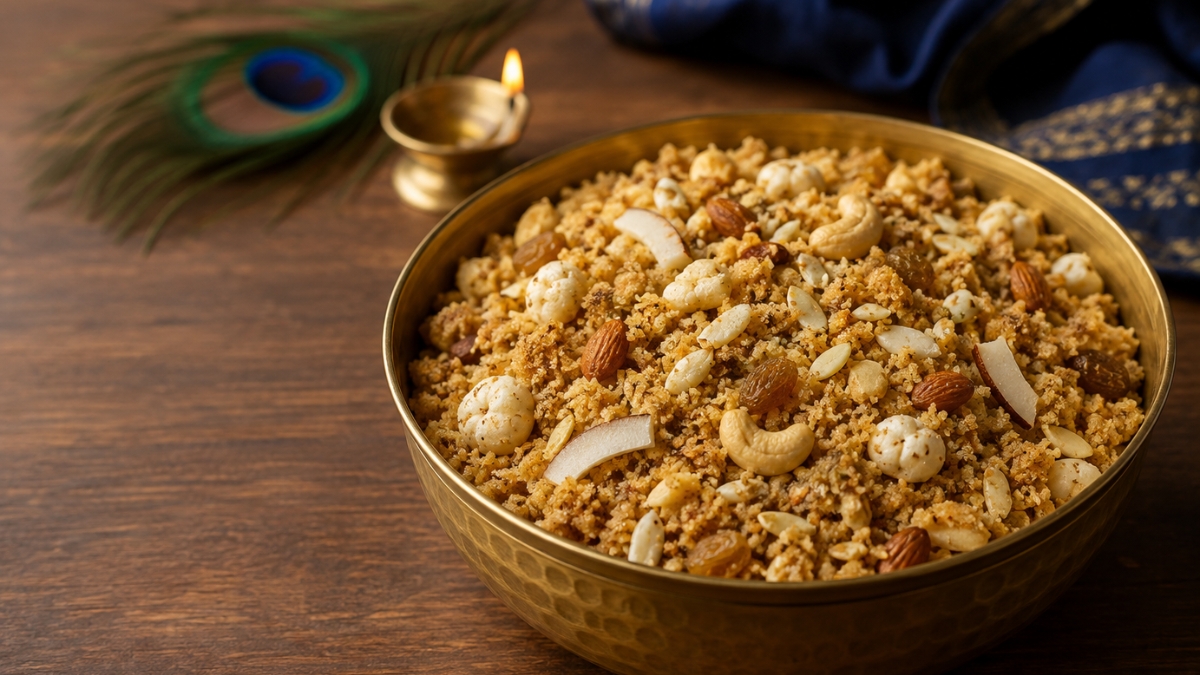
Recipes vary between families. Some use only coriander, sugar and ghee, while more elaborate versions include makhana, dried coconut, melon seeds and nuts. The following recipe retains the traditional coriander base while adding ingredients commonly used in festive North Indian kitchens.
Preparation Time
Approximately 15 minutes
Cooking Time
Approximately 20 minutes
Makes
About 8 small servings
Ingredients
- 1 cup whole coriander seeds, or 1 cup coarsely ground coriander powder
- 4 tablespoons ghee
- 1 cup makhana, or fox nuts
- ¼ cup dried coconut, thinly sliced or grated
- 2 tablespoons almonds, chopped
- 2 tablespoons cashew nuts, chopped
- 1 tablespoon melon seeds
- ¾ cup powdered sugar or boora, adjusted to taste
- ½ teaspoon green cardamom powder
- 1 tablespoon raisins, optional
- 1 teaspoon edible gum, or gond, optional
Method
If using whole coriander seeds, clean them carefully and remove any grit. Dry-roast them in a heavy pan over a low flame for three to four minutes, stirring continuously. The seeds should become aromatic but must not darken excessively.
Allow them to cool completely and grind them into a slightly coarse powder. Dhaniya Panjiri traditionally has some texture, so avoid reducing the seeds to an extremely fine dust.
Heat one tablespoon of ghee in the same pan. Add the makhana and roast over a low flame until crisp. This may take five to seven minutes. To test, remove one makhana and press it after it has cooled slightly. It should break cleanly rather than bend.
Transfer the roasted makhana to a plate. Once cool, crush it roughly with your hands or pulse it briefly in a mixer. Do not turn it into a fine powder.
Add another teaspoon of ghee to the pan and gently fry the cashews and almonds until lightly golden. Add the melon seeds and raisins, if using, and cook briefly. Remove everything immediately to prevent the seeds and raisins from burning.
If using edible gum, heat another teaspoon of ghee and fry the gum in small batches. It will expand and become crisp. Remove it, allow it to cool and crush it lightly.
Place the remaining ghee in the pan and add the ground coriander. Roast it over a low flame for six to eight minutes, stirring continuously.
This is the most important stage. Raw coriander has a sharp, slightly bitter quality. Slow roasting softens its flavour and produces the warm fragrance characteristic of the finished panjiri. Do not increase the heat to shorten the process, as burnt coriander will make the entire preparation bitter.
Add the dried coconut and roast for another minute. Turn off the heat.
Mix in the crushed makhana, fried nuts, melon seeds, raisins, edible gum and cardamom powder.
Allow the mixture to cool until it is only slightly warm. Add the powdered sugar or boora and combine thoroughly. Sugar should not be added while the mixture is very hot, as it may melt and make the panjiri sticky.
Taste and adjust the sweetness if necessary. The finished preparation should remain dry, loose and crumbly.
Serving and Storage
For Janmashtami, Dhaniya Panjiri is traditionally placed in a clean bowl, offered during the midnight worship marking Krishna’s birth and then shared as prasad.
It can be served independently or alongside panchamrit, fruits, makhan-mishri and other fasting preparations.
Once completely cool, store it in a clean airtight container. It should remain fresh for approximately one week at room temperature in a cool, dry place. In humid weather, refrigeration is preferable.
The Taste of the Season
Dhaniya Panjiri is not a commercial sweet designed for immediate richness. Its flavour develops slowly. The coriander is earthy and fragrant, the makhana provides lightness, and the nuts and coconut bring richness without overwhelming the preparation.
For many families, its significance lies less in presentation than in recognition. The first spoonful recalls midnight prayers, temple bells, children dressed as Krishna and Radha, and relatives waiting for the fast to conclude.
It is a recipe shaped by devotion, season and memory, prepared once a year and remembered long after the festival has passed.
The Story Behind Dhaniya Panjiri
Dhaniya Panjiri is a traditional North Indian preparation closely associated with Krishna Janmashtami. While ordinary panjiri is usually made with whole-wheat flour, the Janmashtami version uses roasted coriander seeds because many devotees avoid regular grains while fasting.
The dish is prepared during the day and offered to Lord Krishna after the midnight worship commemorating his birth. It is then distributed as prasad, often alongside panchamrit, fruit and makhan-mishri. Its ghee-rich character also connects it naturally with the milk, butter and pastoral imagery associated with Krishna’s childhood in Gokul and Vrindavan.
There is no single standard recipe. Some families prepare it simply with coriander, ghee and sugar, while others add makhana, coconut, nuts, seeds or edible gum. These variations reflect a recipe preserved primarily through household practice and passed between generations.
Slow roasting transforms coriander’s sharpness into a warm, nutty fragrance. For many families, that familiar aroma immediately signals Janmashtami. Since the dish is rarely prepared during the rest of the year, it also serves as a powerful marker of season and memory.
For the Indian diaspora, Dhaniya Panjiri is particularly meaningful. Its ingredients are easily available, and the dish can be prepared anywhere, allowing families to recreate a cherished festival tradition far from India. Modest in appearance but rich in cultural memory, it brings together fasting, celebration, devotion and the enduring knowledge of the Indian home kitchen.