
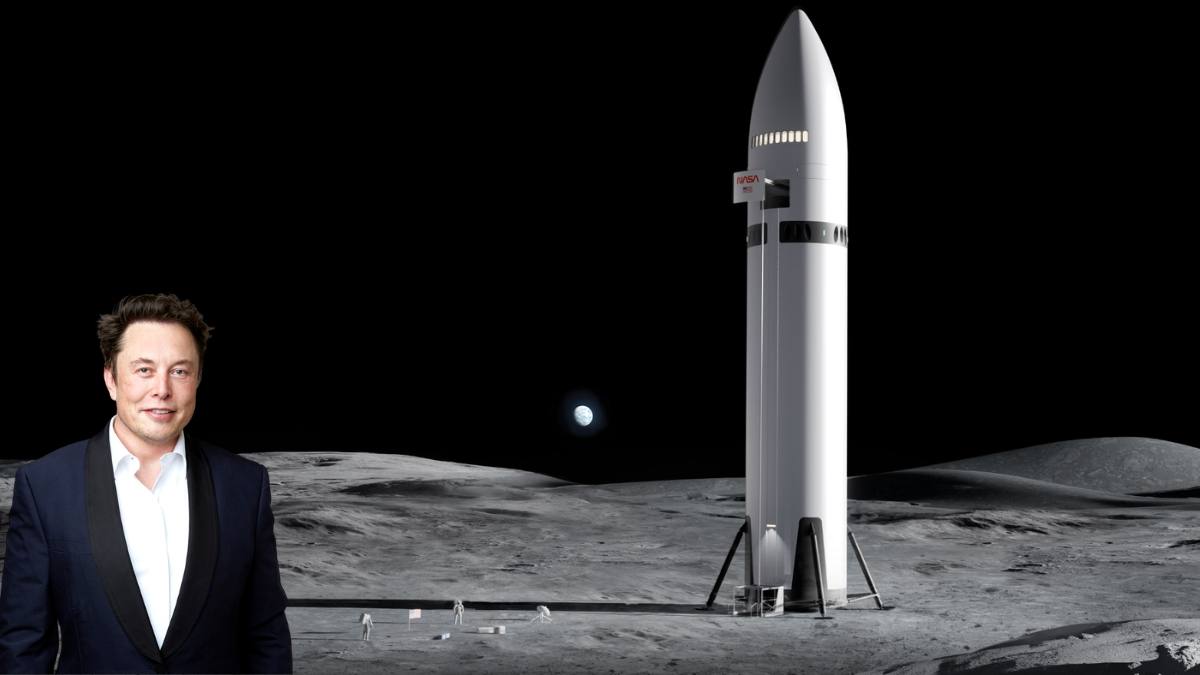
It’s Official Now: SpaceX Will Test The Moon Before Mars
By Pratik Shah, WFY Bureau | Science & Technology | The WFY Magazine, February, 2026, Edition
The destination has not changed, but the order has. SpaceX has indicated that its immediate priority is no longer Mars, but the Moon. The company now intends to focus on building a permanent, expandable human settlement on the lunar surface within the next decade, while keeping a Martian city as a longer-term objective. The reasoning, as outlined by Elon Musk, is practical rather than symbolic: if the aim is to secure the future of civilisation beyond Earth, the Moon offers a faster and more manageable path.
Why the Moon Has Moved Ahead of Mars
For more than a decade, Mars has occupied a central place in discussions about humanity’s future beyond Earth. It has been framed as the next frontier, the planet where long-term human survival could be tested and eventually secured. SpaceX itself has consistently presented Mars as its ultimate goal, investing heavily in launch systems, spacecraft design, and long-range mission planning aimed at reaching the red planet.
The recent shift in emphasis does not overturn that vision. Instead, it rearranges the sequence. Mars remains the destination. The Moon has become the first proving ground.
This change reflects a reassessment of feasibility rather than ambition. Establishing a permanent human presence beyond Earth requires systems that can operate continuously, recover from failure, and scale over time. These systems cannot be perfected through simulations alone. They must function in real environments, under real constraints, with human lives at stake.
The Moon offers that environment sooner and with fewer irreversible risks. By prioritising a lunar settlement first, SpaceX is signalling that survival beyond Earth depends not on reaching the farthest destination quickly, but on learning how to sustain life off-world reliably.
Mars, in this framework, is delayed but not abandoned.
Speed, Distance, and Civilisational Risk
Distance is not a secondary consideration in space exploration. It shapes every operational decision.
The Moon is roughly three days from Earth. Mars, depending on orbital alignment, requires a journey of six to nine months. That difference changes the nature of risk entirely.
A lunar mission allows rapid resupply, crew rotation, and emergency return. Communication with Earth is near real-time. Technical failures can be diagnosed and addressed with constant ground support. Systems that malfunction can be replaced or redesigned within relatively short cycles.
Mars offers none of these safeguards. Once a mission leaves Earth, intervention is limited. Communication delays complicate remote troubleshooting. Medical emergencies, structural failures, or life-support breakdowns cannot be easily mitigated. Mistakes are more costly and less reversible.
From a civilisational planning perspective, speed matters because it determines how quickly lessons can be learned. A lunar settlement allows repeated iteration. Systems can fail, be improved, and redeployed without waiting years between attempts.
If the goal is to establish a sustainable human presence beyond Earth within the lifetime of existing institutions, the Moon presents a lower-risk path. Faster cycles mean faster learning. Faster learning reduces existential risk.
What a ‘Self-Growing City’ Means Operationally
The idea of a “self-growing city” is often misunderstood as a futuristic concept. In operational terms, it refers to a settlement designed to expand without constant dependence on Earth.
Such a city must generate its own energy, recycle air and water, manage waste efficiently, and produce construction materials locally. It must also be capable of autonomous maintenance, as human oversight will always be limited.
On the Moon, this begins with in-situ resource utilisation. Lunar soil, or regolith, can be processed into building components. Polar regions are believed to contain water ice, which can be converted into drinking water, breathable oxygen, and rocket propellant. Solar energy is abundant, particularly in areas with extended sunlight exposure.
Automation is central to this model. Construction, repair, and monitoring must rely heavily on machines. Artificial intelligence systems are expected to manage routine operations, predict failures, and optimise resource use.
The Moon allows these technologies to be tested under real conditions while remaining close enough to Earth for intervention. When systems fail, as they inevitably will, the consequences are manageable. Corrections can be made without abandoning the entire project.
Mars does not offer this margin for error. A self-growing city on Mars would need to work almost perfectly from the outset. The Moon provides a setting where imperfection can be tolerated and corrected.
Institutional and Geopolitical Context
The renewed focus on the Moon is not occurring in isolation. It aligns closely with broader institutional and geopolitical developments.
The United States, through NASA’s Artemis programme, has committed to sustained human activity on the Moon. Unlike earlier lunar missions, Artemis is designed around permanence rather than demonstration. The aim is to establish long-term infrastructure, not simply return astronauts briefly to the surface.
SpaceX plays a central role in this programme, holding a multi-billion-dollar contract to develop lunar landing systems. Aligning corporate ambitions with government-backed missions reduces financial uncertainty and ensures continuity.
China, meanwhile, has outlined its own plans for a long-term lunar presence. These plans include research stations, resource exploration, and eventual human settlement. The Moon is increasingly viewed as a strategic domain where technological leadership and standards will be set.
In this context, lunar infrastructure is not merely scientific. It shapes future access, governance, and cooperation in space. Early movers will influence how resources are allocated and how activity is regulated.
Commercial settlements, therefore, are part of a broader strategic landscape. They intersect with national interests, international partnerships, and long-term policy decisions.
India and the Diaspora Dimension
For India, the shift towards permanent lunar activity has particular relevance.
India’s space programme has demonstrated credibility through cost-effective missions to the Moon and Mars. While its focus has traditionally been scientific rather than settlement-based, the emergence of lunar infrastructure changes the global environment in which space exploration operates.
Indian engineers, scientists, and researchers are already deeply integrated into global aerospace, robotics, and artificial intelligence sectors. Many work within organisations that will be involved in future lunar projects, whether through hardware development, software systems, data analysis, or operational support.
The Indian diaspora plays a significant role in this ecosystem. Indian-origin professionals are present across private space companies, research institutions, and technology firms contributing to lunar exploration.
As lunar settlements move from concept to implementation, participation will not be limited to national space agencies. It will involve supply chains, research collaborations, and specialised services. India’s talent base positions it as a contributor to this emerging phase of space activity, even if settlement itself is not an immediate national priority.
Mars Remains the Destination, Not the First Test
Mars continues to hold scientific and symbolic importance. Its geology offers clues about planetary evolution and the possibility of past life. Its environment presents the ultimate challenge for sustained human survival beyond Earth.
What has changed is the recognition that reaching Mars successfully depends on experience gained closer to home.
A permanent lunar settlement allows technologies to mature. Life-support systems can be refined. Governance models can be tested. Human adaptation to long-term off-world living can be studied in a controlled setting.
Sequence matters because failure at Mars carries greater consequences. By shifting focus to the Moon first, SpaceX is adopting a stepwise approach rather than attempting a single, irreversible leap.
Mars remains part of the future. The Moon has become the test of whether that future can be realised within realistic timeframes and acceptable risk.
The question, then, is not whether humanity will reach Mars, but how prepared it will be when it does. The Moon now stands between ambition and execution. Whether it proves sufficient as a testing ground, or merely reveals new limitations, will shape the next phase of human expansion beyond Earth.
Disclaimer: This article is based on publicly available information, verified reporting, and industry disclosures as of February 2026. It is intended for informational and analytical purposes only. Space exploration strategies, commercial priorities, and international space policies may evolve over time and are subject to change.