RK Narayan: This Is The Remarkable Man Who Made Malgudi Feel Real
By Achint Ganguly
There is no railway ticket to Malgudi. You will not find it on a map of India, nor can you ask for directions to its Market Road, Albert Mission School or the banks of the Sarayu. Yet for generations of readers, Malgudi has felt remarkably real.
That may be R. K. Narayan’s greatest literary achievement. He created an imaginary South Indian town and populated it with schoolboys, teachers, shopkeepers, financial advisers, guides, housewives, printers, astrologers and eccentrics whose lives were so recognisable that the boundary between fiction and memory seemed to disappear. Readers did not merely encounter Malgudi. They felt they had been there.
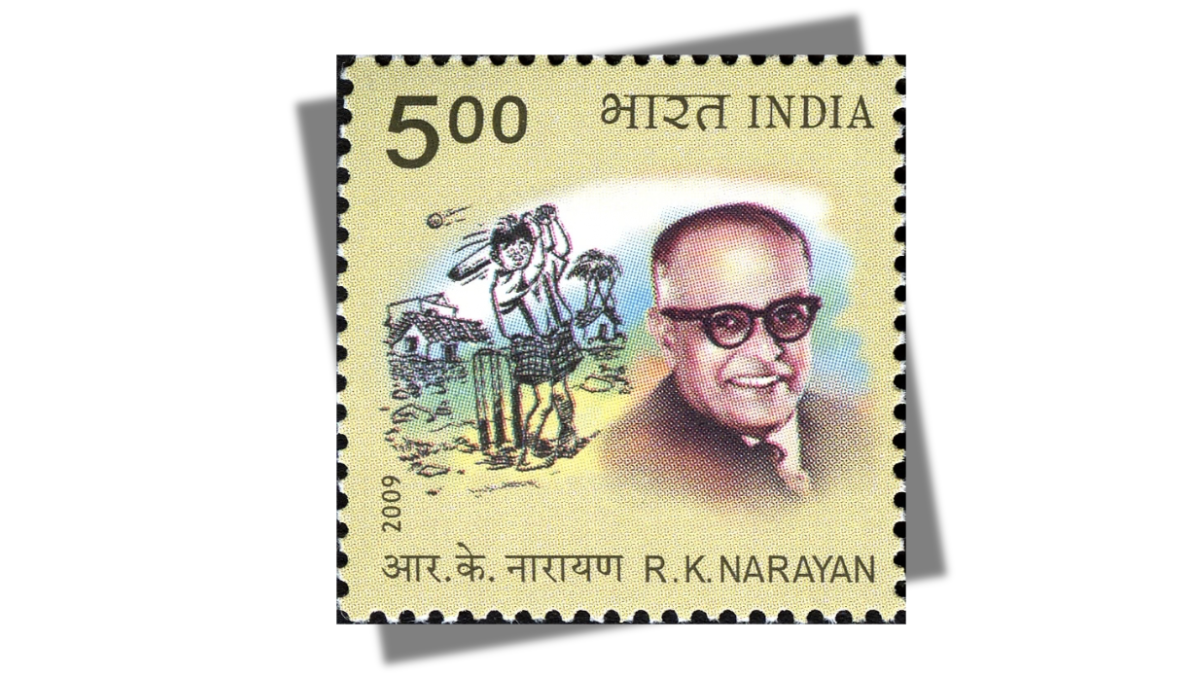
Behind that fictional town stood a writer who rarely needed grand events to make a story interesting. Rasipuram Krishnaswami Narayan wrote about everyday Indian life with warmth, gentle humour and an extraordinary eye for human behaviour. His characters worried about examinations, money, marriage, family, reputation, work and the future. They were ambitious, foolish, hopeful, frightened and occasionally wise.
They were, in other words, ordinary people.
Narayan’s great gift was to show that ordinary lives could make extraordinary literature.
A CHILDHOOD OF BOOKS, STORIES AND UNUSUAL COMPANIONS
R. K. Narayan was born on 10 October 1906 in Madras, now Chennai. His father was a school headmaster and, because of the family’s circumstances, Narayan spent a significant part of his childhood with his maternal grandmother, Parvati.
She became his first real teacher.
His grandmother taught him Sanskrit, mythology, arithmetic and classical Indian music, and introduced him to stories from Indian tradition. Long before Narayan became a professional storyteller, stories were therefore already part of the world in which he was growing up.
She also had an affectionate name for him: Kunjappa. The nickname remained within the family even after the boy grew into the celebrated R. K. Narayan.
Accounts of his childhood also contain a wonderfully Narayan-like detail: among his companions at his grandmother’s home were a peacock and a mischievous monkey. It is difficult not to imagine that the child who grew up observing such an unusual little world was already developing the curiosity that would later populate Malgudi with its memorable collection of human beings.
Books were another important part of his childhood. His father’s connection with education gave Narayan access to school and family libraries, and he became an obsessive reader. Charles Dickens, P. G. Wodehouse, Arthur Conan Doyle and Thomas Hardy were among the writers he encountered.
Curiously, the future master of English prose was not an outstanding student.
Narayan failed his university entrance examination twice and spent an extended period at home reading and writing before eventually entering Maharaja’s College in Mysore. The contrast is irresistible: a young man who struggled with formal examinations would eventually become one of India’s most celebrated writers in the very language in which academic success had not come easily to him.
Perhaps Narayan was simply better at reading the world than at satisfying examination systems.
A TEACHER WHO DID NOT WANT TO TEACH
After graduating from Maharaja’s College, Narayan briefly became a schoolteacher.
It did not go particularly well.
One account of the episode recalls that his dissatisfaction came to a head when the headmaster asked him to substitute for the physical-training teacher. Narayan resigned. Whatever security teaching might have offered him, he had already begun to understand that his real ambition lay elsewhere.
He wanted to write.
It was hardly a financially sensible career decision for a young Indian in the early 1930s. Narayan had no reason to believe that writing fiction in English would provide him with a dependable income. His early newspaper pieces earned little, and the path towards becoming a professional author was uncertain.
Still, he persisted.
This persistence matters because Narayan’s later success can make his beginnings appear inevitable. They were not. Before there were celebrated novels, international readers and literary honours, there was a young man attempting to make a living from words when there was very little evidence that those words would support him.
And then Malgudi appeared.
WHEN AN IMAGINARY TOWN FOUND ITS NAME
Narayan later described the emergence of Malgudi as almost spontaneous.
While beginning his first novel around 1930, he imagined a railway station and a name came to him: Malgudi.
A town that did not exist had been born.
Malgudi would eventually become one of the most memorable fictional locations in Indian literature. Narayan never needed to identify it with a single real place. It was recognisably South Indian, yet sufficiently imagined to belong entirely to him. It acquired roads, houses, schools, shops, offices, a railway station, a river and the distant Mempi Hills.
Most importantly, it acquired people.
Through Malgudi, Narayan could explore family life, childhood, education, social change, tradition and modernity, money, marriage, ambition and ordinary human struggle. He did not need spectacular plots or heroic characters. A schoolboy frightened of authority, a businessman pursuing money or a man trying to escape the consequences of his own choices could provide enough material.
His first novel, Swami and Friends, centred on childhood in this fictional world. But writing the novel proved easier than getting it published.
The manuscript met with rejection.
Then Graham Greene entered the story.
GRAHAM GREENE AND THE DOOR THAT FINALLY OPENED
Narayan’s manuscript reached the English novelist Graham Greene through a friend of Narayan’s who was studying at Oxford. Greene was impressed.
He recognised a distinctive voice in the unknown Indian writer and helped bring the manuscript to the attention of British publishers. He also suggested that the original title, Swami, should become Swami and Friends.
The novel was eventually published in Britain in 1935.
Greene’s role in Narayan’s literary career did not end there. He became an important supporter, mentor and friend, encouraging Narayan’s work and helping introduce it to readers outside India.
It was an unusual literary partnership: an established British novelist recognising the talent of an Indian writer describing an imaginary South Indian town to readers who might never have encountered anything like it.
But Narayan did something important in the process. He did not transform Malgudi into an exotic spectacle for foreign consumption. He did not write as though Indian life required constant explanation before it could become literature.
He simply allowed his people to live.
That confidence helped make his work universal.
THE ART OF WATCHING ORDINARY PEOPLE
Narayan’s prose became known for its clarity, clean construction, gentle irony and quiet humour. His characters were often middle-class or small-town people whose hopes, weaknesses, routines and occasional absurdities were treated with sympathy rather than judgement.
He could see the comedy in human behaviour without becoming cruel towards the people producing it.
That distinction is important.
Many of Narayan’s characters imagine themselves to be something rather different from what the reader can see. They pursue ambitions, misunderstand situations, exaggerate their importance or find themselves trapped by their own decisions. Narayan watches them with amusement, but rarely contempt.
His own family produced another remarkable observer of Indian life.
Narayan’s younger brother, R. K. Laxman, became one of India’s most celebrated cartoonists. His famous “Common Man” would become an enduring symbol of ordinary Indians observing the absurdities of politics, bureaucracy and public life. Laxman also illustrated some of Narayan’s work and designed book covers.
The brothers worked in different forms, but the resemblance in their artistic instincts is striking. Both noticed the ordinary person. Both understood the absurdities of everyday life. And both could make a seemingly insignificant moment reveal something much larger about India.
Narayan’s literary world grew steadily. Among his best-known works were Swami and Friends, The Bachelor of Arts, The Financial Expert, The Guide, The Man-Eater of Malgudi and the stories collected under Malgudi Days. He also wrote essays, memoirs, travel writing and retellings of India’s great epics.
Yet some of his most powerful writing emerged not from observation alone, but from devastating personal experience.
RAJAM: LOVE, LOSS AND A STORY THAT WOULD NOT LEAVE HIM
Narayan’s marriage had begun unusually for its time.
He reportedly first noticed Rajam while she was drawing water from a street tap. At a time when arranged marriages were overwhelmingly the norm, Narayan pursued the relationship himself.
There was, however, an obstacle of a distinctly traditional kind.
An astrologer reportedly warned that the match was unfavourable and that marrying Rajam could leave Narayan a widower. The couple nevertheless married in 1934.
For a few years, Narayan found domestic happiness. They had a daughter, Hema.
Then, in 1939, Rajam contracted typhoid and died.
Narayan was devastated.
The astrologer’s warning, remembered after the tragedy, must have added another strange and painful dimension to his grief. Narayan refused to remarry despite the social expectations of the time and raised Hema with the support of his extended family.
The loss changed him, and eventually it entered his fiction.
The English Teacher, published in 1945, tells the story of Krishna, a college lecturer whose wife dies, leaving him to confront grief and raise their young daughter. Although a novel, its emotional relationship with Narayan’s own experience was unmistakable.
The book revealed something important about the writer behind Malgudi. The man known for gentle humour also understood profound grief.
Yet even when dealing with loss, Narayan rarely surrendered to melodrama. His emotional power came through restraint. The sadness was allowed to exist within the same clear prose that carried his comedy.
Perhaps that is one reason his writing has aged so well.
SIMPLE WRITING IS NOT SIMPLE SEEING
Narayan’s prose is frequently described as simple. It is a useful description, but also a potentially misleading one.
His sentences were generally lucid and unadorned. He did not make readers fight their way through language merely to admire the writer behind it. His stories were accessible, and his humour could appear effortless.
But simplicity of expression is not simplicity of understanding.
Narayan understood vanity, ambition, loneliness, greed, affection, self-deception, disappointment and hope. He knew that human beings could be ridiculous and sympathetic at the same time.
That insight allowed his stories to travel beyond the specific India in which they were written.
Malgudi was Indian in its streets, social relationships, rhythms and assumptions. But the people living there wanted things that people everywhere want: love, money, respect, freedom, success, security and a little happiness.
Sometimes they got what they wanted.
Often they did not.
Narayan understood that both outcomes could make a story.
FROM MALGUDI TO THE WORLD
Over the decades, Narayan became one of the central figures in Indian writing in English. Alongside writers such as Mulk Raj Anand and Raja Rao, he helped establish an Indian English-language literary tradition that could speak from India without imitating Britain or apologising for its cultural origins.
His international reputation grew, but his writing remained rooted in the small world he had created.
The Guide, one of his best-known novels, received the Sahitya Akademi Award. He was honoured with the Padma Bhushan, and in 1994 he was elected a Fellow of the Sahitya Akademi, the institution’s highest literary honour.
His books travelled across countries and languages. Malgudi travelled with them.
For Indian audiences, another transformation would make the town even more familiar. Television brought Malgudi Days into homes and gave visual form to characters and places readers had previously carried in their imaginations. For many Indians, Narayan’s fictional world consequently became intertwined with childhood memories of reading and watching those stories.
The strange thing is that Malgudi continued to feel real through all these transformations.
Perhaps that was because its reality never depended upon geography.
THE EDUCATION THAT EXAMINATIONS COULD NOT MEASURE
Looking back at Narayan’s life, one of its most revealing aspects may be that he was not shaped primarily by formal academic achievement.
The boy who failed university entrance examinations became one of India’s greatest English-language storytellers.
His real education came from many places.
It came from his grandmother’s stories and lessons. It came from mythology and Indian traditions. It came from Dickens, Wodehouse, Conan Doyle, Hardy and the books he found in libraries. It came from the streets around him, family conversations, marriage, fatherhood and devastating loss.
And perhaps most importantly, it came from watching people.
Narayan noticed what others might pass without a second glance.
A railway station could become the entrance to an imaginary town.
A schoolboy’s worries could become literature.
A financial adviser could reveal human greed and ambition.
A guide could become the centre of a story about identity, deception and transformation.
A painful personal loss could become a novel about love, death and survival.
The ordinary world kept offering Narayan stories because he had trained himself to see them.
WHY MALGUDI REFUSES TO DISAPPEAR
R. K. Narayan died in Chennai on 13 May 2001. He was 94.
By then, the India into which he had been born had changed almost beyond recognition. The colonial country of his childhood had become an independent republic. Cities had expanded. Television had entered millions of homes. Economic liberalisation had begun transforming aspirations and lifestyles. Indian writers in English had become major figures in international publishing.
Malgudi survived all of it.
Its continued appeal is sometimes explained through nostalgia, and nostalgia certainly plays a part. Generations of Indians associate Narayan’s stories with childhood, school libraries and the much-loved television adaptation of Malgudi Days.
But nostalgia alone cannot explain why his stories remain readable.
Malgudi survives because the emotions inside it have not disappeared.
Children still worry about examinations. Parents still worry about children. People fall in love, chase money, dream of better lives, exaggerate their importance, quarrel, make mistakes, lose people they love and discover that life has plans different from their own.
Narayan found literature in those experiences.
His contribution was not merely that he created a fictional town. It was that he made us believe that the lives unfolding inside that town mattered.
Perhaps that is why Malgudi remains so difficult to think of as imaginary.
Its railway station was invented. Its streets were invented. Its river and neighbourhoods belonged to a novelist’s imagination.
But its people were recognisable.
They were us.
And somewhere within R. K. Narayan’s remarkable journey lies a particularly satisfying irony. The boy who struggled with examinations became one of India’s greatest teachers of human nature, without ever standing permanently behind a classroom desk.
His lesson was wonderfully simple:
No life is too ordinary to become a story, if someone has learned how to see it.