
Navratri: How Faith Finds A New Home
As Navratri travels with Indian communities across the world, the festival reveals how faith adapts to migration without necessarily losing its spiritual centre. From Garba in Britain, Canada and the Gulf to Durga Puja organised around new calendars and community spaces, traditions are being reshaped by different countries, working lives and younger generations. This article explores how migrants preserve the idea of Shakti while negotiating questions of identity, authenticity and belonging, and how children born far from India inherit traditions their parents and grandparents once experienced very differently. At its heart is a larger spiritual question: when the outward form of faith changes so that a tradition can survive, what must remain unchanged for its deeper meaning to endure?
SPIRITUALITY
Every migration carries things that cannot be packed into a suitcase. People may leave behind houses, familiar streets, neighbourhood temples, family courtyards and the sounds and smells associated with particular seasons, but they carry something less visible with them: rituals, prayers, memories, festivals and ways of understanding the sacred. Navratri is one of those travelling traditions.
As the festival returns this October, millions of people will worship the Divine Feminine in different forms. In Gujarat and Gujarati communities, nights of Garba and Dandiya Raas will fill halls and open spaces. Bengali communities will prepare for Durga Puja. Families elsewhere will fast, pray, visit temples, perform aarti or observe traditions inherited from parents and grandparents. These expressions differ considerably, but they are connected by ideas of Shakti, devotion, renewal and the triumph of constructive forces over destructive ones.
What makes the contemporary story of Navratri particularly fascinating is that these traditions are no longer confined to the places in which they developed. Indian communities now live across North America, Britain, Europe, the Gulf, Africa, Southeast Asia, Australia and elsewhere. A festival once closely connected with particular villages, cities, temples and neighbourhoods has travelled with them. In the process, Navratri demonstrates something important about migrant spirituality: a religious tradition can change its outward form without necessarily surrendering its spiritual centre.
WHEN FAITH MIGRATES
Religion rarely migrates completely unchanged. A family arriving in London, Toronto, Dubai, Nairobi or Johannesburg cannot simply reproduce the social environment it left behind. Working weeks are different, schools remain open, public holidays may not coincide with religious calendars, and large gatherings may require permissions and hired venues. Priests, musicians, ritual materials and traditional spaces may also be less readily available.
Diaspora communities therefore adapt. A celebration traditionally spread across several days may be concentrated around a weekend. Worship that once took place in a neighbourhood pandal may move into a community centre or hired hall. Ritual explanations may be offered in English because younger participants no longer understand Gujarati, Bengali, Hindi or Sanskrit sufficiently well. Garba may begin earlier because children have school the following morning, while programmes that once developed naturally within a neighbourhood must now be planned months in advance by community organisations.
At first glance, such adjustments can appear to represent a dilution of tradition. Yet migration reveals another possibility. Sometimes a tradition changes precisely because a community is determined to preserve it. The alternative to adapting a religious calendar to working life may not be a perfectly traditional celebration, but no celebration at all. This creates one of the most interesting spiritual questions associated with migration: how much can the form of a tradition change while its essential meaning remains intact?
NINE NIGHTS, MANY WAYS OF BELIEVING
Even within India, Navratri has never been one uniform celebration. Its religious and cultural expressions vary considerably by region and community. Gujarat’s Garba and Dandiya Raas have become among its most internationally recognisable forms, while Bengal’s Durga Puja possesses its own extraordinary religious, artistic and social character. Other communities observe fasting, recite sacred texts, arrange Golu displays, conduct temple worship or celebrate Vijayadashami through distinctive regional traditions.
Migration does not necessarily erase these differences. In some cases, distance actually makes regional identities more visible. A Gujarati family living thousands of kilometres from Gujarat may become more conscious of Garba as part of its cultural inheritance precisely because Gujarati culture no longer surrounds it every day. A Bengali child growing up in Britain or North America may experience Durga Puja as one of the few occasions each year when hundreds of people around them speak Bengali, eat familiar foods, hear familiar music and participate collectively in rituals associated with their family’s origins.
This is one of migration’s curious effects on tradition. Practices that may once have been absorbed almost unconsciously become deliberate. Families begin making conscious decisions about what should be taught, celebrated and transmitted. Distance can therefore weaken some traditions, but it can also make communities understand more clearly why those traditions matter.
GARBA FINDS A NEW DANCE FLOOR
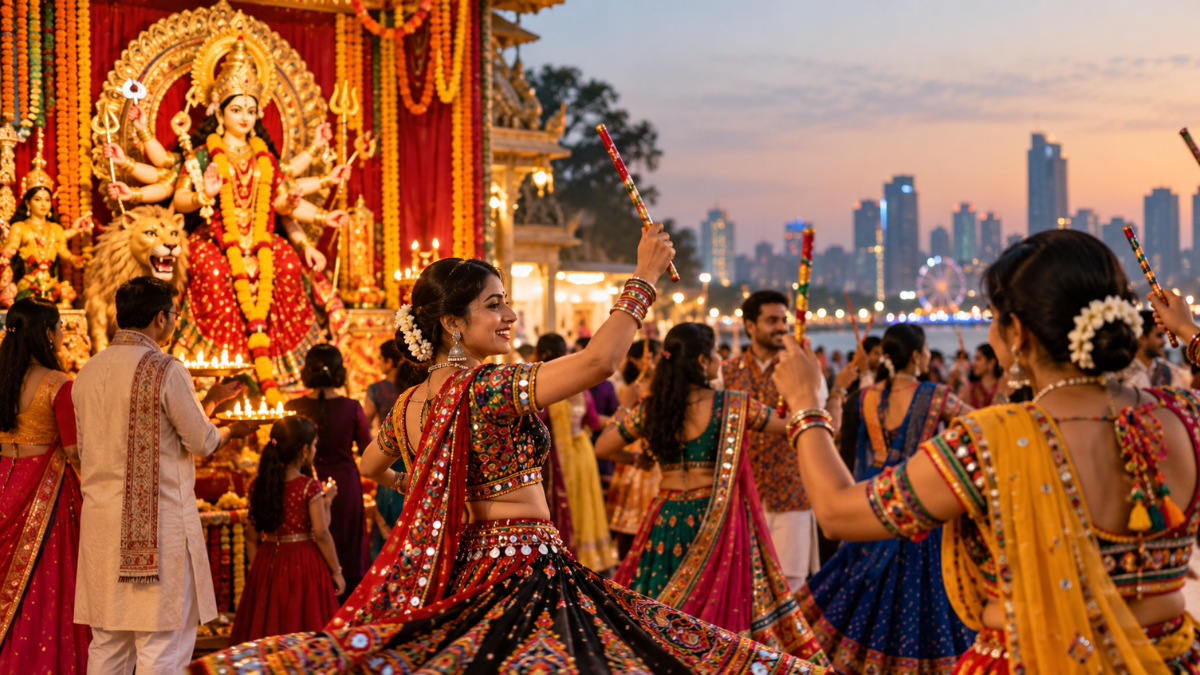
Few Indian religious traditions have travelled as visibly as Garba. The circular movement of dancers around the sacred centre carries spiritual symbolism associated with the feminine divine and the cycle of life, yet Garba has always combined devotion with community celebration. That combination helps explain its extraordinary adaptability.
Outside India, the dance floor often acquires additional functions. It becomes a place where people meet others from their community, where children learn steps from parents or instructors, and where young adults wear traditional clothing that may otherwise remain in wardrobes for much of the year. Traditional devotional compositions increasingly share the evening with contemporary arrangements, professional musicians and large-scale event production.
Across Britain, North America, the Gulf and other regions with substantial Indian populations, Navratri Garba has moved comfortably into sports halls, convention centres, community spaces and other large venues. Even smaller communities are creating their own celebrations. Greater Sudbury’s Gujarati community in Canada, for example, is holding a Navratri Garba this October while welcoming both experienced dancers and newcomers to participate.
That willingness to include newcomers is important to the survival of a migrant tradition. A festival sustained only by people who already understand every ritual risks becoming smaller with each generation. A festival confident enough to explain itself can transmit its meaning beyond those who inherited it directly. Someone may initially attend Garba because of the music, clothes, friends or atmosphere and discover its spiritual meaning later. Another may arrive primarily for worship and remain because of the community. In diaspora life, faith does not always travel first through theology; sometimes rhythm becomes the doorway through which people rediscover it.
DURGA PUJA LEARNS TO LIVE WITH A NEW CALENDAR
The Bengali diaspora offers an especially revealing example of how religious tradition negotiates migration. In Bengal, Durga Puja transforms neighbourhoods. Pandal construction, idol making, food, music, family visits, artistic displays and public celebration occupy physical and emotional space on a scale that is difficult to reproduce abroad.
A Bengali community in Britain or North America therefore faces a practical challenge. Recreating Kolkata or another Bengali city thousands of kilometres away is impossible, yet abandoning the festival would mean losing one of the strongest expressions of Bengali religious and cultural identity. Diaspora communities have consequently developed adaptations, including celebrations concentrated around weekends and worship conducted in hired indoor venues rather than the public spaces familiar in India.
The practical arrangements may change considerably, but Durga remains at the spiritual centre. Community organisations across Britain, North America and elsewhere bring together worship, food, cultural performances, children’s activities and social interaction. What might appear from the outside to be a transformation of a religious festival into a community event is actually more complicated. For migrant communities, religious practice and community formation frequently support one another. Worship creates belonging, while belonging helps preserve worship.
WHEN A COMMUNITY HALL BECOMES SACRED SPACE
In India, religion often exists within a dense network of family and neighbourhood relationships. Grandparents know the rituals, temples may be nearby, festival foods appear naturally in households and children absorb customs simply by being present. Migration disrupts much of that network, forcing communities to rebuild deliberately what geography once provided automatically.
This helps explain why festivals abroad often perform functions far beyond formal worship. They become places where recent migrants meet established families, elderly people encounter others who speak their language, children form friendships with peers from similar cultural backgrounds and young adults participate in traditions that may otherwise be largely absent from their everyday lives.
For several hours or several days, an ordinary community centre can therefore become much more than a hired venue. Through prayer, decoration, food, music, ritual and collective memory, it can temporarily function as temple, neighbourhood, cultural centre, dining room and meeting place. Research into diaspora religious practice has described this kind of place-making, in which communities transform ordinary spaces through the meanings they bring into them.
Migration consequently challenges conventional ideas about sacred geography. A place does not always become sacred because of permanent architecture or centuries of religious history. Sometimes sacredness is created when a community gathers with a shared spiritual intention.
WHAT THE SECOND GENERATION INHERITS
For the first generation of migrants, Navratri or Durga Puja may evoke powerful memories of home. They remember how the festival sounded in Ahmedabad, Kolkata, Vadodara, Mumbai or a smaller hometown. They remember relatives who are no longer nearby, particular foods, neighbourhood gatherings and the anticipation that surrounded the festival when they were children.
Their children inherit something different. For someone born in London, Toronto, New York, Nairobi, Dubai or Melbourne, that city may be home in the deepest sense. India may be somewhere visited during holidays, somewhere described by parents and grandparents, or somewhere experienced through family, food, films, music and festivals. Navratri can therefore become one of the occasions on which an inherited identity becomes physically and emotionally tangible.
A young person who speaks English more comfortably than an Indian language may still know the rhythm of Garba. Someone unable to explain every theological dimension of Durga may nevertheless understand that Puja is the time when the community gathers. This sometimes worries older generations, particularly when younger participants appear more interested in contemporary music, clothes, photographs and socialising than in ritual.
That concern should not simply be dismissed. Religious traditions cannot survive indefinitely if their meanings disappear and only their entertainment remains. Yet transmission has never required exact replication. Every generation receives tradition within a different social world. The more useful question is therefore not whether children born abroad practise exactly as their grandparents did, but whether they have been given enough understanding to know why the tradition exists. Participation can preserve memory, but understanding gives that memory spiritual meaning.
WHEN TRADITION CHANGES, IS IT STILL AUTHENTIC?
Diaspora communities frequently encounter arguments about authenticity. Should Garba use only traditional music? Should Durga Puja follow the precise religious calendar even when most members of the community cannot attend? Should prayers and explanations be translated into English? Should people without Indian backgrounds participate? Does moving worship into a hotel ballroom, school hall or community centre somehow diminish its sacredness?
There are no simple answers because religious traditions require both continuity and adaptability. If everything can be changed without limit, a tradition may eventually lose the ideas that made it distinctive. But absolute rigidity carries another danger. A religious practice that refuses to respond to radically different circumstances can become increasingly difficult for later generations to sustain.
The history of diaspora religion is therefore often a negotiation between preservation and adaptation. The crucial question becomes what constitutes the spiritual core that should not be lost. In Navratri, that core lies deeper than costume, music or location. It lies in devotion, in recognition of Shakti, in the understanding of the Divine Feminine, in the struggle between constructive and destructive forces, and in the possibility of spiritual renewal. The venue can change, explanations can move between languages and schedules may accommodate new realities without necessarily displacing that centre.
SHAKTI IN A MIGRANT WORLD
The idea of Shakti gives Navratri an especially powerful ability to travel because Shakti is not simply a deity associated with one geographical place. It represents divine energy, creative power and the feminine principle through which existence is understood to act. Durga expresses that power through courage and protection, while other manifestations emphasise wisdom, prosperity, transformation, compassion or strength.
For families living far from ancestral homes, these ideas can acquire additional resonance. Migration itself requires resilience. People rebuild lives in unfamiliar societies, negotiate new languages and institutions, and learn to balance the desire to belong in a new country with the wish to preserve what they inherited from another. Women frequently play a particularly important role in carrying family rituals, food traditions, prayers and cultural knowledge between generations.
Parents also face the difficult task of preserving inheritance without making children feel that their identity is divided between incompatible worlds. The spiritual vocabulary of strength, renewal and transformation can therefore speak to experiences that the earliest practitioners of these traditions could never have imagined. Ancient traditions survive not because history remains unchanged, but because human beings continue finding meaning within them as their circumstances change.
FROM PRIVATE FAITH TO PUBLIC CULTURE
Migration can make a religious tradition visible to people who previously knew little about it. A Garba celebration in a multicultural Canadian or British city may attract neighbours without Gujarati backgrounds. A Durga Puja may welcome colleagues, school friends and local residents. Children invite classmates, workplaces begin acknowledging festivals previously unfamiliar to them, and community organisations increasingly explain the meaning behind celebrations to wider audiences.
This creates both an opportunity and a responsibility. Public celebration can encourage greater understanding of Hindu traditions and allow communities to participate confidently in the cultural life of their adopted countries. At the same time, visibility can sometimes reduce sacred traditions to spectacle. Garba may be perceived simply as colourful dancing, while Durga Puja can become associated principally with food, fashion, decoration and photography.
Celebration itself is not the problem. Hindu festivals have always contained music, colour, food and collective joy. The difficulty begins only when celebration becomes completely detached from the spiritual ideas that produced it. Diaspora communities therefore face the challenge not of making festivals less enjoyable, but of ensuring that enjoyment remains connected with understanding. Explaining why Garba moves around a sacred centre, what Shakti signifies or why Durga is worshipped can transform an attractive cultural experience into an encounter with the tradition’s deeper meaning.
WHEN THE FESTIVAL CREATES A TEMPORARY HOME
Perhaps this explains why religious festivals often become particularly important in migrant life. For several nights, communities create something resembling home without attempting to reproduce home exactly. The food may taste familiar although its ingredients were purchased in another country. The prayers may be ancient although their meaning is explained in English. The music may begin traditionally and gradually acquire contemporary rhythms. Children born thousands of kilometres from India may dance beside grandparents who remember celebrating the same festival in another landscape.
They are not necessarily experiencing precisely the same Navratri, but they are participating within the same living tradition. This is one of the quiet achievements of diaspora communities around the world. They have discovered that cultural and spiritual continuity does not require religion to be frozen at the moment of migration. What it requires is an understanding of what deserves to be carried forward and enough confidence to allow the surrounding forms to respond to new circumstances.
This also changes the meaning of home. For migrants and their descendants, home does not always have to be one geographical place. A religious festival can create a temporary landscape of belonging in which memories of India, realities of another country and the identities of new generations coexist without requiring one to eliminate the others.
WHAT MIGRATION TEACHES FAITH
Navratri’s global journey reveals something larger than the story of one Hindu festival. Faith survives through a delicate relationship between memory and renewal. If religion becomes only memory, it risks belonging permanently to the generation that migrated. If it becomes only adaptation, it risks losing the spiritual foundations that gave it meaning. The challenge is to allow each generation to inherit both roots and room to grow.
That is why a Garba night in London or Canada, a Durga Puja in North America, or family worship in the Gulf should not be judged merely by how closely it resembles the equivalent celebration in India. The deeper question is whether the people participating still encounter something sacred within it. A festival has travelled successfully when a child born far from India can enter a community hall, hear music inherited from another land, watch a parent or grandparent bow before the Divine and understand that the tradition belongs to them as well.
Navratri has travelled thousands of kilometres because people themselves travelled thousands of kilometres. Its venues have changed, its languages sometimes change, its music evolves, its calendars accommodate new lives and its communities now include generations whose relationship with India differs profoundly from that of their parents or grandparents. Yet at its spiritual centre remains the ancient idea of Shakti, the divine power through which darkness is confronted, life is renewed and strength is discovered. Perhaps that is ultimately why the festival has travelled so successfully: leaving a homeland does not require people to leave the sacred behind with it.