
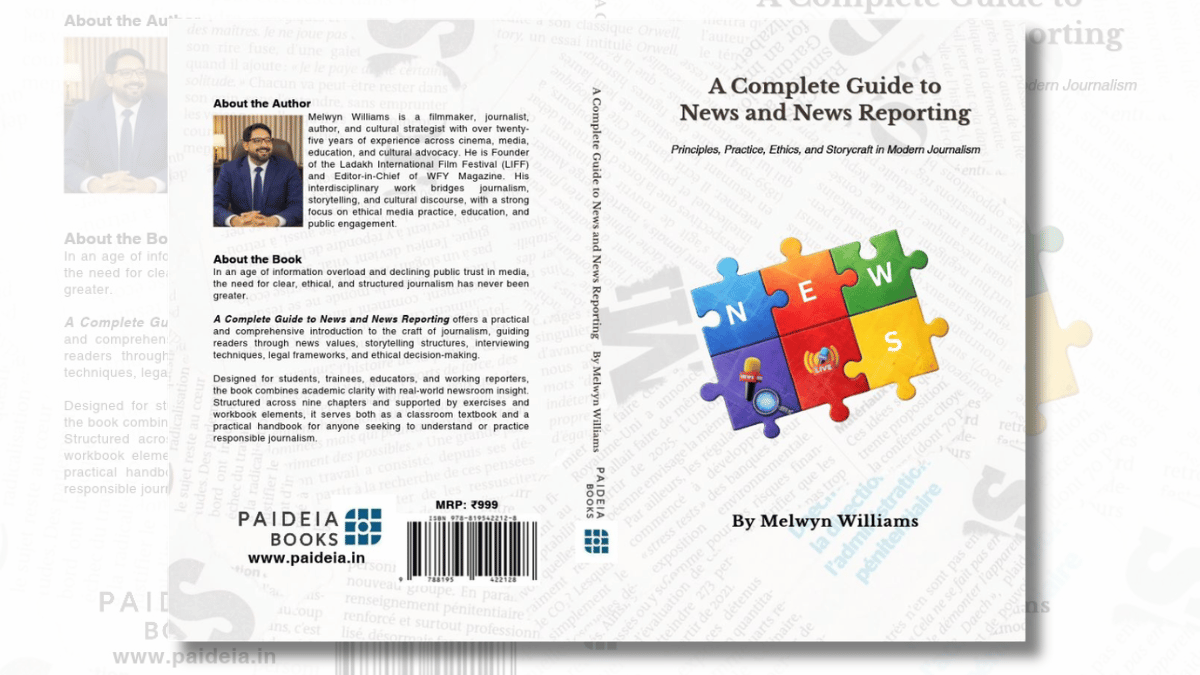
Melwyn Williams’ Latest Book: Spirit And Skill Of Good Journalism
In his newly published book, A Complete Guide to News and News Reporting, Melwyn Williams examines what makes journalism credible, why its fundamentals still matter, and the responsibilities of those who report the news.
By WFY Bureau | Featured | November 2026
The news business has rarely been short of information. What has become harder is knowing what deserves attention, which claims can be trusted and who is prepared to take responsibility for what is published.
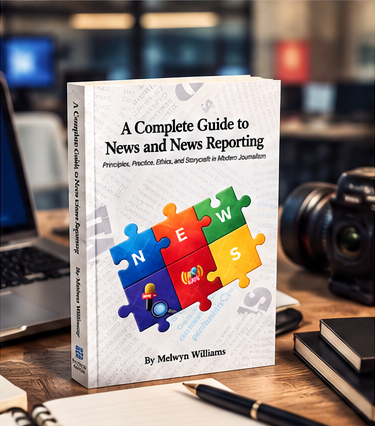
For journalist, filmmaker and WFY Editor-in-Chief Melwyn Williams, these questions are not peripheral to the profession. They form the reason for his latest book, A Complete Guide to News and News Reporting, a practical guide designed to take readers from the earliest questions about newsworthiness through reporting, interviewing, storytelling, ethics, media law and the demands of digital journalism.
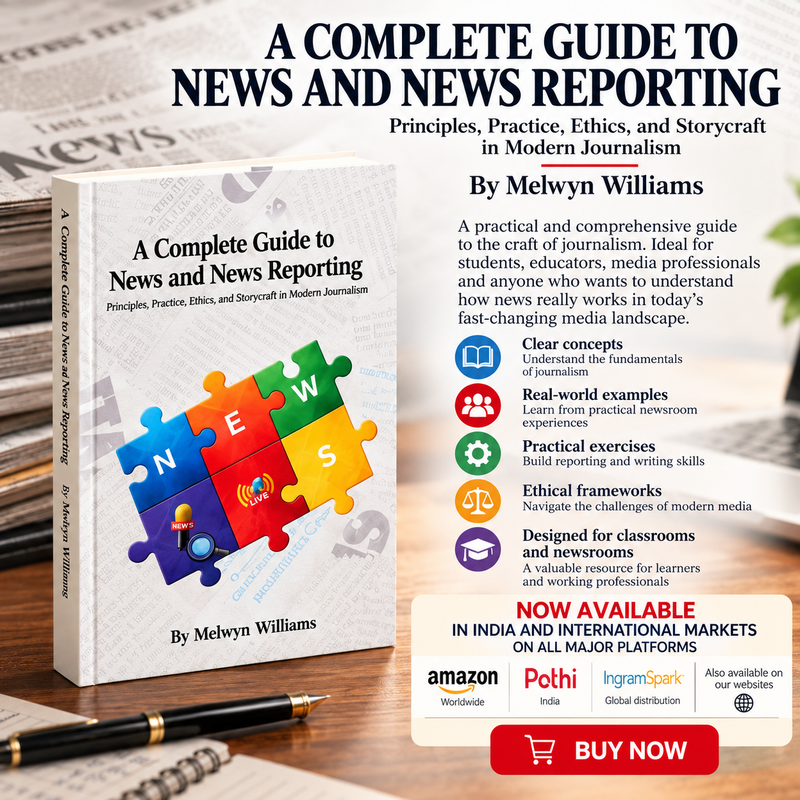
The book was formally released at the Press Club of India on 24 October 2026. Published in India by Paideia Books, it carries a foreword by senior journalist and former Hindustan executive editor Jayanti Ranganathan. At the launch, Ambassador K. P. Fabian presented a copy to Press Club of India president Sangeeta Barooah Pisharoty, marking the book’s public introduction.
Organised into nine chapters and 56 structured parts, with exercises intended to carry learning beyond the printed page, the book addresses a familiar problem: the distance between understanding journalism in a classroom and practising it when facts are incomplete, deadlines are approaching and the consequences of mistakes are real.
For this WFY Bureau feature, Williams reflects on the book’s purpose, the habits that make a reporter credible, the pressures facing journalism and why technological competence can never replace professional conscience.
The Interview
WFY Bureau, Kavya Patel: You have worked in journalism for many years. What made you decide to write this particular book now?
Melwyn Williams: I have been thinking about the gap between what people imagine journalism to be and what the work actually demands. The public usually sees the finished story. It rarely sees the questions behind it, the sources that had to be checked, the details that were left out because they could not be verified, or the difficult decisions made before publication.
At the same time, news has become available almost instantly. Anyone can post an account of an event, and that information may travel across the world before a reporter has had time to establish what happened. Speed is useful, but it has also created confusion about what journalism is.
I wanted to return to the fundamentals and explain them in a way that a beginner can understand and a working journalist can still find useful. The book comes from a conviction that reporting is a craft with methods, standards and responsibilities. Those things have to be learnt, practised and revisited.
Kavya Patel: Its title suggests a comprehensive guide. What will a reader actually find inside?
Melwyn Williams: The book follows the working life of a news story. It begins with a question that sounds simple but is often misunderstood: what makes something news? From there, it examines the journalist’s role, how information is gathered, how a report is structured and why one detail should be given greater importance than another.
It moves into interviewing, news writing, story formats, verification, source relationships, professional ethics, legal awareness and the realities of reporting across different media. The nine chapters are divided into 56 parts so that readers can approach the subject systematically rather than trying to absorb everything at once.
I wanted the explanations to be useful beyond an examination. A student should be able to take a principle from the book and recognise how it applies during an assignment. Equally, a reporter who has been working for some time should be able to return to a section and reconsider a habit or decision.
Kavya Patel: Why was it important to combine instruction with practical exercises?
Melwyn Williams: Journalism cannot be learnt entirely by reading definitions. You can memorise the qualities of a good introduction, but that does not mean you can write one from a confused collection of facts. You can learn the principles of interviewing, but conducting an interview with someone who is reluctant, upset or giving contradictory answers is a different exercise.
The practical work is intended to make readers think and act. They should learn to identify the strongest fact, decide what needs checking, recognise the missing voice and explain why a particular approach is fair.
This also helps educators. A teacher needs material that can be discussed, questioned and applied, not simply repeated. The same is true of newsroom training. People learn professional judgement through practice, feedback and the willingness to correct themselves.
Kavya Patel: There are already journalism textbooks and reporting manuals. What did you feel was missing?
Melwyn Williams: There are excellent books on journalism, and anyone serious about the profession should read widely. My purpose was not to dismiss what has been written before. I wanted to bring together essential principles and everyday working methods in one accessible structure.
Some learners begin with theory and find it difficult to see its relevance on the ground. Others enter a newsroom with practical enthusiasm but without a firm understanding of ethics, law or the reasons behind editorial decisions. Both need a bridge.
The book is written for that space between knowing a rule and exercising judgement. It recognises that journalism now happens through print, video, audio and digital platforms, but it also insists that the obligations of accuracy, fairness and accountability travel with the journalist from one medium to another.
Kavya Patel: You place considerable emphasis on ethics. Is that because you believe journalism is losing its moral direction?
Melwyn Williams: I would hesitate to make a sweeping judgement about an entire profession. There are journalists doing difficult, careful and courageous work every day, often with limited resources and under considerable pressure. That work deserves recognition.
But there are also pressures that can weaken judgement. Competition for attention encourages dramatic headlines. The desire to publish first can reduce the time available for checking. Commercial interests, political influence and personal opinions can all interfere with the obligation to be fair.
Ethics cannot be treated as one chapter to be studied and forgotten. It has to inform the choice of a story, the questions asked, the treatment of a source, the use of images and the decision to publish. A journalist’s responsibility does not end when the report goes online. It includes being answerable for errors and correcting them openly.
Kavya Patel: Many people now encounter news through social media. What separates a journalist from someone who simply posts information?
Melwyn Williams: The distinction is not the device used or the platform on which a story appears. A citizen with a mobile phone can record something important. A blogger or independent creator can do serious reporting. Journalism does not belong exclusively to a large newspaper or a television studio.
The distinction lies in the work undertaken before a claim is presented as fact. What is the source? Is there independent confirmation? What context is missing? Has the person affected been given a fair opportunity to respond? Are we telling the audience what we know and what remains uncertain?
Publishing is easier than ever. Verification has not become easier in the same proportion. The responsibility to establish the truth of a claim remains central, whatever the platform.
Kavya Patel: What is the most common mistake a young reporter should learn to avoid?
Melwyn Williams: Confusing information with understanding. A reporter may collect statements, figures and opinions and still fail to establish the meaning of the event. The material has to be tested, arranged and put in context.
Another danger is becoming satisfied with the first version of a story. An official statement is a starting point, not necessarily the whole account. An eyewitness may sincerely believe something that later proves inaccurate. A widely shared image may be genuine but unrelated to the event being reported.
I would encourage a beginner to be curious, but also patient. Ask the additional question. Check the spelling, the date and the document. Distinguish what someone alleges from what the evidence establishes. Good reporting depends as much on what a journalist chooses not to publish as on what finally appears in the story.
Kavya Patel: Artificial intelligence is entering newsrooms. Does it make the fundamentals you teach less important?
Melwyn Williams: Quite the opposite. Technology may assist with transcription, sorting information, analysing data or adapting material for different formats. These can be valuable tools when used properly. But a system that produces fluent language can also produce incorrect information, misleading summaries or invented references.
The journalist still has to determine what is accurate, lawful, fair and relevant. A machine cannot take moral responsibility for a false accusation or understand the human consequences of exposing a vulnerable source in the way a responsible editor must.
My view is not that journalism should resist technology. Journalists need to understand it, question it and learn to use it competently. What they must not do is surrender their judgement to it. The methods may develop, but the duty to verify remains with the human being who publishes.
Kavya Patel: The book discusses media law and source protection. How much legal knowledge does an ordinary reporter need?
Melwyn Williams: Enough to recognise the responsibilities and risks that arise during everyday reporting, and enough to know when specialist advice is necessary. A journalist should not have to become a lawyer, but ignorance of the law is not a sound professional position.
Questions about defamation, privacy, court reporting, copyright and the handling of confidential material can affect even a routine assignment. Source protection is especially important because people may speak to a journalist at personal or professional risk. Promises of confidentiality should never be made casually.
Legal knowledge is not simply about avoiding trouble. Properly understood, it helps reporters make informed decisions while pursuing legitimate public-interest stories. The book introduces these concerns as part of professional practice, while recognising that laws and procedures differ across jurisdictions and require current local guidance.
Kavya Patel: Is journalism primarily about exposing wrongdoing, or is its purpose broader than that?
Melwyn Williams: Holding powerful institutions accountable is an essential function, but it is not the whole profession. Journalism also explains, connects and records. A well-reported story about a public health service, a village school, a scientific discovery or a family’s experience can help people understand something that affects their lives.
There is a tendency to associate importance only with conflict and scandal. Yet some of the most valuable reporting makes complicated developments understandable or brings attention to communities that have received very little coverage.
For me, the journalist is accountable to the public. That means asking difficult questions when necessary, but also listening carefully, resisting exaggeration and remembering that people should not become mere material for a dramatic story. Accuracy and humanity belong together.
Kavya Patel: As the Editor-in-Chief of an international magazine with an Indian diaspora perspective, does working across cultures influence your approach to journalism?
Melwyn Williams: It reinforces the importance of context. An event may be understood quite differently by people living in different countries, and a report that makes perfect sense to one audience may leave another without the background it needs.
For people of Indian origin living across the world, stories often cross borders. They involve more than geography: families, identities, laws, economies, cultures and a continuing relationship with places of origin. That makes accuracy in representation particularly important.
But I do not believe every story has to be forced into a diaspora frame. Good journalism has wider relevance. Our responsibility is to make the world intelligible to readers while respecting the people and societies we report on. The discipline of asking whose perspective is absent can improve reporting anywhere.
Kavya Patel: Your book has now been formally launched at the Press Club of India. What did that occasion mean to you?
Melwyn Williams: A book begins as an individual undertaking, but it reaches the public through the support and work of many people. The launch was an opportunity to place it before readers and colleagues in a setting closely associated with journalism.
I am grateful to those who contributed to its publication and introduction, including the publisher, the journalist who wrote its foreword and the people who took part in the release. Their involvement gave the occasion personal meaning.
What matters beyond the event is whether the book becomes useful. The purpose of publishing a journalism guide is not fulfilled when a copy is displayed or a speech is delivered. It is fulfilled when someone opens it, learns something that improves their reporting and carries that discipline into their work.
Kavya Patel: Who, in your view, should read this book? Only someone planning to become a journalist?
Melwyn Williams: Journalism students, newsroom interns, independent reporters and teachers are its most obvious readers. It is designed to support formal courses, practical training and self-study.
But the underlying skills have relevance beyond the newsroom. Learning to distinguish evidence from assertion, to ask precise questions, to check information and to communicate clearly is useful in public life and in many professions.
I would welcome a reader who is simply trying to understand how news should be produced. Better public understanding can also lead to more demanding audiences. When readers recognise the difference between reporting and unsupported commentary, they are in a better position to hold media organisations accountable.
Kavya Patel: Do you see the book as a finished contribution, or the beginning of something larger in journalism education?
Melwyn Williams: I see it as part of a continuing effort. A printed book creates a foundation, but journalism is learnt through doing. There is scope to develop workshops, guided exercises, classroom discussions and training opportunities that allow learners to test what they have read.
I am interested in conversations with educators, institutions and working journalists about how the material can be used effectively. It could support an introductory course, a newsroom induction or a professional refresher, depending on what the learners need.
I would also expect to keep learning. A book on journalism should not suggest that its author has finished asking questions. Changes in technology, law and public life will require us to reconsider methods while remaining firm about standards.
Kavya Patel: Finally, what would you say to a young person who wants to enter journalism today but is uncertain about the profession’s future?
Melwyn Williams: I would tell them to take the work seriously and remain curious. Learn how to observe, read carefully, listen without prejudice and write clearly. Build the habit of checking facts even when nobody is looking over your shoulder. Read beyond your immediate interests. Understand the community you are reporting on.
They should also recognise that journalism can be demanding. Recognition may be slow, the work may be criticised, and the right decision is not always the easiest one. The answer is not to become cynical. It is to develop the skills and character that allow you to work responsibly under pressure.
If this book helps a new reporter pause before publishing an unverified claim, ask one more necessary question or treat a source with greater care, it will have achieved something worthwhile. Journalism will continue to change, but its future still depends on people willing to do that work well.
Beyond the Launch
The publication of A Complete Guide to News and News Reporting brings together two concerns that run through Williams’ work: the need to teach the practical craft of reporting and the need to preserve the standards that make journalism worthy of public trust.
It is designed for readers encountering the newsroom for the first time, but the questions it raises are not confined to beginners. How should a journalist respond when information is incomplete? What happens when speed competes with accuracy? How can reporting remain independent while technology and public expectations change?
No textbook can answer every question a reporter will face. A useful one can provide the habits with which to approach them. That, more than the physical volume or the occasion of its launch, is the ambition behind Williams’ new book.
Book details: A Complete Guide to News and News Reporting by Melwyn Williams. Indian publishing imprint: Paideia Books. Foreword: Jayanti Ranganathan. Intended readership: journalism students, educators, newsroom trainees, independent journalists and anyone interested in the craft of reporting. For review, institutional, distribution or workshop enquiries, contact the publisher or the author through their official channels.
Editorial note: The subject of this feature is also Editor-in-Chief of The WFY Magazine. The interview text is an editorial draft based on author-supplied material and requires his review and confirmation before publication as an interview.
Disclaimer: Views expressed in the interview are those of the author and are presented for discussion of journalism education and professional practice. References to media law and newsroom responsibilities are general in nature and do not constitute legal advice. Book availability and institutional arrangements should be confirmed with the publisher.