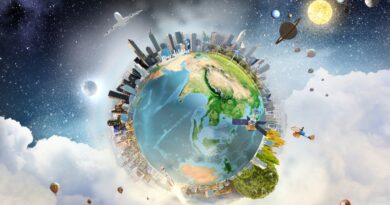

The Human Measure: Powerful Hope For A Wounded World
From the Editor’s Desk
The Human Measure of Progress
By Melwyn Williams
September arrives carrying two contradictory impressions of our age. Humanity appears more capable than ever, yet the world around us often seems increasingly fragile.
We send physicians into space, teach machines to make financial decisions, cross borders through facial recognition and redesign education around artificial intelligence. At the same time, wars continue to destroy cities, humanitarian facilities come under attack, preventable diseases return, climate disasters displace communities and millions of migrant workers remain uncertain about where they will spend their final years.
Progress is accelerating. Wisdom is struggling to keep pace.
That tension runs through the September 2026 edition of WFY. Our articles travel from the International Space Station to the United Nations, from migrant households in the Gulf to universities confronting artificial intelligence, from the Venice Film Festival to traditional Indian kitchens. Yet beneath their differences lies one shared question: as institutions and technologies transform the world, are human beings becoming more secure, more connected and more valued?
Our cover personality, Dr Anil Menon, offers one possible answer. His journey from emergency medicine and disaster response to the International Space Station is not simply a story of personal achievement. It is a reminder that the most sophisticated machinery humanity builds remains dependent upon courage, judgement, cooperation and care.
Menon entered space not merely as an astronaut, but as a physician who had treated people during earthquakes, transported critically ill patients and spent years protecting other space crews as a flight surgeon. His Indian and Ukrainian family heritage, American upbringing, Russian spacecraft training and work aboard an international laboratory also reflect the interwoven character of the modern world.
At a time when nations are hardening their positions on Earth, astronauts continue to depend upon one another in orbit. Space does not abolish political differences, but it makes the cost of refusing cooperation impossible to ignore.
That same lesson confronts the United Nations as its eighty-first General Assembly opens in New York on 8 September under the theme, “Restoring Trust, Managing Transformation: A United Nations That Delivers for All.” The words are appropriately ambitious. The circumstances are unforgiving.
The war in Ukraine continues to intensify. In early September, a Russian drone struck the headquarters of Ukraine’s security service in Kyiv, while a World Health Organization warehouse containing humanitarian medical supplies was also attacked in the region. Gaza remains devastated, with renewed political calls for Palestinian emigration deepening fears of permanent displacement. Sudan continues to face war, hunger and a humanitarian system struggling to reach those in need. Across conflict zones, the World Health Organization has reported that attacks on healthcare facilities, workers and patients averaged more than four each day during 2026.
The United Nations will once again become a stage for speeches about peace, sovereignty and international law. The real test, however, will not be the elegance of those speeches. It will be whether international institutions can protect civilians, deliver assistance and defend principles consistently, including when doing so is politically inconvenient.
Our World Politics article asks whether the UN can meet its greatest challenge in a wounded world. The answer cannot be supplied by the organisation alone. An institution composed of nations inevitably reflects both their collective aspirations and their competing interests. If governments use international law selectively, multilateralism becomes theatre. If they defend it consistently, it can remain a form of protection for those without military or economic power.
Nature, meanwhile, is delivering warnings of its own.
The Nepal–Tibet catastrophe examined in this edition is not an isolated tragedy to be observed briefly and forgotten. Across the world, floods, fires, droughts and extreme heat are exposing weaknesses in infrastructure, planning and public preparedness. Nepal has estimated billions of dollars in losses from catastrophic flooding, while European countries are confronting a climate bill accumulated over decades. Spain has called for a dedicated European climate-adaptation fund and binding targets, arguing that responding only after disaster is no longer sufficient.
Climate change is frequently discussed through distant targets and global averages. For those who lose homes, livelihoods or family members, there is nothing abstract about it. Adaptation must now stand alongside prevention. Roads, hospitals, water systems, communication networks and housing must be designed for conditions that have already begun to change.
The return of measles presents a different but equally troubling warning. Modern societies sometimes mistake familiarity for safety. Measles may be remembered as a childhood illness, but it is highly contagious and can cause severe complications and death. When vaccination coverage falls, outbreaks can return rapidly, including in countries that had previously eliminated sustained transmission.
For diaspora families, the issue is especially relevant. International travel connects generations and communities, but it can also carry infection across borders. Checking vaccination records before travelling is not an act of panic. It is a simple expression of responsibility towards infants, older people and medically vulnerable individuals.
Mobility is also transforming the meaning of home.
For generations, millions of Indians left the country to study, work and build more secure futures. Some are now considering returning. Their reasons cannot be reduced to economics. Ageing parents, cultural distance, changing opportunities in India and questions about what children inherit all influence the decision.
But return is rarely a journey back to the life that was left behind. Countries change. Families change. Migrants change. The India preserved in memory may not be the India encountered after decades abroad.
Tushar Unadkat’s essay asks whether Indians can reclaim the life they left. Perhaps reclamation is not quite the destination. The deeper possibility is reconciliation: bringing together the person one was, the life one built and the relationships that still matter.
For long-serving South Asian workers in the Gulf, the question is more urgent. Many helped construct the cities, industries and service economies that transformed the region. After thirty or forty years, some now confront retirement without permanent residency, portable pensions or affordable long-term healthcare.
They built lives in the Gulf, but may be unable to grow old there.
Their possible return is therefore not always a freely chosen homecoming. It can be a painful relocation to a country they continued to support but no longer know intimately. Any serious discussion of migration must look beyond recruitment and remittances. It must ask what societies owe those whose labour sustained them for decades.
Economic headlines can be equally deceptive. A rupee approaching ₹95 to the US dollar may appear immediately beneficial to NRIs because their overseas earnings convert into more rupees. Yet exchange rates do not create universal winners. Families paying for international education, imported goods or overseas travel face a different calculation. Transfer costs, taxation, investment purpose and inflation may matter more than the satisfaction of receiving additional rupees from a dollar or dirham.
India’s consumer economy is also changing through the growing influence of large corporations. A ₹10 ice cream sounds like a small pleasure. Behind it lies a serious business question about scale, distribution, refrigeration, retail control and the ability of smaller manufacturers to survive aggressive pricing by conglomerates.
The price may be tiny, but the competition is not.
Technology introduces another form of power. India’s emerging agentic UPI framework imagines authorised artificial-intelligence systems making limited payments for users. A digital assistant may eventually compare prices, choose a seller and complete a purchase within rules established by its owner.
Convenience is obvious. Responsibility is not.
If an AI agent misunderstands an instruction, selects a fraudulent merchant or exceeds its authority, who bears the loss? The consumer, the bank, the platform, the software developer or the seller? Innovation should not advance faster than accountability.
The same principle applies when facial recognition begins replacing visible travel documents. Biometric systems promise faster airports and more efficient borders, but they also create permanent records of identity and movement. A face cannot be cancelled and reissued like a compromised password. Efficiency must therefore be accompanied by transparency, security and a meaningful system of appeal when technology fails.
Universities face their own reckoning with artificial intelligence. If software can generate a fluent essay in seconds, institutions must reconsider what an examination is meant to measure. The answer cannot be endless surveillance or unreliable AI-detection tools. Education must move towards assessments that reveal understanding through supervised writing, oral defence, practical application, reflection and sustained work.
The question is not whether students will use AI. They already do. The challenge is to distinguish assistance from substitution and learning from performance.
Technology is also altering entertainment. India’s microdrama boom is producing fictional stories designed for the upright mobile screen, often in episodes lasting only a minute or two. It may appear to be a passing novelty, but new formats frequently seem trivial before they develop their own language. The creative test will be whether microdramas can become more than a procession of cliffhangers engineered to hold attention.
Esports presents a similar generational shift. Its inclusion as a medal discipline at the 2026 Asian Games requires us to reconsider conventional definitions of athletic competition. Elite gaming demands reflexes, strategy, coordination, psychological discipline and extensive training. Yet questions about addiction, commercial ownership and the impermanence of individual game titles cannot be ignored.
Even spirituality is entering unfamiliar territory. AI systems now explain scripture, assist with sermons and simulate conversations with religious figures. Such applications may offer privacy and immediate reassurance, but spiritual authority cannot be delegated casually to a machine. An algorithm can reproduce language about grief, repentance or faith. Whether it can understand their moral weight is another matter entirely.
Amid these large transformations, the quieter articles in this edition remind us that culture survives through intimate things.
A hand-held pankha once cooled homes, fed the flames of a chulha, accompanied religious rituals and displayed the craftsmanship of different Indian regions. Today it may hang on a wall as decoration, yet it still carries the memory of hands that made and used it.
Dhaniya panjiri similarly connects food with season, devotion and inherited knowledge. A recipe is never merely a combination of ingredients when it has travelled through generations. It is history made edible.
Our exploration of lived-in interiors makes the same point. After years of homes arranged for social-media perfection, people are rediscovering the warmth of rooms shaped by family life. In diaspora homes especially, an inherited lamp, faded photograph or mismatched piece of furniture may contain more meaning than an immaculate designer interior.
This edition also carries poetry and remembrance. Kardia turns towards the landscape of the heart, while Till I See You Again, Mom enters the private territory of loss. In a magazine concerned with world events, such writing is not an interruption. It is a reminder of why the world matters to us at all.
Behind every argument about politics, migration, technology or public health is a human attachment. Someone is trying to protect a child, remain close to a parent, preserve a memory, find a home or understand an absence.
Perhaps that is the human measure of progress.
Not how quickly a machine can pay.
Not how silently a border can scan a face.
Not how convincingly an algorithm can imitate belief.
Not even how far a spacecraft can travel.
The real measure is whether progress protects dignity, expands opportunity, strengthens responsibility and leaves space for memory, love and belonging.
September’s world is wounded, inventive, anxious and astonishingly alive. It contains reasons for alarm, but also evidence of resilience. Doctors become astronauts. Artisans preserve fading crafts. Scientists defend public health. Filmmakers turn cinema into witness. Migrants continue rebuilding the meaning of home.
We may not be able to slow every transformation. But we can decide what values travel with us.
As you read this edition of WFY, I invite you to look beyond the subjects and towards the people within them. They remind us that the future is not something technology, governments or markets create on our behalf.
It is something we shape through the questions we ask, the truths we defend and the humanity we refuse to leave behind.
Welcome to the September 2026 edition of WFY.