
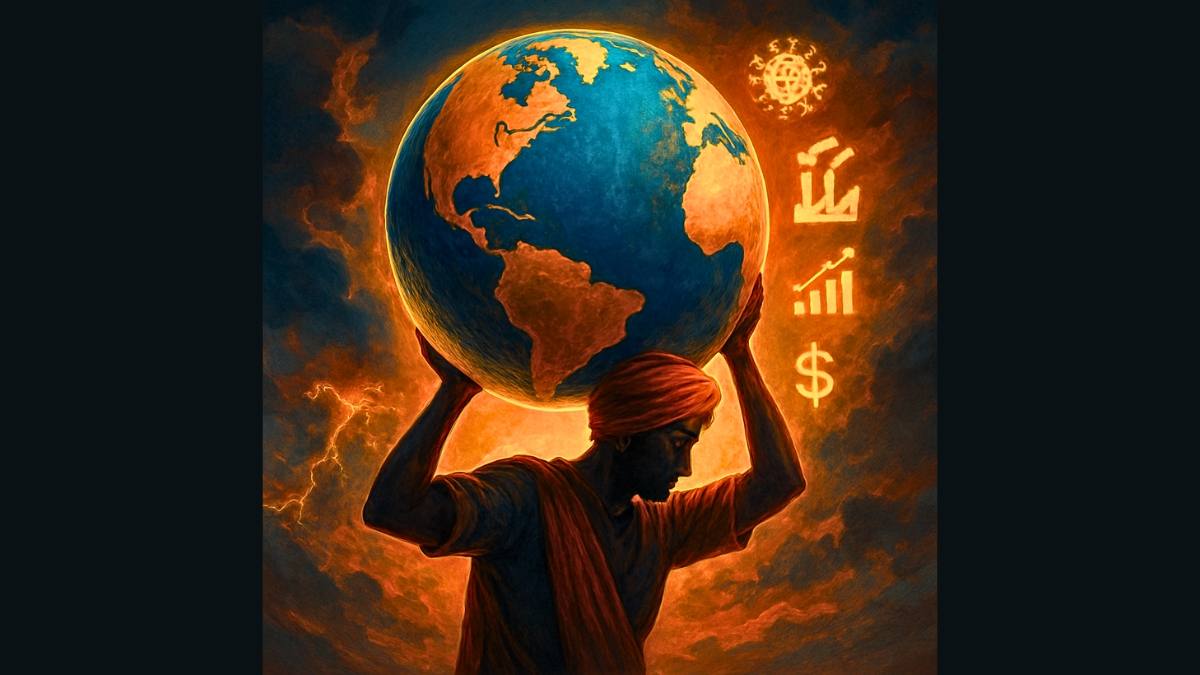
Weight Of The World Now On Indian Shoulders
From the Editor’s Desk
WFY – World For You, March 2026 Edition
Dear Readers,
When we put together an edition of The WFY, we are not simply arranging articles. We are taking stock of a moment. March 2026 finds the world unsettled and fast-moving at the same time. Borders feel tighter. Information moves faster than ever. Economies are adjusting. Communities are learning to adapt. For the Indian diaspora, which stands at roughly 35 million people across continents according to India’s Ministry of External Affairs, these currents are not abstract. They are personal.
The Indian diaspora remains the largest in the world. Indians live and work in more than 200 countries and territories. In 2023, India received over 125 billion US dollars in remittances, the highest figure recorded globally, according to the World Bank. That money does not remain in statistics. It reaches homes. It pays school fees in Punjab and medical bills in Kerala. It sustains households in Bihar and supports small businesses in Gujarat. It represents sacrifice, mobility and ambition.
Yet behind these strong numbers lie anxieties that cannot be measured in currency.
This edition of WFY reflects that balance. There is pride. There is achievement. There is cultural expression. But there is also uncertainty. Our role is not to dramatise events or to reassure without reason. It is to inform, to question, and to examine what this period demands of us.
Changing Migration Realities
Tushar Unadkat’s analysis of visa disruptions and deportations affecting Indians in the United States and Canada arrives at an important time. Over the past year, immigration policies in North America have tightened in response to domestic political pressures and labour market concerns.
Canada, long seen as welcoming to Indian students and skilled migrants, introduced caps on international student permits in 2024 and revised post-study work pathways through 2025 and into 2026. Indians form the largest group of international students in Canada, numbering more than 320,000 at peak enrolment. Even moderate policy adjustments therefore affect a large number of Indian families who have invested heavily in overseas education.
In the United States, Indian nationals remain among the largest recipients of H-1B skilled worker visas. At the same time, green card backlogs for employment-based applicants from India continue to stretch for many years because of per-country limits. Data from the US Department of Homeland Security consistently show high approval numbers for Indian professionals. Yet long waits for permanent residency remain a reality.
When policies shift, even slightly, they unsettle lives. Students worry about work permits. Families worry about status renewals. Employers worry about compliance. These are not minor administrative matters. They shape career paths and long-term plans.
There has also been increased enforcement activity in parts of North America. Deportations of undocumented migrants have risen in certain jurisdictions. Indian nationals have featured among communities affected in some regions. For a diaspora often described only through success stories, this is a reminder that migration also involves risk and vulnerability.
The Gulf and Regional Stability
If North America presents regulatory uncertainty, the Gulf region presents geopolitical concern. Approximately nine to ten million Indians live and work across Gulf Cooperation Council countries, particularly in the United Arab Emirates and Saudi Arabia. They work in construction, healthcare, retail, engineering, finance and entrepreneurship.
Recent tensions in West Asia have raised concerns about stability. While large-scale disruption has been avoided, the possibility of escalation remains on people’s minds. Remittances from the Gulf form a substantial portion of India’s foreign income. Kerala, in particular, has long depended heavily on Gulf remittances.
When tensions rise, practical questions follow. Will flights continue without interruption? Will workplaces remain secure? Will earnings and remittances be affected? These concerns circulate in daily conversations between families separated by distance.
India’s foreign policy has become more visible and active in recent years. Balancing relations across West Asia, North America, Europe and Asia requires steady diplomacy. For diaspora communities, that steadiness matters.
Technology, Leadership and Representation
Our cover story this month, Microsoft Gaming: Asha Is The Best To Lead Now, examines leadership within one of the world’s most influential technology sectors. The global gaming industry is valued at well over 180 billion US dollars annually. Microsoft strengthened its position in this sector following its acquisition of Activision Blizzard in 2023.
This matters to a diaspora publication because representation in global leadership influences perception. Indians have been visible in senior roles in major technology firms for several years. Satya Nadella at Microsoft and Sundar Pichai at Google are widely recognised examples. Their journeys reflect the movement of talent across borders.
Leadership stories are not merely corporate developments. They signal how education, migration and opportunity intersect. For young Indians studying engineering in Hyderabad or Manchester, these examples are not distant. They are markers of possibility.
At the same time, artificial intelligence and automation are changing labour markets. Skilled migration in 2030 may look different from 2010. Adaptability will be essential.
Women, Law and Social Awareness
Kulmohan Kaur’s exploration of remarkable women of India reminds us that progress requires sustained effort. Indian women have contributed across politics, science, sport and the arts. Yet gender disparities remain in workforce participation and safety.
World Bank data indicate that India’s female labour force participation rate has historically trailed global averages, although recent surveys suggest improvement. Within diaspora communities, Indian women often balance professional careers with cultural and family responsibilities. Their contributions deserve sustained attention.
Sunita Krishnan’s examination of the distinction between flirting and sexual harassment in our Finance and Legal section addresses an issue relevant across borders. Workplace standards are evolving. Laws differ between countries. Awareness and clarity are essential for professionals working internationally.
Health and Community
Health is central to stability. Aisha Sabah writes about social isolation, a reality for many migrants who live far from extended family networks. Surveys in the United Kingdom and other Western countries have identified loneliness as a public health concern. Migrants often face added challenges of cultural adjustment and language.
Priya Sharma’s health outlook for 2026 and Naisa V. Melwyn’s guidance on measuring blood pressure may appear practical. They are. But they are also necessary. Cardiovascular disease remains one of the leading causes of death globally, including among people of Indian origin. Preventive awareness can reduce risk. Access to modern healthcare systems does not replace personal responsibility.
Lifestyle and Public Debate
Ridhima Kapoor’s article on veganism examines a lifestyle shift that has gained acceptance in many urban centres. In the United Kingdom, surveys in recent years have indicated growing interest in plant-based diets, particularly among younger people. For Indians abroad, food remains closely tied to culture and memory. Dietary change therefore has cultural meaning.
Jijoy Mathew’s reflection on cancel culture addresses a debate that continues across democracies. Public accountability in the digital age is swift. For diaspora professionals and creatives, social media scrutiny can influence careers. The balance between accountability and open dialogue requires careful thought.
Shilpi Pandey writes about expectations and frustration. Many migrant families carry high hopes. Migration is often associated with upward mobility. When outcomes are slower or more complex than expected, emotional strain can follow. Honest reflection is necessary.
Literature, Memory and Place
In our Art and Culture section, form matters.
Rema Pisharody contributes a poem titled That Girl. Poetry condenses experience and emotion. It invites interpretation rather than explanation.
Sudha Mukhopadhyay offers a narrative story, The Story of My Istriwali. Through storytelling rooted in everyday experience, she highlights dignity and human connection.
Both remind us that global mobility does not erase memory.
Sandhya Naren’s feature on Kochi returns us to place. The city’s long history of maritime trade reflects India’s centuries-old engagement with the world. Migration is not new. Its scale is.
Education and the Future
Kamal Arora’s analysis of academic trends shaping 2026 arrives at a time of reassessment in global higher education. Indians remain among the largest groups of students abroad, particularly in the United States, Canada, Australia and the United Kingdom.
However, rising tuition costs, housing pressures and immigration uncertainty are influencing decisions. Families are evaluating risks more carefully. At the same time, domestic higher education in India continues to expand. Studying abroad is no longer assumed. It is weighed carefully.
A Measured View
This edition is guided by one principle: clarity.
The Indian diaspora is accomplished and influential. It is also exposed to global volatility. Immigration policy shifts, regional tensions, economic adjustments and technological change affect Indian-origin communities directly.
India’s own global engagement has grown. Yet the wellbeing of overseas Indians will always depend partly on conditions within host countries. No narrative should simplify migration into pure success or pure hardship. It contains both opportunity and responsibility.
For readers of WFY, whether in Mumbai, Manchester, Muscat or Melbourne, staying informed matters. Staying connected matters. Asking serious questions matters.
We do not claim to have final answers. We do claim the importance of thoughtful discussion.
Thank you for continuing this conversation with us.
Warm regards,
Melwyn Williams
Editor – in – Chief, The WFY