
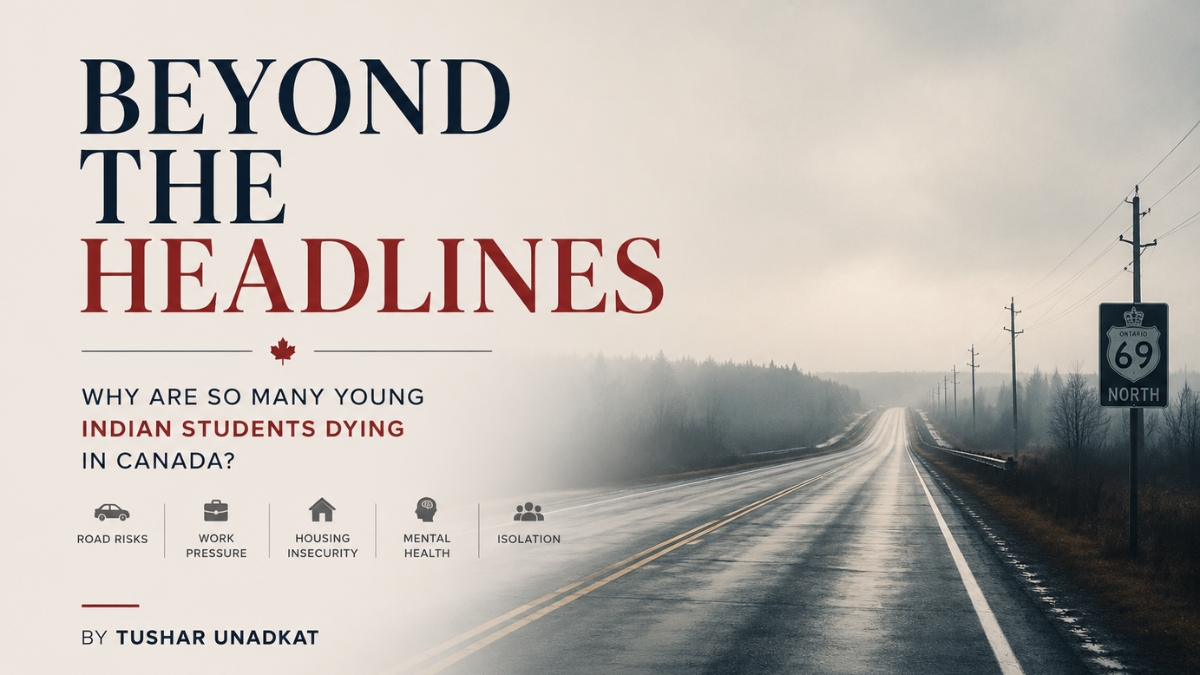
Beyond the Headlines: What Risks Are Indian Students in Canada Facing That We Aren’t Talking About?
Opening
The public conversation surrounding Indian students in Canada often erupts only after a violent crime.
A shooting. A suspicious death. A body was discovered under tragic circumstances.
These stories generate headlines, political statements, and social media outrage. Yet they represent only part of a much larger picture.
Away from the spotlight are students killed in highway collisions after late-night shifts, young people who drown while exploring unfamiliar lakes, individuals struggling with isolation, financial pressure, and deteriorating mental health, and newcomers quietly navigating dangerous work schedules, overcrowded housing, and long commutes.
While no comprehensive Canadian database categorizes every Indian student death by cause, publicly reported incidents suggest the risks extend far beyond violent crime.
Perhaps the more important question is not simply how many students are dying.
This is why so many of the risks surrounding international student life remain largely invisible until tragedy strikes.
A dream built on long hours
For thousands of international students, Canada is not simply a destination for education.
It is an investment.
Families often sell property, borrow money, or spend years saving to finance tuition that can exceed domestic rates several times over. Students arrive carrying not only academic ambitions but financial obligations owed to parents, relatives, or lenders.
According to the Government of Canada, international students are permitted to work while studying under specific conditions, and many rely on employment to cover living expenses.
For many students, this translates into balancing lectures with evening, overnight, or weekend employment.
Community advocates say the result can be chronic fatigue, reduced social support, and little time for rest.
When the commute becomes a risk
One recurring theme in publicly reported tragedies is transportation.
Students frequently accept employment far from their homes because housing closer to workplaces is unaffordable or unavailable.
Long commutes after night shifts, winter weather, unfamiliar rural highways, and fatigue can create dangerous conditions.
The death of Divya (name as appropriate to your reporting), who died in a collision on Highway 69 after building a life in Canada through study and work, has renewed discussion about road safety on one of Ontario’s most hazardous corridors.
Highway 69 has been the subject of repeated calls for full four-laning following multiple fatal collisions.
Ontario Ministry of Transportation: https://www.ontario.ca/page/highway-69-four-laning
Housing: the invisible pressure
Housing affordability has become one of the defining challenges facing international students.
Students frequently report:
- shared bedrooms
- overcrowded apartments
- frequent moves
- long commutes from lower-cost communities
- limited privacy
The Canadian Center for Housing Rights has documented affordability challenges affecting newcomers and renters across Canada.
Housing stress rarely makes headlines after a student’s death.
Yet it often shapes daily decisions about where students live, work, and travel.
Mental health beyond awareness campaigns
Mental health has become part of institutional messaging across Canadian colleges and universities.
Yet awareness does not automatically translate into access.
Many international students face additional barriers, including:
- financial concerns
- fear of disappointing family
- stigma surrounding counseling
- uncertainty about immigration status
- cultural expectations
According to the Center for Addiction and Mental Health (CAMH), international students may experience unique pressures associated with migration, academic expectations, and isolation.
Community leader Don Patel told WFY Magazine that families often become aware of emotional struggles only after a tragedy.
Recreation can become a tragedy.
Canada’s natural environment is unfamiliar to many newcomers.
Every year, drownings occur in lakes, rivers, and conservation areas.
Organizations such as the Lifesaving Society note that newcomers may be unfamiliar with cold-water shock, changing currents, or local swimming conditions.
Many incidents receive only local media attention before disappearing from public discussion.
The workplace reality
International students contribute significantly to Canada’s labor force.
Many work in:
- manufacturing
- warehouses
- logistics
- food service
- retail
- delivery
These jobs often involve shift work, physical labor, or overnight schedules while students continue full-time studies.
Statistics Canada has documented the growing economic participation of international students in Canada’s labor market.
The challenge is not employment itself.
It is the cumulative effect of work, study, commuting, financial obligations, and adaptation occurring simultaneously.
Beyond numbers
Every publicly reported death tells only one story.
Behind it is another story rarely measured:
- parents waiting for a phone call
- roommates wondering whether they noticed the warning signs
- employers who saw a hardworking employee
- classmates who assumed everything was fine
Community organizations such as Humans for Harmony often meet families at the point where headlines end and practical realities begin—helping navigate paperwork, repatriation, and the long journey home.
A question Canada should be asking
International students contribute billions of dollars annually to Canada’s economy and enrich campuses, workplaces, and communities across the country.
But as Canada’s reliance on international education has grown, an equally important conversation has lagged.
Are enough questions being asked about the everyday risks these students face?
Not simply whether they arrive.
Not simply whether they graduate.
But whether they are truly supported while they are here.
Because behind every headline is a life that came to Canada believing the future would be brighter.
For too many families, that future ended far sooner than anyone imagined.
Further Reading
- Government of Canada – Working while studying in Canada
- Statistics Canada
- Canadian Center for Housing Rights
- Center for Addiction and Mental Health (CAMH)
- Lifesaving Society Canada
- Ontario Highway 69 Four-Laning Project
Editorial Note
This article combines publicly available reporting, official information, academic and institutional resources, and community perspectives to examine potential risks affecting international students in Canada. It is intended to encourage informed discussion rather than establish causal relationships between individual incidents. The examples referenced are illustrative, not exhaustive, and should not be interpreted as statistical evidence of national trends. Individual circumstances vary, and some incidents remain under ongoing investigation or subject to privacy protections.