
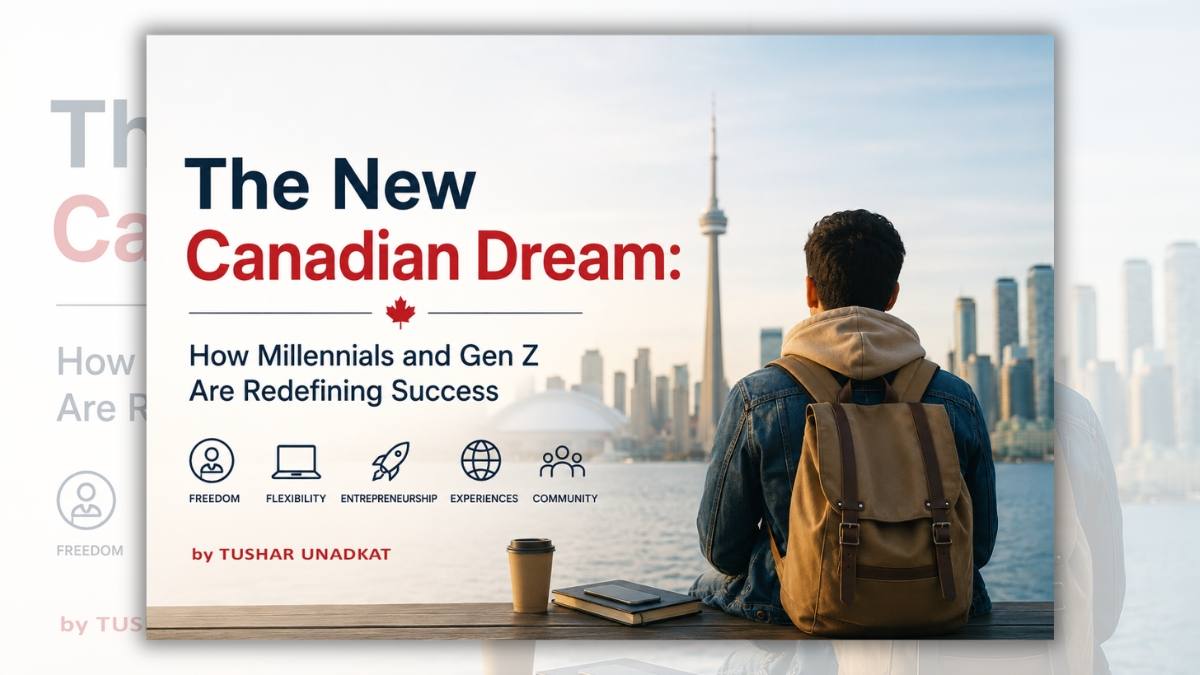
The New Canadian Dream: A Generation Surprisingly Redefines Success
For generations, the Canadian Dream followed a familiar script.
Get a good education. Find stable employment. Buy a home. Raise a family. Retire comfortably.
For many Canadians, that formula represented security, prosperity, and upward mobility.
Homeownership was not simply a financial milestone; it was a symbol of achievement and belonging.
Today, however, a growing number of Millennials and Gen Z Canadians are rewriting that script.
The dream has not disappeared. It has evolved.
A Generation Facing Different Realities
Younger Canadians have entered adulthood during a period marked by rising housing costs, economic uncertainty, changing labour markets, and rapid technological disruption.
Recent Statistics Canada data shows that Millennials are less likely to own homes than previous generations were at the same age. Many are delaying major life milestones such as marriage, parenthood, and homeownership. More young adults are living with parents or in multigenerational households compared to previous generations.
Yet focusing solely on what younger Canadians cannot afford risks missing a larger story.
Many are actively redefining what success means.
As Natasha Mody, Founder & CEO, NMDreams | NMInspires, explains:
“As a first-generation Canadian entrepreneur, I grew up understanding that homeownership represented stability, security, and success. For many immigrant families and members of the Canadian diaspora, owning a home was the ultimate milestone, reflecting years of sacrifice, resilience, and hard work.
While I deeply respect that aspiration, my definition of success has evolved. Today, I value the ability to create my own opportunities, build something meaningful, and have the flexibility to design a life aligned with purpose. Entrepreneurship has given me a different kind of security—one rooted not just in what I own, but in what I can create.
For many younger Canadians, success is becoming less about a single asset and more about freedom, impact, and the ability to live life on their own terms.”
For many, success is no longer tied to owning a detached home in a major city. Instead, it may involve financial flexibility, entrepreneurship, remote work, travel, creative freedom, or achieving a healthier work-life balance.
The Rise of Financial Independence Over Property Ownership
Homeownership remains an aspiration for many Canadians. However, younger generations increasingly view financial independence as the more important goal.
Rather than concentrating exclusively on accumulating property, many Millennials and Gen Z professionals are building diversified sources of income. Side businesses, freelance work, content creation, consulting, and digital entrepreneurship have become common components of modern careers.
As Hitesh Mehta, Founder and Director of Photobooth Empire, puts it:
“When I started, success was defined for me very traditionally—job security, a steady paycheck, and eventually property ownership. But entrepreneurship changed that perspective. Now, success is about scalability, freedom, and building something that reflects your identity, not just your job title.”
The traditional concept of a single employer over a thirty-year career is gradually giving way to what many experts describe as “portfolio careers”—multiple income streams that offer both flexibility and resilience.
This shift reflects pragmatism as much as ambition. In a rapidly changing economy, diversification is no longer just an investment strategy; it has become a career strategy.
Experiences Over Possessions
Previous generations often viewed ownership as the ultimate indicator of progress.
Younger Canadians frequently place greater value on experiences.
Travel, personal development, mental wellness, flexibility, and meaningful work increasingly rank alongside financial goals.
As Jaimeen Baxi, Content Creator shares:
“Ownership for new Canadians is getting tied down to unsustainable mortgage payments, effectively handicapping young home buyers by restricting their movements. Imagine taking a sabbatical to the tropics between jobs while paying $4500 monthly for mortgage! You’d end up switching from Negronis to cold local beer to make the trip affordable.
Now couple these with car payments, insurance on motor vehicles and all your monthly entertainment subscriptions, and you will quickly realize that home ownership is nothing but a financial leash.”
Social media has undoubtedly amplified exposure to global lifestyles, but it has also encouraged people to prioritize experiences over traditional status symbols.
Many young professionals are asking different questions than their parents did.
Instead of asking, “How large is my house?” they may ask, “How much control do I have over my time?”
Instead of measuring success by square footage, they may measure it by quality of life.
The Entrepreneurial Generation
Technology has lowered barriers to entry for business ownership. A laptop, internet connection, and specialized skill set can now launch ventures that previously required significant capital investment.
Across Canada, younger entrepreneurs are creating consulting practices, digital agencies, e-commerce businesses, media platforms, and personal brands.
Many are motivated not only by financial opportunity but also by a desire for autonomy.
Entrepreneurship offers something traditional employment often cannot: the ability to shape one’s own path.
While business ownership comes with risk and uncertainty, it also reflects a growing preference for independence and self-determination.
The Importance of Community
Ironically, as society becomes increasingly digital, younger generations are placing renewed value on community.
Many Millennials and Gen Z Canadians seek connection through cultural organizations, volunteer initiatives, networking groups, faith communities, and professional associations.
For immigrant families in particular, community remains a powerful source of identity, support, and opportunity.
Success today is often viewed less as an individual accomplishment and more as a collective journey involving family, mentorship, and meaningful relationships.
What the New Canadian Dream Looks Like
The new Canadian Dream is not necessarily about abandoning traditional aspirations.
Many young Canadians still hope to own homes, build families, and achieve financial stability.
The difference is that these goals now exist alongside new priorities.
- Flexibility.
- Purpose.
- Financial independence.
- Mental wellness.
- Entrepreneurship.
- Community.
In many ways, younger Canadians are not lowering their expectations. They are broadening them.
The Canadian Dream is no longer defined by a single destination.
It is increasingly defined by the freedom to choose one’s own path.
As Canada continues to evolve, perhaps success should not be measured by whether younger generations are following the same roadmap as their parents.
Perhaps it should be measured by whether they have the opportunity to create a roadmap of their own.
Key References
- Statistics Canada – Housing and Millennials
- Statistics Canada Daily Housing Release
- RBC Small Business Insights (Millennial & Gen Z entrepreneurship)