
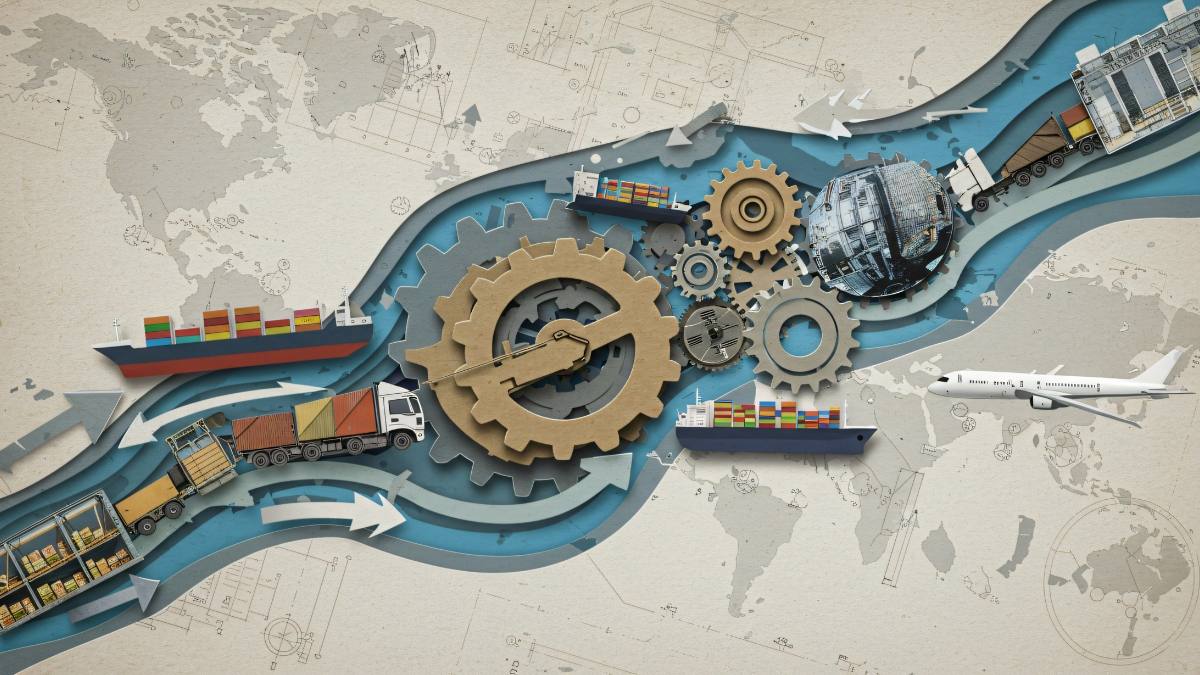
Why Global Supply Chains Face Peril In New Ways
By Priya Sharma, WFY Bureau | Economy & Business | The WFY Magazine, January, 2026 Anniversary Edition
Global Supply Chains Are Breaking Again — This Time Differently
Summary
As the world enters 2026, global supply chains are fracturing once again, not from sudden shock but from sustained structural pressure. Geopolitics, trade barriers, climate disruption, and regulatory divergence are reshaping how goods move across borders, forcing companies to abandon efficiency-first models in favour of resilience and control. This article examines why supply chain volatility has become permanent, how businesses are redesigning production and logistics networks, and what these changes mean for global trade, emerging economies, and the Indian diaspora operating at the intersection of manufacturing, technology, and commerce.
When Disruption Stops Being an Exception
For much of the last three decades, global supply chains were designed around a simple promise: efficiency would triumph over uncertainty. Components would arrive just in time, costs would remain low, and scale would neutralise risk. That promise has now broken, not once, but repeatedly. As the world enters 2026, supply chains are breaking again. Yet this time, the fracture is not sudden or temporary. It is structural, deliberate, and ongoing.
Unlike the pandemic years, when disruption arrived as a shock, today’s breakdown is unfolding in plain sight. Companies are not scrambling to restore the old system. They are abandoning it. Tariffs, geopolitical tensions, climate pressures, regulatory divergence, and technology shifts are reshaping how goods move across borders. The result is not a collapse of global trade, but a reordering of how supply networks are built and managed.
For businesses, this moment marks the end of the idea that disruption is an occasional event. Volatility has become a permanent feature of global commerce. For the Indian diaspora, deeply embedded in manufacturing, logistics, technology, and global trade, this transformation carries direct implications for employment, entrepreneurship, and investment decisions.
Why Supply Chains Are Breaking Again
The current phase of supply chain disruption differs fundamentally from earlier crises. It is not driven by a single trigger. Instead, multiple risk vectors are converging at once.
Geopolitics now plays a central role. Trade restrictions, export controls, and strategic decoupling in sensitive sectors have altered sourcing strategies. Companies can no longer assume that access to suppliers will remain politically neutral. Conflict zones and diplomatic standoffs influence shipping routes, insurance costs, and delivery timelines.
Trade barriers have also multiplied. Tariffs and regulatory requirements are increasingly used as policy tools rather than economic safeguards. Compliance costs rise, and complexity replaces simplicity. Firms that once relied on seamless cross-border movement now face layers of documentation, approvals, and uncertainty.
Environmental pressures add another dimension. Extreme weather events disrupt ports, railways, and production hubs with increasing frequency. Droughts affect inland shipping routes. Floods halt manufacturing clusters. Climate volatility now ranks alongside labour and capital as a supply chain risk.
These forces do not operate independently. They reinforce one another, creating a system where disruption is not an anomaly but a constant condition.
From Efficiency to Resilience
The defining shift of this new phase is the move from efficiency-first models to resilience-driven strategies. For decades, supply chains were optimised to minimise cost and inventory. That logic is being replaced by a new priority: continuity.
Companies now accept higher costs in exchange for reliability. Inventory buffers are increasing. Redundant suppliers are being added. Geographic concentration is being reduced. The goal is no longer maximum efficiency, but acceptable risk.
Nearshoring and regionalisation have accelerated as a result. Instead of relying on single distant production hubs, firms are spreading manufacturing across regions closer to end markets. This does not eliminate global trade, but it redistributes it. Production networks become shorter, more fragmented, and more complex.
For emerging economies, this shift creates opportunity as well as competition. Countries that can offer political stability, skilled labour, and infrastructure stand to benefit. Those that cannot risk being bypassed as companies redesign supply maps.
Industry Responses: When Corporations Rebuild from Within
The scale of change is visible in how major companies are restructuring their supply ecosystems. Rather than relying solely on external suppliers, firms are bringing critical components back under tighter control.
In advanced manufacturing sectors, companies are acquiring or integrating key suppliers to secure production. This vertical integration reflects a recognition that delays in one link can halt entire systems. Control has become as valuable as cost savings.
Aerospace provides a telling example. Long lead times, specialised components, and strict safety standards leave little margin for disruption. Delays ripple across years, not weeks. To manage this risk, firms are restructuring supplier relationships, securing parts production, and redesigning logistics flows.
This approach is spreading beyond aerospace. Automotive, electronics, pharmaceuticals, and energy equipment manufacturers are all reassessing which parts of their supply chains must be insulated from external shocks.
Technology as the New Supply Chain Backbone
Technology now sits at the centre of supply chain resilience. Digital visibility tools, predictive analytics, and automated planning systems are replacing static forecasting models.
Artificial intelligence enables companies to simulate disruption scenarios and adjust sourcing strategies in real time. Digital twins replicate supply networks virtually, allowing firms to stress-test decisions before implementing them. Risk mapping tools identify vulnerabilities not just at first-tier suppliers, but deep within multi-layered networks.
This shift transforms supply chains from linear pipelines into adaptive systems. Instead of reacting to disruption after it occurs, companies anticipate and absorb shocks.
However, technology adoption is uneven. Large corporations with capital and expertise move faster. Smaller firms struggle with cost and integration challenges. This gap risks creating a two-tier supply chain economy, where resilience becomes a competitive advantage accessible only to some.
Logistics Under Pressure: The Climate Factor
Logistics infrastructure faces mounting stress from environmental change. Ports, shipping lanes, rail corridors, and warehouses are increasingly exposed to climate-related disruption.
Rising sea levels affect port operations. Heatwaves strain storage facilities. Storms delay maritime schedules. Insurance premiums for shipping routes rise as risk assessments change. These pressures increase transit times and costs, undermining predictability.
Maritime logistics, which carries the majority of global trade by volume, is particularly vulnerable. Congestion at key chokepoints amplifies disruption. Rerouting vessels to avoid risk zones adds days or weeks to delivery schedules.
Companies now factor climate resilience into logistics planning. Diversified routing, alternative ports, and adaptive warehousing strategies are becoming standard practice. Sustainability considerations intersect with operational necessity.
The Cost of Constant Disruption
Persistent supply chain instability carries economic consequences. Costs rise as inefficiencies are deliberately built into systems. Inventory holding expenses increase. Redundant sourcing adds complexity. Technology investment requires capital.
These costs ultimately feed into pricing. While inflationary pressures have eased in recent periods, supply chain fragility remains a latent driver of price volatility. Consumers may not see dramatic spikes, but gradual increases reflect higher operating costs.
For businesses, margin management becomes more challenging. Passing costs downstream risks demand erosion. Absorbing those pressures profitability. Strategic pricing and value positioning gain importance.
Governments face their own dilemmas. Industrial policy aimed at securing supply chains often requires subsidies or incentives. Balancing fiscal discipline with strategic resilience becomes a policy challenge.
India’s Position in the Reconfigured Supply Map
As global supply chains restructure, India occupies a critical position. Its large domestic market, expanding infrastructure, and growing manufacturing base align with the new emphasis on diversification and regionalisation.
Production-linked incentives, logistics modernisation, and digital integration have strengthened India’s appeal as an alternative manufacturing and sourcing destination. While challenges remain in scale, consistency, and regulatory efficiency, momentum is evident.
India’s role is not to replace existing hubs entirely, but to complement them. Multi-location sourcing strategies favour economies that can integrate into diversified networks rather than dominate them.
For the Indian diaspora, this shift opens multiple pathways. Professionals in operations, procurement, and logistics find increased demand. Entrepreneurs build supplier networks linking India with global markets. Investors assess opportunities in manufacturing, warehousing, and logistics infrastructure.
Small and Medium Enterprises in a Volatile World
Small and medium enterprises sit at the heart of supply chain transformation. They are often the most exposed to disruption, yet also the most adaptable.
Higher input costs and tighter credit conditions challenge SMEs. At the same time, digital platforms enable them to access global markets and integrate into larger networks. Visibility tools and data access, once reserved for large firms, are becoming more accessible.
Diaspora-led SMEs leverage cross-border knowledge and trust networks. Their ability to operate across regulatory and cultural environments becomes an asset in fragmented supply systems.
Policy support remains critical. Access to finance, digital infrastructure, and skills development determine whether SMEs can participate in the reconfigured supply economy or are pushed to the margins.
Trade Is Not Ending, It Is Re-Routing
Despite recurring headlines about deglobalisation, global trade volumes continue to grow. What has changed is the route trade takes and the logic behind it.
Supply chains now prioritise alignment with regulatory regimes, political stability, and environmental compliance. Trade corridors shift accordingly. South-South trade expands. Regional blocs strengthen.
This re-routing introduces complexity but also resilience. Dependence on a single route or region diminishes. The system becomes more modular, though less efficient by traditional metrics.
For businesses, success depends on understanding these new patterns. Market access requires regulatory fluency as much as competitive pricing.
Labour, Skills, and the Supply Chain Workforce
Supply chain transformation reshapes labour demand. Skills in logistics planning, data analysis, risk management, and compliance are increasingly valuable. Manual roles persist, but automation alters their nature.
Labour shortages in logistics and manufacturing remain a constraint in many regions. Training and retention become strategic priorities. Remote coordination tools globalise certain functions, while physical operations remain location-bound.
For diaspora professionals, supply chain expertise becomes a portable asset. Global firms seek talent capable of managing complexity across borders.
What Comes Next
As 2026 begins, one conclusion is clear. Supply chains are not breaking because they failed. They are breaking because the world around them has changed.
The old model assumed stability. The new reality demands adaptability. Disruption is no longer something to recover from. It is something to design around.
Businesses that accept this shift gain advantage. Those that cling to efficiency at the expense of resilience face repeated shocks. Governments that recognise supply chains as strategic infrastructure, rather than invisible systems, are better positioned to support growth.
For the Indian diaspora, the transformation of global supply chains represents both challenge and opportunity. Those who understand the new logic of trade, technology, and risk will shape the next chapter of global commerce.
Conclusion: A Different Kind of Breakdown
Global supply chains are breaking again, but not in panic. They are breaking apart to be rebuilt differently. The emphasis has shifted from speed to security, from scale to stability, from cost to continuity.
This transformation will not be smooth or uniform. It will test businesses, policymakers, and workers alike. Yet it also offers a chance to create supply systems better suited to a volatile world.
The question is no longer whether supply chains will change. It is whether organisations are ready to change with them.
Disclaimer: This article is an independent journalistic and analytical work produced by the WFY Bureau for informational and educational purposes. It does not represent the official position of any government, corporation, or institution. All observations are based on publicly available data, industry trends, and reasoned analysis as of the period leading into 2026.