
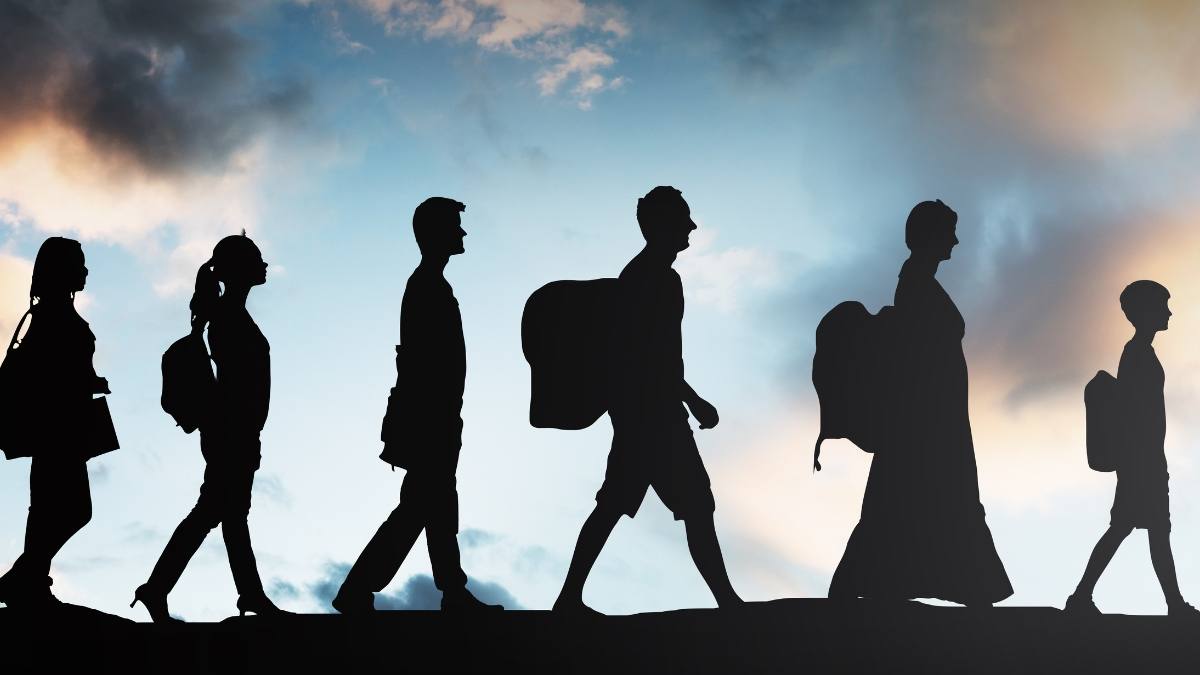
A New Order In Peril: Borders, Refugees, People
By Selvan Durairaj, WFY Bureau | World Politics | The WFY Magazine, January 2026 Anniversary Edition
Immigration, Borders and Backlash: Why the World Is Turning Inward
Summary
As the world moves into 2026, immigration has become one of the most contested issues shaping global politics. Across Europe and the United States, borders are tightening, public sentiment is hardening, and migration is increasingly framed as a threat rather than a necessity. This article examines the forces driving the global turn inward, from economic anxiety and political opportunism to security narratives and cultural unease, while exploring the economic and human costs of restrictive border policies. For the Indian diaspora, whose lives and livelihoods span continents, this shift is not an abstract debate but a defining reality of an unsettled world.
A World on the Move, A World That Resists
Human mobility has always shaped civilisation. Trade routes, cultural exchanges, labour migration, exile, and refuge have defined how societies grow and adapt. Yet as the world enters 2026, migration has become one of the most politically charged and emotionally loaded issues of our time. Borders are hardening, policies are tightening, and public discourse across continents increasingly frames immigration not as a force of renewal but as a threat.
From Europe’s streets to America’s southern frontier, from island nations fortifying coastlines to wealthy economies rewriting visa rules, the global mood is unmistakable. The world is turning inward. Immigration is no longer discussed primarily in terms of opportunity or humanitarian obligation, but through the language of control, security, and backlash.
For the Indian diaspora, one of the largest and most globally dispersed communities in history, this shift is deeply consequential. Migration pathways that once seemed predictable now feel fragile. Social acceptance can no longer be taken for granted. Policies change with elections, narratives harden overnight, and long-settled communities find themselves pulled into polarised debates.
This article explores why immigration has become such a fault line in world politics, what is driving the global turn towards restrictive borders, and whether this inward drift can be reversed without undermining democratic values, economic vitality, and social cohesion.
The Scale of Global Migration Today
The numbers alone explain why migration sits at the centre of political debate. By the end of 2025, the global migrant population had crossed an estimated 285 million people, accounting for over 3.5 percent of the world’s population. This includes economic migrants, students, professionals, refugees, and displaced persons.
At the same time, forced displacement has reached record levels. Conflicts, political instability, climate stress, and economic collapse have pushed more than 110 million people from their homes worldwide. These movements are not evenly distributed. A majority of displaced people remain in neighbouring or developing countries, yet political pressure is most intense in wealthier states that receive a smaller share but possess greater media visibility and electoral sensitivity.
Migration flows are also changing in character. Skilled migration, student mobility, and temporary work visas have grown alongside irregular and humanitarian movements. The lines between legal and irregular migration are often blurred by complex systems, long waiting periods, and mismatched labour demands.
Despite these realities, public perception in many countries exaggerates both the scale and impact of immigration, creating fertile ground for fear-driven politics.
Europe’s Uneasy Reckoning With Migration
Nowhere is the backlash against immigration more politically visible than in Europe. Over the past decade, migration has shifted from being a policy challenge to a defining electoral issue.
Several European societies face a contradiction. Their populations are ageing rapidly, birth rates are falling, and labour shortages are emerging across healthcare, construction, agriculture, and technology. Yet public resistance to immigration has intensified rather than softened.
In recent elections and opinion surveys across multiple European countries, parties campaigning on restrictive migration platforms have gained ground. Street protests, localised tensions, and heated parliamentary debates have pushed mainstream governments towards tougher rhetoric and policy recalibration.
The European Union’s forthcoming migration and asylum reforms, scheduled to take effect in mid-2026, reflect this pressure. The framework aims to streamline asylum procedures, strengthen external borders, and introduce mechanisms for responsibility sharing among member states. While presented as a balance between solidarity and control, the political messaging surrounding the reforms often emphasises deterrence and enforcement.
For migrants and diaspora communities, this environment creates uncertainty. Policies may be legalistic in design, but public discourse increasingly frames migrants as burdens rather than contributors. This shift influences everything from housing access and employment opportunities to social acceptance and personal security.
The American Border Debate and Its Global Echo
Across the Atlantic, the United States continues to serve as both a destination and a symbol in global migration narratives. The American border debate has become a focal point of domestic politics, influencing rhetoric far beyond US shores.
In recent years, border enforcement has tightened, asylum processes have been scrutinised, and migration has been framed as a matter of national sovereignty and public order. While the specifics of policy fluctuate with administrations, the underlying trend towards stricter control enjoys significant political support.
This matters globally because the United States has long been seen as a reference point. When America hardens its stance, it legitimises similar moves elsewhere. Governments across regions cite border security and domestic pressure as justification for restrictive measures, often without addressing underlying drivers of migration.
For the Indian diaspora in the US, which includes students, technology professionals, healthcare workers, and entrepreneurs, the implications are complex. Legal pathways remain open, yet uncertainty around visas, processing times, and policy reversals affects long-term planning and emotional well-being.
Why the World Is Turning Inward
The global turn towards restrictive borders is driven by a convergence of forces rather than a single cause.
Economic Anxiety
Despite overall global growth, inequality within countries has widened. Many citizens feel economically insecure, facing rising living costs, job precarity, and stagnant wages. Migration becomes an easy target, often blamed for pressures that stem from structural economic issues.
Cultural and Identity Concerns
Rapid demographic change can provoke fear, particularly when integration policies are weak or uneven. In societies that struggle with inclusion, migration becomes framed as a threat to national identity, language, or social norms.
Political Opportunism
Migration is a powerful mobilising issue. Simplistic narratives offer clear villains and easy solutions, making immigration a convenient tool for political campaigns. Complex realities are reduced to slogans, and long-term costs are ignored.
Security Narratives
Global instability, terrorism, and organised crime have reinforced the perception that borders equal safety. While security concerns are legitimate, they are often overstated or misdirected when applied broadly to migration.
Media Amplification
Digital platforms amplify extreme voices. Isolated incidents are magnified, while positive contributions of migrants receive less attention. The emotional impact of images and headlines often outweighs statistical reality.
Together, these factors create a climate where turning inward appears politically rewarding, even when it contradicts economic and demographic logic.
The Economic Cost of Closing Doors
One of the most striking contradictions in contemporary migration debates is the gap between rhetoric and economic evidence. Numerous studies across economies consistently show that immigration, when managed effectively, contributes positively to growth, innovation, and public finances.
Migrants are disproportionately represented among entrepreneurs, healthcare workers, researchers, and essential service providers. In advanced economies, foreign-born workers fill gaps that domestic labour markets cannot meet alone.
Restrictive immigration policies carry tangible costs. Labour shortages slow growth. Innovation suffers when skilled workers are deterred. Public services face strain as ageing populations increase dependency ratios without a corresponding workforce expansion.
By 2025, several developed economies reported tens of thousands of unfilled positions in critical sectors. At the same time, visa caps, processing delays, and restrictive criteria limited the entry of qualified candidates. This mismatch highlights how political pressure often overrides pragmatic economic planning.
For diaspora communities, these contradictions are lived realities. Professionals are welcomed for their skills yet confronted with suspicion in public discourse. Students contribute billions in tuition and living expenses but face uncertain post-study pathways.
Migration, Innovation, and the Knowledge Economy
The modern global economy is increasingly knowledge-driven. Innovation thrives on diversity, cross-border collaboration, and the free exchange of ideas. Migration plays a central role in this ecosystem.
In technology hubs, research institutions, and healthcare systems, migrants contribute disproportionately to patents, start-ups, and scientific output. Restrictive policies risk creating innovation bottlenecks, particularly in fast-moving fields such as artificial intelligence, biotechnology, and renewable energy.
Countries that position themselves as open and predictable destinations gain a competitive edge. Those that appear hostile or unstable risk losing talent to more welcoming jurisdictions.
The Indian diaspora exemplifies this dynamic. Indian-origin professionals have played significant roles in global technology, medicine, academia, and entrepreneurship. Their success underscores how migration benefits both host societies and countries of origin through remittances, knowledge transfer, and global networks.
Borders in the Age of Climate Change
Climate change adds a new dimension to migration politics. Rising sea levels, extreme weather events, water scarcity, and agricultural disruption are already displacing populations. These movements are likely to intensify in the coming decades.
Climate-induced migration challenges existing legal frameworks, which are primarily designed around conflict and persecution. As environmental pressures grow, countries face difficult questions about responsibility, adaptation, and shared burden.
Yet climate migration is rarely discussed in nuanced terms. Instead, it is often folded into broader fears of uncontrolled movement. This risks delaying policy innovation and international cooperation at a time when proactive planning is essential.
The Human Cost of Backlash
Beyond economics and policy, the turn inward carries human consequences. Migrants and diaspora communities increasingly report experiences of discrimination, social exclusion, and psychological stress.
Children growing up in migrant families absorb these tensions. Questions of belonging, identity, and safety become part of everyday life. Even long-settled communities can feel suddenly vulnerable when political narratives shift.
The erosion of trust between communities undermines social cohesion. When migrants are framed as outsiders rather than neighbours, integration falters, creating a self-fulfilling cycle of alienation and resentment.
The Indian Diaspora at a Crossroads
For the Indian diaspora, global migration politics are deeply personal. Spread across North America, Europe, the Middle East, Africa, and Asia-Pacific, the community experiences the full spectrum of migration regimes.
Highly skilled professionals navigate tightening visa rules. Students weigh rising costs against uncertain futures. Workers in essential sectors confront both demand and stigma. Families balance opportunity with emotional strain.
Yet the diaspora also possesses agency. Through civic engagement, entrepreneurship, cultural diplomacy, and professional excellence, Indian communities shape perceptions and policy debates in host countries. Their contributions challenge simplistic narratives and demonstrate the tangible value of migration.
Can the Inward Turn Be Reversed?
The global drift towards restrictive borders is not inevitable. History shows that migration policy swings in cycles, often shaped by leadership, economic conditions, and public discourse.
Several pathways offer hope.
Evidence-Based Policy
Grounding migration debates in data rather than fear can recalibrate public understanding. Transparent communication about costs, benefits, and trade-offs builds trust.
Smarter Migration Systems
Efficient, humane, and flexible systems reduce irregular movement and public frustration. Clear pathways align labour needs with mobility.
Integration as Investment
Successful integration reduces social tension. Education, language support, and inclusive urban planning strengthen cohesion.
Shared Responsibility
International cooperation spreads the burden of humanitarian migration and reduces unilateral pressure.
Diaspora Engagement
Diaspora communities can act as bridges, humanising migration debates and fostering cross-cultural understanding.
Choosing Between Walls and Wisdom
As 2026 begins, immigration stands at the heart of a larger question about the future of globalisation, democracy, and human mobility. Turning inward may offer short-term political comfort, but it risks long-term economic stagnation, social division, and moral compromise.
Borders will always matter. Sovereignty and security are legitimate concerns. Yet walls alone cannot address the forces driving migration, nor can they replace the need for cooperation, compassion, and foresight.
For a world shaped by movement, the challenge is not whether migration will continue, but how it will be managed. The choice facing governments and societies is clear. They can retreat into fear, or they can design systems that balance control with openness, and security with humanity.
For the Indian diaspora and for millions like them, the stakes could not be higher.
Disclaimer: This article is an independent journalistic and analytical work produced by the WFY Bureau for informational purposes. It does not represent the official position of any government, political party, or institution. All observations are based on publicly available data, global trends, and reasoned analysis as of early 2026.