
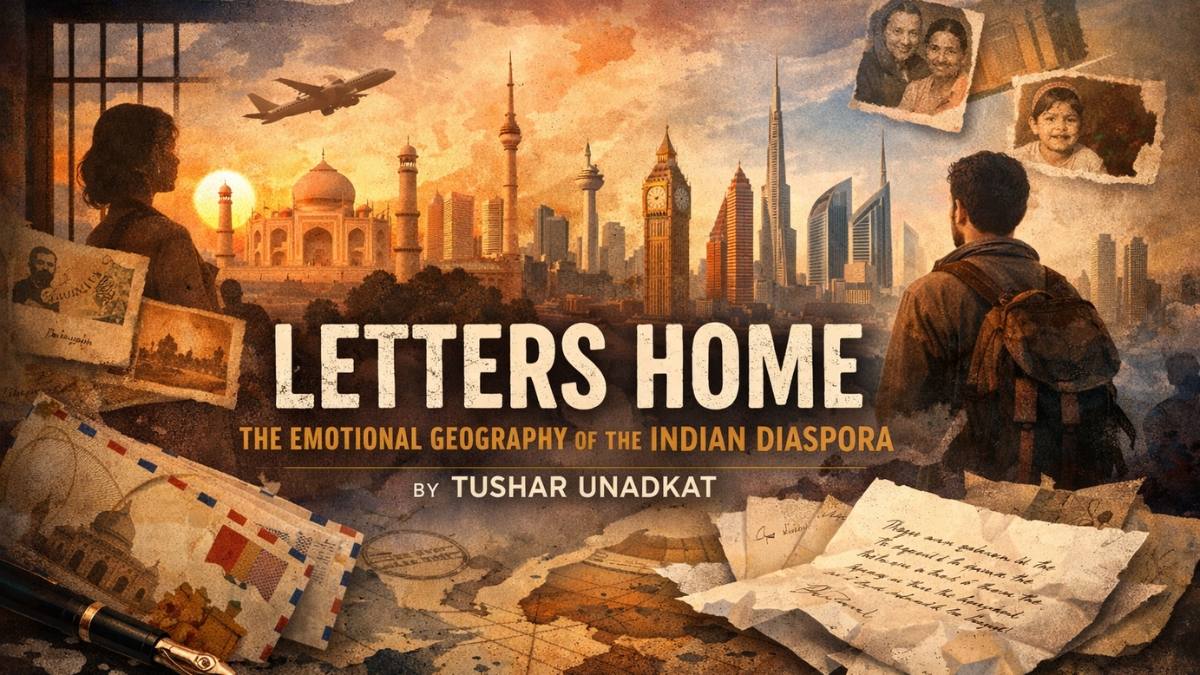
Letters Home: The Emotional Geography of the Indian Diaspora
By Tushar Unadkat, WFY Bureau, Canada | Human Interests & Social Pursuits | The WFY Magazine, February, 2026, Edition
We are taught to write home with care.
To soften the truth.
To make the miles between us sound like gratitude—to wrap the space in thankfulness rather than loneliness.
But distance does something else first. Before anything else, it startles us. It catches us off guard. It forces us to see honestly.
It makes us honest.
For many in the Indian diaspora, “home” is not a single place. It is a map of feelings—guilt, relief, anger, unfinished conversations. It shows in missed calls across time zones, visits delayed by visas, and pressing questions: Are you settled? Are you earning enough? When are you coming back?
This essay is made of letters that were never sent.
Some letters begin Dear Ma, others Dear India, Dear Baba, or Dear Me. They come from cities in Canada, the UK, and the Gulf, but share a common voice: love complicated by distance, and distance chosen for survival.
Leaving India is often called ambition—a career move, a better life. But often, departure is a response to suffocation. Migration can be an act of preservation.
Some leave to escape marriages decided before desire.
Some leave because caste, gender, or faith narrowed their futures too early.
Some leave because queerness had no safe grammar at home.
Some leave because staying means shrinking every year.
From afar, the diaspora is expected to show loyalty. Nostalgia—longing for the comforts and memories of home—becomes proof of belonging. Pride in one’s origins becomes a requirement. But many carry another truth quietly: love for home does not erase harm. And offering critique is not the same as betrayal.
For some, home was not neutral.
It was a place where bodies were monitored. Futures were negotiated. Silence was rewarded. Distance does not erase this power—it clarifies it. Only when we leave do we realize how much of ourselves we were editing to remain acceptable.
This is why so many truths arrive in English. Not because it is easier—but because it is safer. Some languages come preloaded with obedience. Some words do not survive translation without consequences.
Letters to mothers who loved fiercely but conditionally. To fathers who mistook authority for care. To families who ask about visas before well-being. Letters to a country that celebrates diaspora success but will not ask why so many had to leave to survive.
In the Gulf, love is shaped by precarity. Lives depend on renewals, contracts, and stamps that annually determine futures. Labour is welcome; belonging is not. Gratitude is expected; anger is discouraged. Stability is fleeting, even in the language used to describe it.
In Canada and the UK, distance brings new understanding. There, many see that love can come without questions. Community can be chosen. Rest need not be earned through struggle. Joy arrives quietly—without apology or explanation.
This joy does not erase grief. It sits beside it.
Grief for the home that could have been kinder.
Grief for conversations that never learned how to hold truth.
Grief for love that required silence as its condition.
Many in the diaspora fear failing two homes—too different for one, too foreign for another. Success does not end with longing. It makes it more complex. Guilt sharpens gratitude. Relief shadows loss.
And yet, something radical happens when we stop asking home to approve our becoming.
We begin to understand that love does not always look like closeness. Sometimes it looks like distance. Sometimes it looks like a refusal. Sometimes it looks like leaving so that what comes next can be gentler.
There are letters to children not yet born—distance chosen not from rejection, but from care. We left so you would not inherit silence. We left so your body would not be debated. We left so that home could be yours to choose.
February asks us to celebrate love. This essay offers a different definition—one rooted in truth rather than endurance. Love that allows critique. Love that makes room. Love that does not demand erasure as its price.
The emotional geography of the Indian diaspora remains unfinished—a layered, unresolved terrain. In naming these landscapes, and refusing to romanticize or excuse them, we begin to claim something rare.
Not a perfect home.
But an honest one.
Cover Image: Dall-E